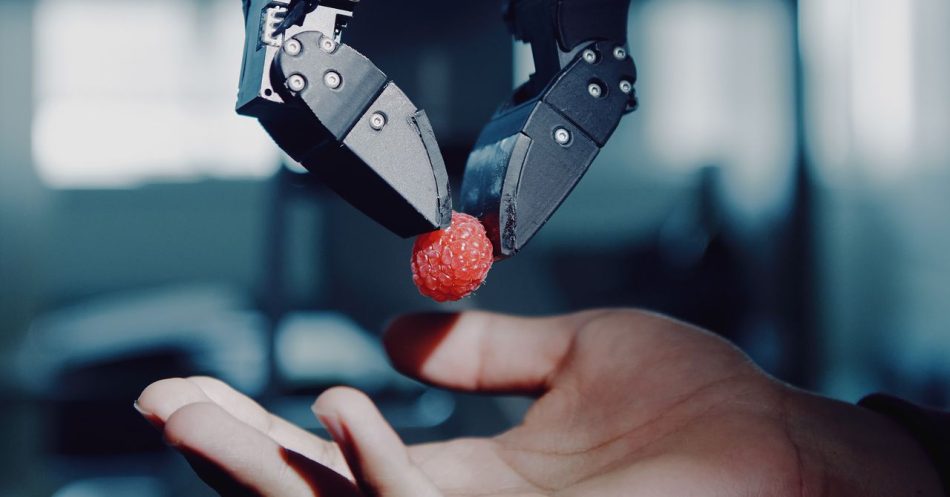
When Robots Have Their ChatGPT Moment, Remember These Pincers
In the ever-evolving world of robotics, a new startup named Eka is making waves with its innovative approach to robotic dexterity. Located in Kendall Square, Cambridge, Massachusetts, just a stone’s throw from MIT, Eka is developing robots that can perform tasks with a level of finesse previously unseen in the industry.
The Robotic Claw: A Leap Forward
During a demonstration, Eka’s robotic claw approached a light bulb on a table. Observers held their breath, anticipating a clumsy mishap. However, the claw slowed down, delicately maneuvering around the table as if it were searching for misplaced glasses. It gently grasped the bulb, even chasing after it when it rolled away. After a few attempts, the claw successfully secured the bulb and screwed it into a socket, illuminating the workspace.
This level of dexterity is a significant advancement in robotics. Most robotic arms on the market today are clumsy and struggle with delicate tasks. Eka’s robot, however, showcases a natural movement that feels almost intelligent, reminiscent of the first interactions many had with ChatGPT.
A New Era of Dexterity
Eka’s co-founders, Pulkit Agrawal and Tuomas Haarnoja, envision a future where robots can perform a variety of tasks across different sectors, including factories, restaurants, and households. Agrawal, a professor at MIT, stated, “Trillions of dollars flow through the human hand. To me, this is the biggest problem in the world to be solved.” They believe that they are on the brink of a breakthrough in robotic dexterity.
The Challenge of Dexterity
The challenge of imparting dexterity to robots has long been a topic of discussion among researchers. As Austrian computer scientist Hans Moravec noted, tasks that seem simple to humans can be incredibly complex for machines. The ability to interact with the physical world is something that humans have evolved to do effortlessly, but replicating this skill in robots has proven difficult.
Learning from Experience
In 2018, OpenAI developed Dactyl, a robotic hand that utilized AI to solve a Rubik’s Cube. This project involved simulating the hand’s movements and training an artificial neural network through reinforcement learning. While Dactyl achieved remarkable results, it still lacked the physical intelligence necessary to handle real-world objects effectively.
OpenAI eventually shifted its focus away from robotics to concentrate on large language models and chatbots. However, Agrawal and Haarnoja remained committed to the idea of closing the “sim-to-real gap” by creating simulations that closely mimic real-world conditions.
Innovative Approaches to Training
Agrawal’s research at MIT focused on training robotic hands to grasp objects from above, rather than simply holding them. This required a deeper understanding of the robot’s movements and the interactions with the objects it was manipulating. Despite skepticism from peers, Agrawal persevered, driven by a vision of creating robots that could perform tasks with human-like agility.
Building a Better Robot
By late 2021, Agrawal had developed a virtual hand capable of manipulating 2,000 different objects upside down. This achievement came during a time when many in the robotics field were moving away from simulation-based training. However, the success of large language models like ChatGPT inspired Agrawal and Haarnoja to explore the potential of using vast amounts of human interaction data to teach robots physical intelligence.
Testing and Development
Eka’s testing facilities are filled with various robotic arms and an array of objects of different sizes, shapes, and weights. The robots are put through rigorous testing, where they learn to pick up and manipulate items in a way that mimics human behavior. This hands-on approach is crucial for developing the dexterity needed for real-world applications.
The Future of Robotics
The implications of Eka’s advancements are profound. If the company can successfully scale its approach to dexterity, it could revolutionize industries that rely on manual labor. From manufacturing to service industries, the ability to automate tasks that require fine motor skills could lead to significant economic changes.
As robots become more capable of performing tasks that were once thought to be exclusive to humans, questions about the future of work and the role of automation in society will become increasingly relevant. The transition to a world where robots can assist or even replace human labor in certain tasks could reshape our economy and daily lives.
Conclusion
The journey of Eka and its innovative robotic technology marks a pivotal moment in the field of robotics. As we witness advancements that bring us closer to machines capable of human-like dexterity, we must consider the broader implications of these technologies. The potential for robots to transform industries is immense, and as we move forward, it is essential to approach this new era with both excitement and caution.
Note: The developments in robotics are ongoing, and the information presented in this article reflects the state of knowledge as of October 2023.