
The Molten History of the Aravalli Mountains: How Two Magmas Built India’s Oldest Rocks
Nearly 2.5 billion years ago, a significant geological event occurred beneath what is now Northwest India, leading to the formation of some of the oldest rocks on Earth. Recent research conducted by a team from the Indian Institute of Technology (IIT) Roorkee, Kumaun University, and the CSIR-Central Building Research Institute has unveiled the complex processes that contributed to the creation of the Berach granitoids, which are among the region’s oldest and most stable rocks.
The Aravalli Craton: A Geological Overview
The Aravalli craton is a massive fragment of the Earth’s ancient crust that extends across several Indian states, including Gujarat, Rajasthan, Haryana, and Delhi. This craton is significant not only for its age but also for the geological history it encapsulates. The rocks within this region provide crucial insights into the early processes that shaped the Earth’s surface.
Understanding Magma Types
The study identified two distinct types of magma involved in the formation of the Berach granitoids:
- Mafic Magma: Rich in magnesium and iron, this dark magma originates from deep within the Earth’s mantle.
- Felsic Magma: This lighter magma, rich in feldspar and quartz, is found closer to the Earth’s surface.
Researchers discovered that these two magma types interacted in a complex manner, leading to the formation of the granitoids. The interaction between hot, dark mafic magma and cooler, lighter felsic magma is a key aspect of this geological narrative.
The Research Expedition
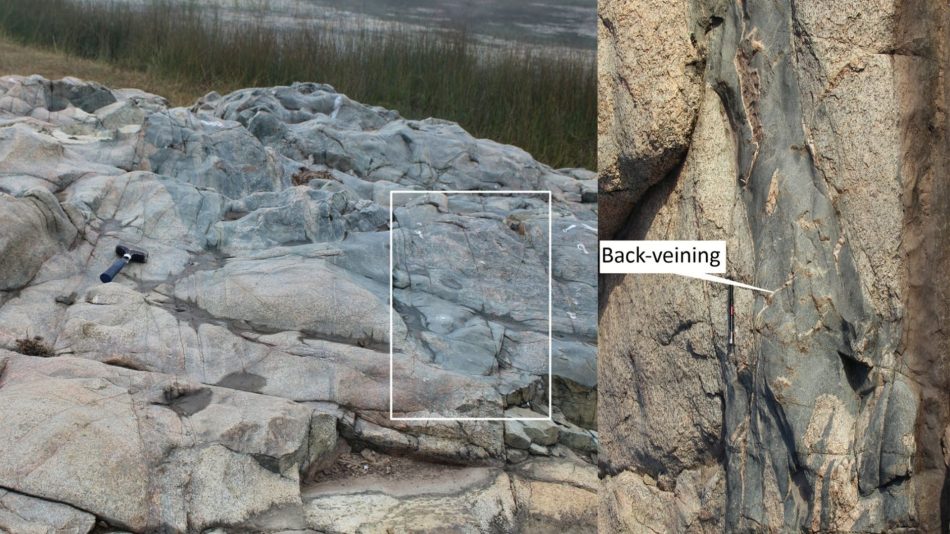
The research team undertook a 65-kilometer journey across the rugged terrain of the Berach River section in Rajasthan. Their goal was to locate synplutonic dykes, which are long veins of dark rock that resemble scars running through the lighter granite. These dykes serve as frozen records of ancient volcanic activity.
In addition to the dykes, the researchers identified microgranular enclaves—blobs of one type of rock trapped within another. This phenomenon can be likened to the droplets in a lava lamp, showcasing the dynamic interactions between different magma types.
Advanced Analytical Techniques
To analyze the rocks, the researchers employed Back-Scattered Electron (BSE) microscopy. This technique utilizes high-energy electrons to map the surface composition of materials, allowing scientists to zoom in on individual crystals and identify xenocrysts—crystals that were physically removed from one magma and incorporated into another.
Through this analysis, the team observed microscopic features indicating that the crystals underwent sudden changes in temperature and chemistry during the interaction of the two magmas. They also discovered back-veining, a process where the host granite melted into the dark magma dykes due to extreme heat.
Reconstructing Geological History
By mapping these microscopic features, the researchers were able to reconstruct a narrative of intense heat and chemical chaos that transpired deep underground during the Neoarchean era, approximately 2.8 to 2.5 billion years ago. This period is crucial for understanding the stabilization and growth of the Earth’s crust.
The study proposes a detailed schematic model that outlines the specific stages of how the magma was disrupted, cooled, and ultimately solidified into its current state. Unlike older theories that treated these rocks as a single cooling mass, this research highlights the recharged system in which fresh pulses of heat from deep within the Earth kept the magma chambers active for extended periods.
Implications for Geological Understanding
This level of microscopic detail allows geologists to observe the disequilibrium or chemical struggles that occur when the mantle and crust collide. However, the researchers also acknowledged the limitations of their observations. Due to the differing physical properties of the two magma types, complete mixing is often resisted, resulting in a final rock that is a patchwork of various mini-environments.
While the study reveals the results of the mixing process, the exact journey of the deepest magma from the mantle remains partially obscured by billions of years of geological changes. Despite these challenges, the research provides valuable insights into the Earth’s cooling history and the tectonic forces that shape mountains and valleys today.
Conclusion
By examining the microscopic records of the Berach granitoids, researchers are essentially peering back into the foundations of the Indian subcontinent. This study not only enhances our understanding of the processes that formed some of the Earth’s oldest rocks but also sheds light on the fundamental mechanisms that continue to shape our planet.
Note: This article was written with the help of generative AI and edited by an editor at Research Matters.


