
NHA Organizes Federated Intelligence Hackathon for Health AI Innovation at IIT Kanpur
New Delhi: The National Health Authority (NHA), in collaboration with the ICMR–National Institute for Research in Digital Health and Data Science (ICMR-NIRDHDS) and the Indian Institute of Technology (IIT) Kanpur, has organized the Federated Intelligence Hackathon for Healthcare at the IIT Kanpur campus. This national-level initiative aims to advance secure and scalable artificial intelligence solutions for India’s healthcare ecosystem.
Overview of the Hackathon
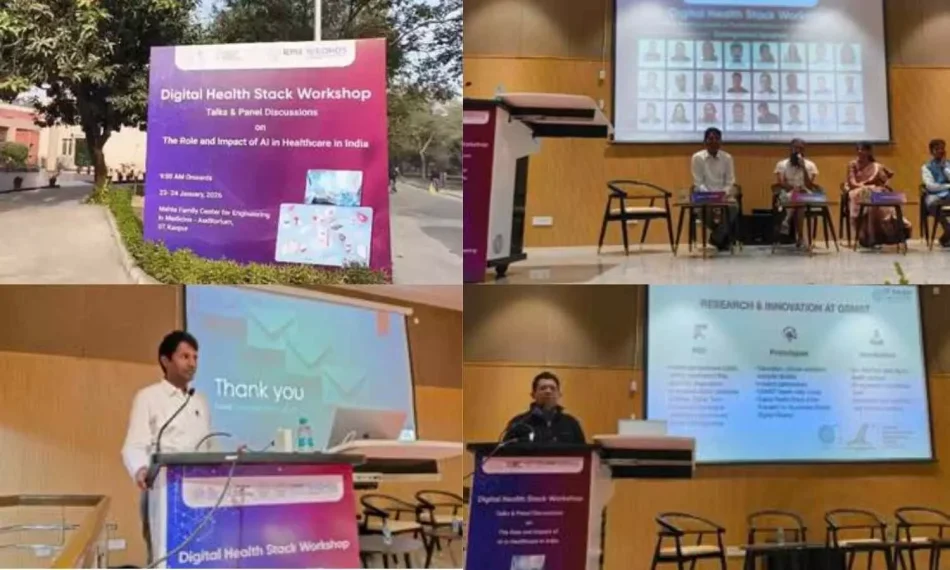
The Federated Intelligence Hackathon for Healthcare commenced on January 19, 2026, and ran through Hackathon Week from January 19 to January 23, 2026. This week featured intensive technical development, mentoring, and evaluations at IIT Kanpur. The two-day on-site program, starting on January 23, 2026, gathered policymakers, clinicians, researchers, start-ups, and industry experts for expert sessions, technical presentations, and panel discussions.
Keynote Address and Expert Sessions
The sessions kicked off with a keynote address by Prof. Sandeep Verma, Head of the Gangwal School of Medical Sciences and Technology. In his address, he emphasized the pivotal role of interdisciplinary research in driving AI-enabled healthcare innovation. Prof. Verma highlighted the necessity of cross-domain collaboration, stating that meaningful progress in Health AI can only be achieved through the integration of medicine, engineering, data science, and policy. He noted that such convergence is essential for building sustainable and impactful healthcare systems for the future, as reported by the Press Information Bureau (PIB).
Technical Sessions and Discussions
Following the keynote address, technical sessions were conducted by Prof. Phaneendra Kumar Yalavarthy, Chief PM at TANUH, IISc Bengaluru. His sessions covered traditional machine learning methods, clinical evaluation of AI systems, and regulatory considerations for healthcare deployment. He stated, “AI in healthcare has evolved from rule-based systems to data-driven learning, where deep learning enables autonomous feature discovery for complex tasks like medical image segmentation. By balancing bias–variance and applying methods such as regression, SVMs, and regularization, we can build robust, reliable, and clinically sustainable digital health solutions.”
Live Demonstrations and Panel Discussions
The program also featured a live Health AI demonstration by Google Health AI and the Wadhwani Foundation, presented by Manish Kumar, Vice President – AI Platform at the Wadhwani Foundation. Panel discussions on Health Technology Assessment (HTA) for algorithms and data sourcing for Health AI in India brought together experts from government, industry, and academia, including representatives from Samsung India, Google Health AI, CoRover.ai, ArtPark@IISc, and NITI Aayog. These discussions focused on validation pathways, regulatory readiness, data standardization, and large-scale deployment of AI tools within public health systems.
Domain-Specific Sessions
Domain-specific sessions showcased datasets and AI use cases in various fields such as ophthalmology, bone age detection, and computational pathology. These sessions highlighted emerging opportunities for population-scale screening and diagnostics, which are crucial for improving healthcare delivery across the nation.
Concluding Remarks and Future Outlook
The technical program concluded with remarks on responsible AI deployment in healthcare by Prof. Nisheeth Srivastava from IIT Kanpur. His insights underscored the importance of ethical considerations and the need for frameworks that ensure the safe and effective use of AI technologies in healthcare settings.
Participation and Engagement
The hackathon has garnered significant interest, with a total of 191 registrations, comprising 76 individual participants and 115 teams. This reflects strong nationwide participation from health-tech start-ups, AI/ML researchers, and various stakeholders in the healthcare ecosystem.
Significance of the Hackathon
The Federated Intelligence Hackathon serves as a platform for innovation and collaboration among diverse stakeholders in the healthcare sector. By bringing together experts from various fields, the initiative aims to foster the development of advanced AI solutions that can address pressing healthcare challenges in India.
Conclusion
The successful organization of the Federated Intelligence Hackathon at IIT Kanpur marks a significant step towards integrating artificial intelligence into the healthcare landscape of India. As the healthcare sector continues to evolve, such initiatives will play a crucial role in shaping the future of medical technology and improving patient outcomes.
Note: The information presented in this article is based on the latest updates from the National Health Authority and other related sources as of January 2026.


