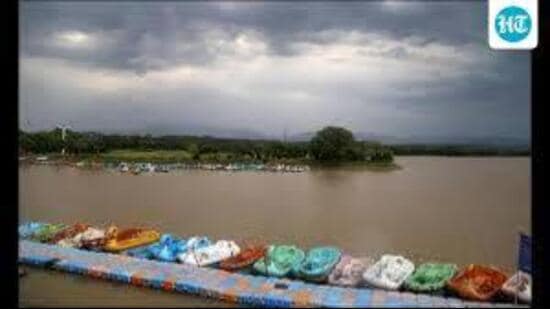
Sukhna Lake’s Depth Has Been Shrinking but Volume Rising: IIT Roorkee Survey
Published on: January 25, 2026
By Hillary Victor, Chandigarh
Introduction
Sukhna Lake, a man-made reservoir located at the foothills of the Shivalik hills in Chandigarh, has been the subject of increasing concern regarding its ecological health. A recent bathymetric survey conducted by the Indian Institute of Technology (IIT) Roorkee has revealed alarming trends: while the lake’s depth is diminishing, its overall water-holding capacity is paradoxically rising.
Historical Context
Created in 1985 by damming the Sukhna choe, the lake was initially 4.69 meters deep. However, since its inception, the lake has faced numerous challenges, including sedimentation and environmental stress, leading to a significant reduction in depth. By 2025, the average depth had decreased to approximately 2.7 meters, with the deepest recorded points nearing 3 meters.
Current Findings
The IIT Roorkee survey highlights several critical findings:
- The lake’s water-holding capacity has increased from 4,416 acre-feet (54.47 million cubic meters) in 2015 to 5,083 acre-feet (62.67 million cubic meters) in 2025.
- Despite the increase in volume, the lake has been losing depth since 1979, raising concerns about its long-term viability.
- The required water level for the lake is 1163 feet, but it currently stands at only 1,154 feet, indicating a need for a nine-foot rise in water levels.
Impact of Sedimentation
Siltation has been a significant issue for Sukhna Lake since its creation. The accumulation of silt began as early as 1960, just two years post-construction. Efforts to de-silt the lake have included voluntary service initiatives since 1988, but these have yielded minimal results. In 2010, heavy machinery was employed to remove silt, yet challenges persist. Currently, around 200 check dams have been installed in the catchment area to mitigate silt flow, but the effectiveness of these measures remains questionable.
Weed Infestation
Another pressing issue is the proliferation of aquatic weeds. Initially, only one type of weed was present in the lake; however, this has escalated to nine different types. This infestation has significantly reduced the boating area, prompting the administration to allocate substantial funds annually for weed removal prior to the monsoon season.
Expert Opinions
Chief Justice of India (CJI) Surya Kant recently expressed concerns over the lake’s condition, questioning the ongoing neglect. He attributed the lake’s deterioration to a “connivance between bureaucrats, politicians, and the builder mafia.” Experts, including Prof. Alok Srivastava from Panjab University, emphasize the need for regular monitoring and modern techniques such as GPS-based surveying and echo sounding to better understand the lake’s dynamics.
Proposed Solutions
To address these issues, IIT researchers have recommended a comprehensive management plan that includes:
- Regular monitoring of the lake’s depth and volume using advanced technology.
- Implementation of a five-year action plan developed in consultation with key departments to preserve the lake’s natural character.
- Annual desilting efforts to restore effective storage capacity.
Conclusion
The future of Sukhna Lake hangs in the balance. Its status as a major tourist attraction and ecological asset is under threat if immediate action is not taken. The findings from the IIT Roorkee survey serve as a wake-up call for authorities and stakeholders to prioritize the lake’s health and sustainability.
Note: The information presented in this article is based on a survey conducted by IIT Roorkee and reflects the current state of Sukhna Lake as of January 2026.