Made-in-Assam Robots and MRI: Assam CM Charts Tech-Driven Healthcare Future
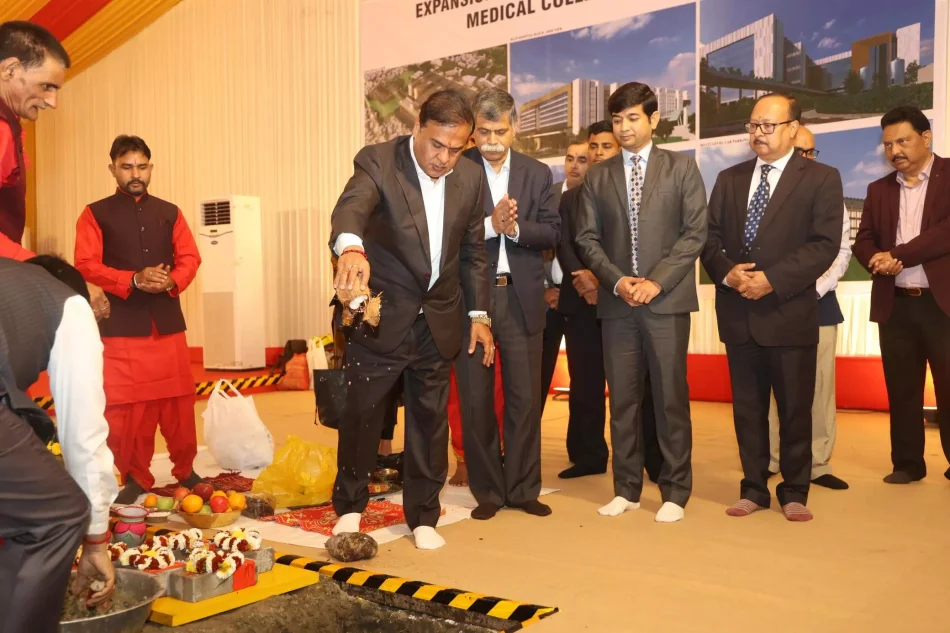
On February 1, 2026, during the Bhumi Pujan ceremony for the new building of the Gauhati Medical College and Hospital (GMCH), Assam Chief Minister Himanta Biswa Sarma unveiled an ambitious roadmap aimed at transforming the healthcare landscape of Assam. This initiative is part of a broader vision to integrate advanced technology into medical services, ensuring that the people of Assam have access to high-quality healthcare at affordable prices.
Transforming Gauhati Medical College and Hospital
Chief Minister Sarma emphasized that GMCH is set for a comprehensive overhaul, which includes significant upgrades to both infrastructure and technical capabilities. The new facility will feature 3,000 beds and will offer super-specialty services designed to meet the growing healthcare demands of the region. Sarma remarked, “In the coming years, the old buildings at Narakasur Pahar may be the only reminder of the past.”
Aligning with National Initiatives
As the central government outlined its commitment to artificial intelligence and digital infrastructure in the Union Budget for 2026–27, Sarma stated that Assam must align itself with these national priorities. He highlighted the importance of developing a robust urban medical ecosystem in Guwahati to enhance healthcare delivery across the state.
Comprehensive Revamp of the State’s Health Sector
Beyond GMCH, the Chief Minister indicated that the government is also focusing on enhancing medical colleges in Jorhat, Silchar, and Dibrugarh, with support from the Japan International Cooperation Agency (JICA). “The idea is to completely revamp the state’s health sector,” he said, showcasing a commitment to improving healthcare infrastructure throughout Assam.
The Role of Medical Technology
Sarma stressed the pivotal role that medical technology will play in the future of healthcare in Assam. He announced a partnership with the Indian Institute of Technology (IIT) Guwahati, which is collaborating with the All India Institute of Medical Sciences (AIIMS) to foster a strong ecosystem for medical technology development.
Indigenous Robotic Surgical Equipment
During the ceremony, the Chief Minister introduced prototypes of indigenously developed robotic surgical equipment. He asserted that these devices deliver performance comparable to imported systems but at a fraction of the cost—approximately one-fifth of the price. “These are made in India, made in Assam,” he stated, emphasizing their potential to enhance accessibility for public healthcare institutions.
Affordable MRI Technology
In addition to robotic surgery, Sarma showcased a prototype of an indigenous MRI machine, which is priced around Rs 1.5 crore. This is significantly lower than the nearly Rs 16 crore cost of imported MRI machines. “People exploit us. We must stop that,” he remarked, highlighting the necessity of developing local solutions to reduce dependency on foreign technology.
Encouraging Start-ups and Innovation
The Chief Minister expressed his vision for GMCH to become a breeding ground for start-ups and innovation. He encouraged local entrepreneurs to consider whether they can produce medical technologies domestically rather than relying on foreign brands. “It may be good for us individually, but not for the country,” he noted, advocating for a mindset shift towards self-sufficiency in technology.
Strengthening Educational Institutions
In a bid to further bolster Assam’s technological capabilities, Sarma announced the establishment of Kanaklata University, which will focus on artificial intelligence. This initiative aims to enhance the state’s educational framework, fostering innovation and preventing brain drain among the youth. “Innovation is the only way out. I have complete faith in our youth,” he stated.
A Call for Change
Chief Minister Sarma called for a shift in mindset among medical colleges in Assam, urging them to become hubs of innovation. He remarked, “After doing the same things for 30 years, it is time to do something new. We have bright students.” He emphasized that this is a crucial moment for Assam to take decisive action and break free from past limitations.
Local Technical Capabilities
In his address, Sarma also referenced the Guwahati–North Guwahati bridge, which is set to be inaugurated on February 14, as a testament to local technical capabilities. “At least at the technical level, our boys have occupied the field,” he said, indicating a growing confidence in local talent and expertise.
Conclusion
Chief Minister Himanta Biswa Sarma concluded his address by urging collaboration among various stakeholders to bring about a positive change in Assam’s healthcare sector. “It’s time for a new revolution in Assam. If we join hands, we can change things for good,” he asserted, highlighting the potential for innovation and progress in the state.
Note: This article reflects the ambitious plans laid out by the Assam government to enhance healthcare through technology, focusing on indigenous solutions and fostering local innovation.