
ARCI–IIT Hyderabad Innovation Offers Eco-Friendly Alternative for Next-Gen Electronics
In a significant breakthrough for sustainable electronics, researchers at the International Advanced Research Centre for Powder Metallurgy and New Materials (ARCI), Hyderabad, in collaboration with the Indian Institute of Technology (IIT) Hyderabad, have developed a novel lead-free, eco-friendly photodetector. This innovative device operates without external power while delivering high performance and long-term stability, addressing a key limitation of existing high-performance photodetectors.
The Importance of Photodetectors
Photodetectors are critical components in a variety of applications, including:
- Cameras
- Environmental sensors
- Smart wearables
- Security systems
- Biomedical imaging devices
These devices convert light into electrical signals, making them essential for many modern technologies. However, traditional photodetectors often rely on lead-based perovskites, which pose toxicity risks and suffer from poor durability under real-world environmental conditions.
A Safer Alternative to Lead-Based Photodetectors
To overcome the limitations of lead-based photodetectors, the Indian research team developed a photodetector using the lead-free double perovskite material Cs₂AgBiBr₆. This innovative material combines environmental safety with robust optoelectronic performance, making it a promising alternative for future applications.
Simple, Low-Cost, and Room-Temperature Fabrication
Unlike conventional devices that require:
- Expensive metal electrodes
- Additional hole-transport layers
- Complex fabrication in gloveboxes or vacuum systems
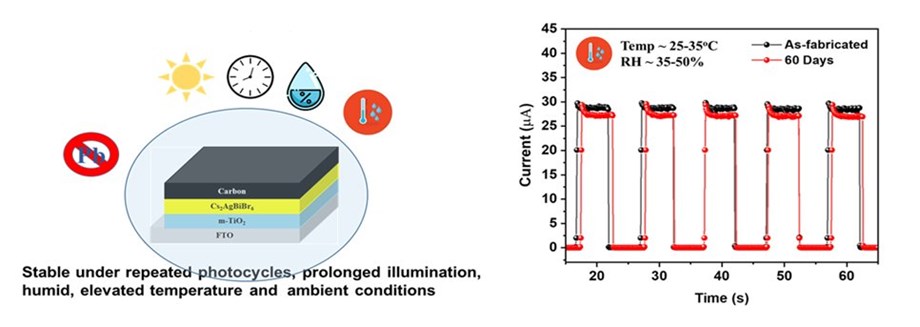
The new device is hole-transport-material (HTM) free, utilizes low-cost carbon electrodes, and is fabricated entirely at room temperature through a simple one-step coating process. This streamlined approach significantly reduces manufacturing complexity and cost, improving scalability for commercial applications.
Self-Powered Operation with Stable Performance
The device architecture naturally promotes efficient charge separation, enabling self-powered operation without any external voltage source. Key performance highlights include:
- Strong and consistent response to visible light
- Clear ON–OFF switching behavior
- More than 90% performance retention after 60 days of storage
Stability tests were conducted under ambient room conditions (25–35°C and 35–50% relative humidity). The near-overlap of photo-response curves before and after aging confirms the device’s long-term environmental stability, marking a significant advancement over existing perovskite-based photodetectors.
Wide-Ranging Applications and Strategic Relevance
The combination of lead-free material chemistry, ambient-condition fabrication, low-cost components, and long-term operational reliability makes this technology highly promising for various applications, including:
- Consumer electronics
- Industrial and environmental monitoring
- Security and surveillance systems
- Biomedical imaging and diagnostics
Importantly, this development aligns closely with India’s national priorities on green manufacturing, sustainable materials, and self-reliance in next-generation electronic technologies.
Research Support and Publication
This groundbreaking research was supported by the Department of Science and Technology (DST), Government of India, and has been published in the international peer-reviewed journal Solar Energy (Elsevier). The study is titled “Ambient-processed lead-free Cs₂AgBiBr₆ photodetector with long-term environmental stability and self-powered operation.”
Validated Through Accelerated Stability Testing
The published study includes a schematic of the eco-friendly photodetector and results from accelerated stability tests. These tests compare the photo-response of freshly fabricated devices with those aged for 60 days, validating the device’s reliability under practical operating environments.
Conclusion
The innovation presented by the ARCI and IIT Hyderabad researchers marks a significant step forward in the field of sustainable electronics. By developing a lead-free photodetector that operates efficiently without external power, they have opened new avenues for environmentally friendly technology that can be widely adopted across various sectors.
Note: This article is based on research and developments as of February 2026 and may be subject to further advancements in the field of photodetector technology.


