
IIT-M Researchers Develop VR Tool to Quantify Surgeons’ Laparoscopic Skills
Chennai: Researchers at the Indian Institute of Technology Madras (IIT-M) have made significant strides in the field of surgical training by developing a virtual reality (VR) tool designed to objectively measure the skills of surgeons performing laparoscopic procedures. This innovative approach could standardize the teaching and assessment of surgical skills, addressing long-standing challenges in surgical education.
Understanding Laparoscopic Surgery
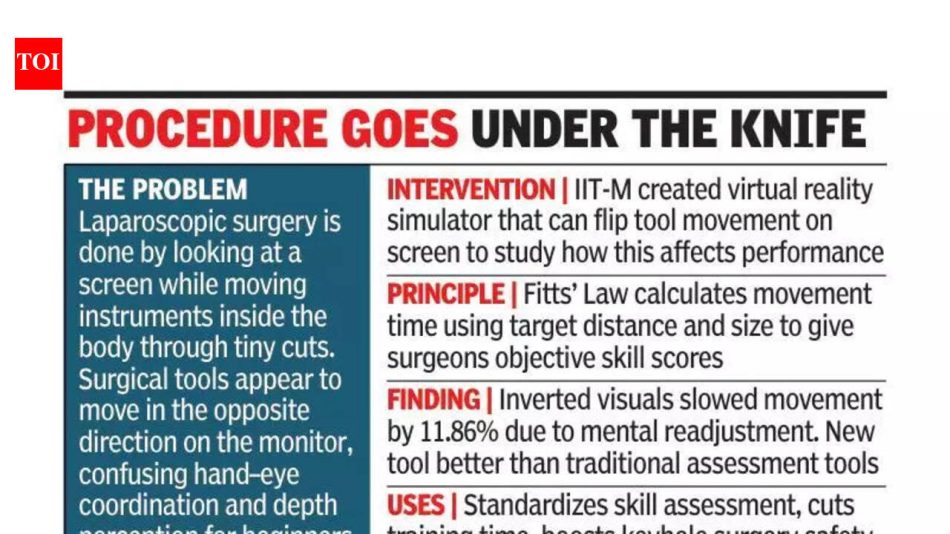
Laparoscopic surgery, often referred to as keyhole surgery, is a minimally invasive surgical technique commonly used for procedures such as gallbladder removals and bariatric weight-loss operations. This method involves operating through small incisions using long instruments, while the surgeon views their movements on a monitor. However, this approach presents unique challenges:
- Limited Tactile Feedback: Surgeons cannot feel the tissues they are manipulating, which can complicate their ability to gauge the amount of force applied.
- Depth Perception Issues: The two-dimensional view on the monitor can hinder a surgeon’s ability to judge distances accurately.
- Inverted Hand Movements: Due to the fulcrum effect, when a surgeon moves their hand left, the tool tip moves right, requiring mental remapping of movements.
The Need for Objective Assessment
Traditionally, surgical training programs have relied on subjective evaluation tools to help surgeons navigate these challenges. While structured, these methods often depend heavily on the instructor’s judgment, leading to variability in scoring across different areas such as precision, efficiency, tissue handling, and overall competence. This inconsistency can hinder the development of standardized training protocols.
Innovative VR Solution
The research team at IIT-M, led by Professor Manivannan M, head of the Touch Lab in the Department of Applied Mechanics and Biomedical Engineering, took a novel approach by integrating principles from computer science into surgical training. They applied Fitts’ Law, a concept from human-computer interaction that predicts movement time based on the distance to and size of a target, to create a custom VR haptic simulator.
This simulator replicates the conditions of laparoscopic surgery, including:
- Inverted visuals to mimic the challenges faced during actual procedures.
- Quantified performance metrics such as movement time and throughput during standardized tapping tasks.
Research Findings
The findings of the study were published in the peer-reviewed International Journal of Human–Computer Interaction. The researchers tested their VR model on 24 young surgeons, revealing that the use of inverted tool visuals increased movement time by an average of 11.86% compared to non-inverted movements. This VR method effectively addresses various training hurdles, including the fulcrum effect, reduced tactile feedback, and mirror (reversed) movements.
By providing consistent, data-driven scores, the VR tool outperforms traditional subjective evaluation systems. Dr. Venkatraman Sadanand, a senior neurosurgeon based in the United States and co-author of the study, emphasized that this research bridges the fields of computer science, engineering, and neurosurgery. It sets the stage for the global adoption of standardized VR assessments, which could revolutionize minimally invasive surgical training worldwide.
Implications for Surgical Training in India
As India faces a shortage of surgeons coupled with a rising demand for minimally invasive procedures, this innovative VR tool could play a crucial role in accelerating skill development among surgeons. The potential benefits include:
- Reduced Training Costs: The VR system could lower the financial burden associated with traditional training methods.
- Improved Patient Safety: By enhancing surgical skills through objective assessment, the likelihood of complications during procedures may decrease.
- Enhanced Skill Development: Surgeons can practice and refine their skills in a controlled environment, leading to better performance in real surgical settings.
Future Directions
The researchers acknowledged the need for larger trials to validate their findings across various experience levels and surgical specialties. Such studies will help ensure that the VR tool is effective for a broad range of surgical procedures and can be integrated into existing training programs.
As the medical field continues to evolve, the incorporation of advanced technologies like VR into surgical training may become a standard practice, ultimately benefiting both surgeons and patients alike.
Conclusion
The development of a VR tool by IIT-M researchers represents a significant advancement in the objective assessment of laparoscopic surgical skills. By addressing the limitations of traditional training methods and providing a standardized approach to skill evaluation, this innovation has the potential to transform surgical education and improve patient outcomes in India and beyond.
Note: This article is based on research findings and developments as of February 2026. For the latest updates and further information, please refer to reputable medical and academic sources.

