IIT-H Launches Drone Propulsion Lab
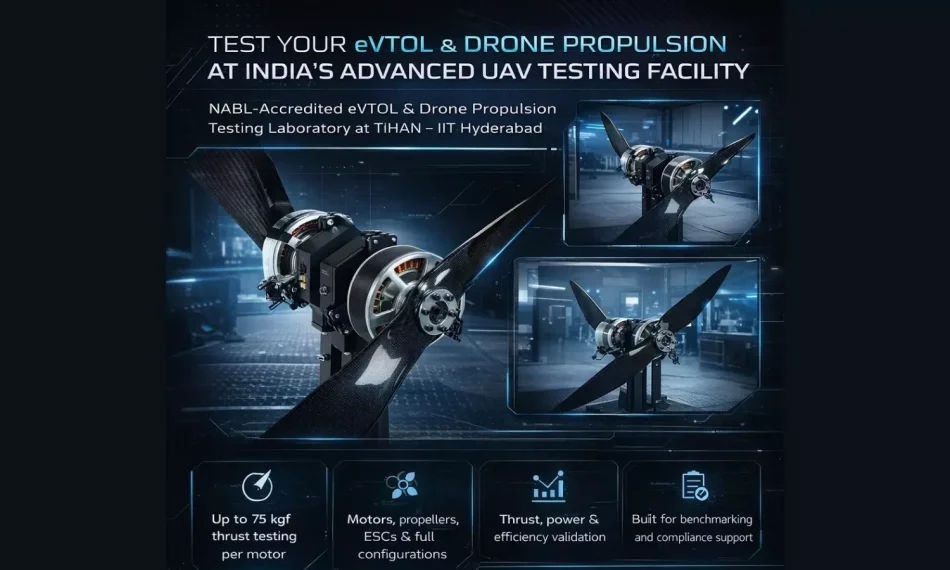
Hyderabad, India – In a significant advancement for the drone industry, the Indian Institute of Technology Hyderabad (IIT-H) has operationalized a state-of-the-art drone propulsion testing laboratory. This facility is designed to support the growing needs of drone manufacturers and start-ups in validating their vehicles without the need for informal testing or sending prototypes abroad.
Overview of the Drone Propulsion Lab
The newly established lab is part of IIT-H’s Technology Innovation Hub on Autonomous Navigation (TiHAN) Foundation. It has been accredited by the National Accreditation Board for Testing and Calibration Laboratories (NABL), ensuring that it meets the rigorous ISO/IEC 17025 standards. This accreditation allows for the testing of propulsion systems in a calibrated and traceable environment, which is crucial for manufacturers seeking reliable data for benchmarking, research documentation, and regulatory compliance.
Capabilities and Features
The drone propulsion lab is equipped to test various propulsion configurations, including:
- Single propulsion systems
- Coaxial configurations
- Staggered propulsion setups
Thrust capacities range from 0.1 to 70 kilogram-force, with the infrastructure capable of supporting tests up to 75 kilogram-force per motor. This versatility allows the lab to accommodate both small drones and heavier payload platforms.
Measurement and Testing Standards
Dr. Santosh Reddy, the Chief Executive Officer of TiHAN, emphasized the importance of NABL-accredited measurements. The lab provides data on:
- Thrust
- DC current
- DC voltage
- Power
- Thrust efficiency at nominal speed
- RPM (Revolutions Per Minute)
- Temperature measurements
Furthermore, the facility can test brushless DC (BLDC) motors with controllers rated from 29 kV to 3000 kV, along with propeller assemblies used in unmanned aerial vehicles (UAVs).
Importance of Reliable Propulsion Validation
Reliable propulsion validation is a critical step before the deployment of any drone system. Dr. Reddy noted that many teams previously lacked easy access to accredited testing infrastructure within India. This new facility provides a structured environment where propulsion systems can be evaluated using calibrated instruments, leading to documented performance data that can be relied upon.
Support for Various Sectors
The drone propulsion lab is expected to support a variety of stakeholders, including:
- Unmanned aerial vehicle original equipment manufacturers (OEMs)
- Advanced air mobility ventures
- Defense-linked research units
- Academic teams
As the use of drones expands into fields such as logistics, surveillance, agriculture, and urban mobility, the reliability of propulsion systems is becoming a central concern for developers and researchers alike.
Local Testing Benefits
The establishment of this testing lab marks a significant milestone for the Indian drone industry. With certified testing now available locally, developers face one less barrier between their prototypes and field deployment. This accessibility is expected to accelerate innovation and enhance the competitiveness of Indian drone technology on a global scale.
Conclusion
The launch of the drone propulsion lab at IIT-Hyderabad represents a pivotal development in the Indian aerospace sector. By providing a reliable and accredited testing environment, IIT-H is empowering drone manufacturers and researchers to enhance their products and contribute to the rapidly evolving field of unmanned aerial vehicles.
Note: The information presented in this article is based on the latest updates from IIT-Hyderabad and reflects the current state of the drone propulsion lab as of February 2026.