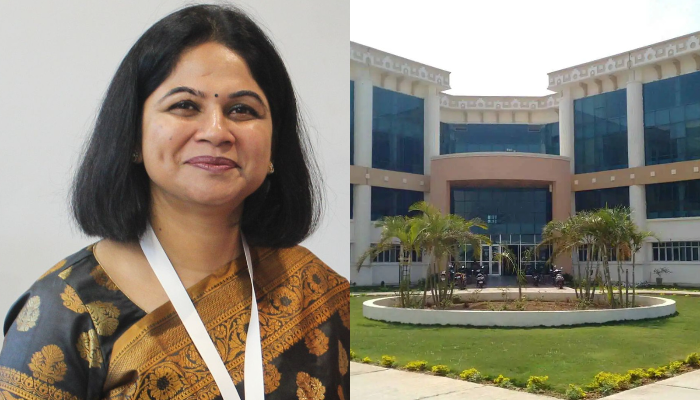
Who is Priyanka Tripathi, the IIT Patna Professor behind the lesbian ‘Shakti’ paper?
The Indian Institute of Technology (IIT) Patna has recently found itself at the center of a heated public and academic debate following the circulation of excerpts from a research paper authored by Dr. Priyanka Tripathi, an Associate Professor of English at the institution. The paper, titled “(En)Queering Prakriti: Decolonial Ecofeminism and Lesbian Subjectivity in Out! Stories from the New Queer India,” was co-written with Chhandita Das and published in the international journal Feminist Encounters: A Journal of Critical Studies in Culture and Politics.
The Controversy
The controversy erupted after many on social media alleged that the paper distorted core Hindu philosophical concepts, particularly Prakriti and Shakti, in order to advance a contemporary queer ecofeminist framework. One of the most debated portions of the paper reads:
“Since ages, Prakriti has been believed in Hindu mythology to be closely associated with femininity in India, and the present article will elaborate on how it energises lesbian experiences as an alternative source of Shakti (i.e., power) beyond the heteronormative Prakriti and Purusha (literal meaning man) dualism.”
The authors further argued:
“Shakti in the decolonial context of queer eco-feminism can not only offer resistance to fixed heterosexual categories, but also can shape potential pathways of queer subjectivity and sustainability.”
Public Reactions
The repeated invocation of sacred Hindu terms within a contemporary gender and sexuality framework has drawn sharp criticism from several quarters. Critics contend that such interpretations amount to an ideological repurposing of religious concepts. For instance, a tweet from the account Gems of Indian Academia criticized the paper, stating:
“Distortion of Hindu Scriptures by IIT Patna’s Humanities Department👉 lesbian experiences as an alternative source of Shakti👉the lap of Prakriti marks the heightened Shakti of lesbianism…Why this is happening on tax money, @dpradhanbjp⁉️”
Reframing Prakriti and Shakti
In the paper, the authors attempt to create a conceptual bridge between traditional Indian philosophical ideas and modern queer theory. They noted:
“It is primarily the shared emphasis on fluidity and interconnectivity among species beyond any binary mechanism, that the decolonial Indian concept Prakriti and queer ecofeminism are deeply related.”
The authors also argue that reconstructing lesbian ecofeminism through the decolonial lens of Prakriti and its associated spiritual belief of Shakti could offer possibilities that go “beyond the traditional method of othering.”
Another controversial passage states:
“The provocation of these identifications of lesbians in or as Prakriti, in turn, empowers them with Shakti.”
Perhaps the most debated line in the paper reads:
“Their unification, though in death, in the lap of Prakriti, marks the heightened Shakti of lesbianism to reject every compulsory pressure to conform, so that even death is preferable to convention.”
While many describe the paper as an example of interdisciplinary scholarship blending postcolonial thought and gender studies, others argue that invoking sacred spiritual concepts to frame sexual politics crosses a sensitive line in a country where such ideas are deeply revered.
Who is Dr. Priyanka Tripathi?
Dr. Priyanka Tripathi is currently an Associate Professor of English at IIT Patna and previously served as the Head of the Department of Humanities and Social Sciences at the institution. She completed her PhD from the Indian Institute of Technology Kharagpur.
According to her official profile available on the institute’s website, she also serves as the Fellowship Coordinator for the Journal of International Women’s Studies, published by Bridgewater State University in the United States. Additionally, she holds editorial roles with the Journal of Graphic Novels and Comics and Global South Literary Studies, both published by Taylor & Francis.
Academic Distinctions
Dr. Tripathi has received several academic distinctions, including:
- Charles Wallace India Trust Visiting Fellowship (2024-25) at the School of History, University of Leeds
- IPD Visiting Research Fellowship (2022-23) at the Institute for Advanced Studies in the Humanities (IASH), University of Edinburgh
- Her monograph titled The Gendered War: Evaluating Feminist Ethnographic Narratives of the 1971 War of Bangladesh was published by Bloomsbury in 2022.
- A forthcoming monograph with the National Book Trust of India is reportedly titled Mann Ki Baat & Bharatiya Art, Culture and Heritage.
Her areas of research include Medical Humanities, Gender Studies, South Asian Fiction, and Graphic Novels.
Earlier Writings and Criticism of Hindu Social Structures
The current controversy has also led to renewed scrutiny of Dr. Tripathi’s earlier academic writings. In her work titled “Women and Wounded Self: Exploring Indian Women’s Short Fiction in English,” she examined themes of patriarchy and domestic violence. In that context, she referenced Hindu mythology and scriptural traditions to argue that women have historically been positioned in subordinate roles within certain social frameworks.
Another co-authored paper, “Exploring the Margins of Kotha Culture: Reconstructing a Courtesan’s Life in Neelum Saran Gour’s Requiem in Raga Janki,” discussed the cultural positioning of courtesans. In it, the authors wrote:
“Such othering of women is also an innate part of Hindu patriarchal societies which believe that women are unable to address their own issues of which Manusmriti, an ancient text, completely boasts off stating that a woman belongs to her father in childhood, to her husband in youth and in her old age she belongs to her son only.”
</blockquote
Disclaimer: A Teams provides news and information for general awareness purposes only. While we strive for accuracy, we do not guarantee the completeness or reliability of any content. Opinions expressed are those of the authors and not necessarily of A Teams. We are not liable for any actions taken based on the information published. Content may be updated or changed without prior notice.