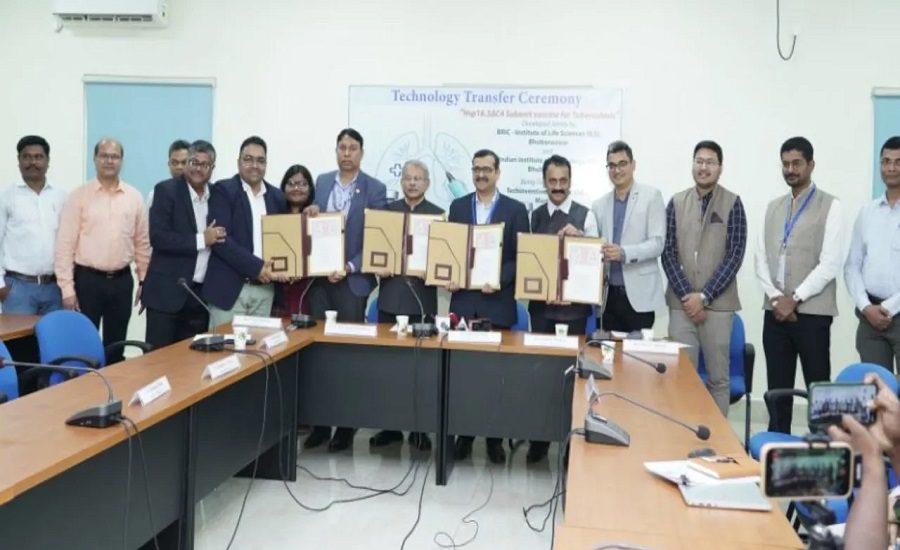
IIT Bhubaneswar and ILS Bhubaneswar Partner with TechInvention Lifecare to Advance Next-Gen TB Vaccine
In a significant advancement in the fight against tuberculosis (TB) in India, the Indian Institute of Technology (IIT) Bhubaneswar and the Institute of Life Sciences (ILS) Bhubaneswar have successfully transferred a next-generation TB vaccine technology to TechInvention Lifecare Limited. This transfer was formalized through a Quadripartite License Agreement (QLA) facilitated by the National Research Development Corporation (NRDC).
Overview of the HSP Subunit Vaccine
The agreement specifically covers the commercialization of the “HSP Subunit Vaccine in Adjuvant (DDA) Against Mycobacterium tuberculosis.” This vaccine is designed to overcome the limitations of the century-old Bacillus Calmette-Guérin (BCG) vaccine, which has shown limited efficacy in protecting adolescents and adults. The new vaccine candidate aims to elicit robust humoral and cell-mediated immune responses, thereby improving protection against TB in these age groups.
Global Health Challenge: Tuberculosis
Tuberculosis remains one of the deadliest infectious diseases worldwide. According to the World Health Organization (WHO), TB claimed approximately 1.23 million lives in 2024 alone. The development of the HSP Subunit Vaccine represents a major stride in India’s ongoing efforts to create innovative and indigenous solutions to combat TB.
Technology Developed by Indian Scientists
The vaccine technology was collaboratively developed by:
- Prof. Ashis Biswas of IIT Bhubaneswar
- Dr. Sunil Kumar Raghav of ILS Bhubaneswar
The transfer ceremony took place at ILS Bhubaneswar and was attended by several prominent officials, including:
- Dr. Debasis Dash, Director, ILS
- Prof. Shreepad Karmalkar, Director, IIT Bhubaneswar
- Prof. Dinakar Pasla, Dean (Sponsored Research & Industrial Consultancy), IIT Bhubaneswar
- Dr. B. K. Sahu, Senior Regional Manager, NRDC
- Syed S. Ahmed, Director & CEO, TechInvention Lifecare
- Prof. Biswas and Dr. Raghav
This collaboration exemplifies the strength of India’s research ecosystem and highlights the importance of partnerships between academic institutions and industry in addressing critical public health challenges.
Role of TechInvention Lifecare
As the licensed industry partner, TechInvention Lifecare Limited will spearhead the vaccine’s transition from research to product development, validation, and market readiness. The company brings extensive experience in vaccine development, manufacturing, and navigating regulatory processes, ensuring that the HSP Subunit Vaccine progresses efficiently through the development pipeline. This is crucial for contributing to India’s mission to eliminate tuberculosis.
NRDC: Catalyzing Innovation and Technology Commercialization
The National Research Development Corporation (NRDC) has played a vital role in this collaboration by identifying and evaluating the vaccine innovation and facilitating the licensing process. Acting as a bridge between scientific research and industry, NRDC enables indigenous innovations to reach commercialization while promoting public-private partnerships. By supporting this technology transfer, NRDC reinforces its commitment to accelerating research-driven solutions for national and global health challenges, exemplifying its dedication to fostering impactful innovation in India.
Conclusion
The partnership between IIT Bhubaneswar, ILS Bhubaneswar, and TechInvention Lifecare marks a significant advancement in the fight against tuberculosis. With the development of the HSP Subunit Vaccine, there is hope for improved protection against TB, particularly among adolescents and adults who have historically been underserved by existing vaccines. This initiative not only showcases the capabilities of Indian researchers but also emphasizes the importance of collaboration between academia and industry in addressing pressing health issues.
Note: This article provides an overview of the recent advancements in tuberculosis vaccine development in India, highlighting the collaborative efforts of key institutions and the role of innovative solutions in public health.