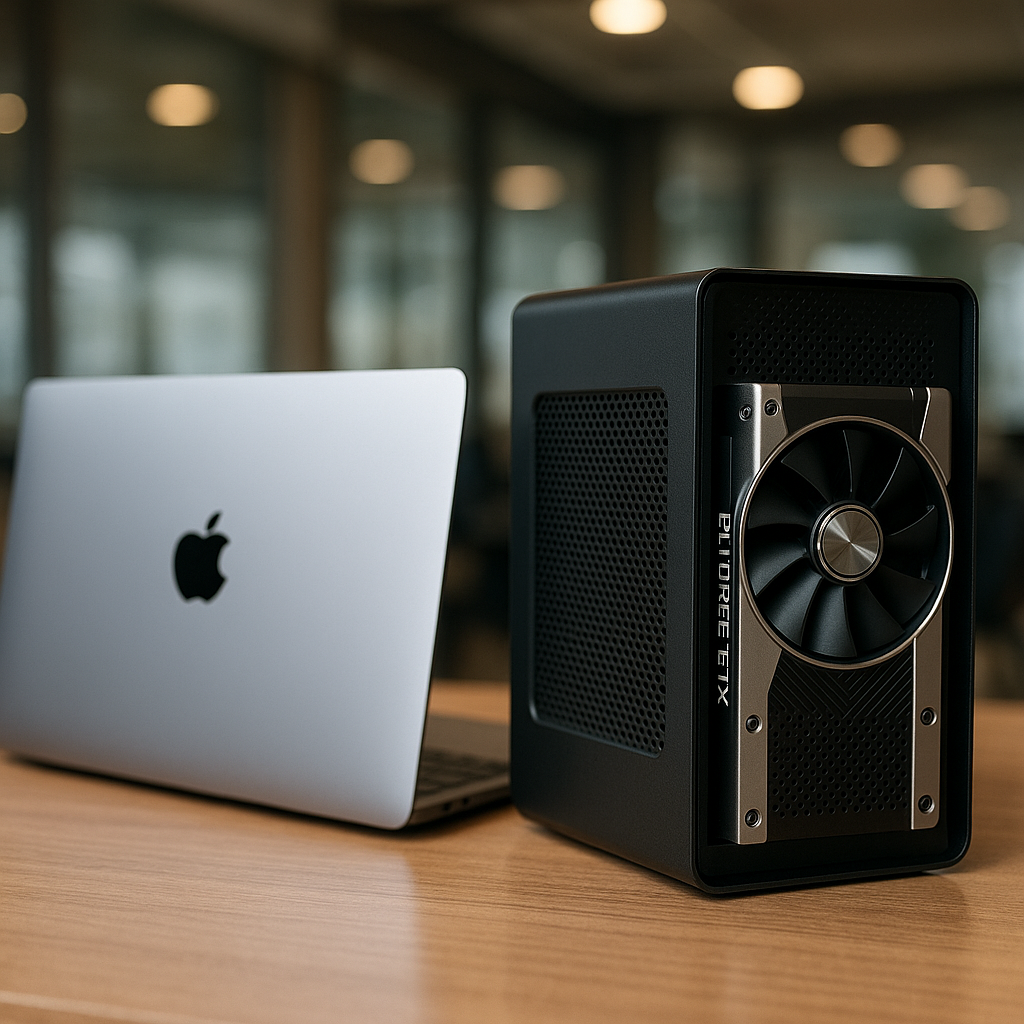
Apple unveils shocking Nvidia move
In a surprising development, Apple Inc. (AAPL) has approved a third-party driver for Apple Silicon Macs, allowing Nvidia GPUs to function in external setups. This move, reported by Tom’s Hardware, may seem minor at first glance, but it could have significant implications for the artificial intelligence (AI) landscape.
The Significance of Apple’s Closed Ecosystem
Apple’s closed ecosystem has long been a hallmark of its brand, providing the company with control over performance, security, and user experience. However, in the rapidly evolving field of AI, such control can become a limitation. Unlike traditional computing tasks, the focus in AI is on access to powerful tools rather than maintaining a pure platform.
Understanding the Driver Approval
The driver approved by Apple was developed by Tiny Corp, an AI startup. This driver enables the use of Nvidia GPUs with Apple Silicon Macs, but it is not a straightforward plug-and-play solution. Users must compile the driver themselves, often utilizing tools like Docker. The current implementation is primarily targeted at advanced users and AI workloads, rather than general graphics or consumer applications.
Historical Context
For years, Apple Silicon made it nearly impossible to utilize external GPUs on Intel-based Macs, limiting options for developers and users alike. By approving this driver, Apple is cautiously reopening the door to external GPU use, albeit in a limited capacity. This change is noteworthy as it signals a shift in Apple’s strategy towards greater flexibility in its Arm-based Macs.
The Implications for Nvidia
Nvidia is not just another chipmaker; it is a leader in the AI space. The company’s GPUs are widely recognized for their performance in demanding AI workloads, making them a preferred choice among developers. Apple’s decision to support Nvidia GPUs, even in a limited manner, may indicate a recognition of Nvidia’s growing importance in the AI landscape.
Market Reactions
Wall Street is keenly observing this development. The question on many investors’ minds is whether this driver approval will lead to more mainstream support for Nvidia GPUs on Macs in the future. Apple is known for being selective about what it allows on its macOS, especially regarding hardware support. Therefore, the approval of a third-party driver for Nvidia GPUs suggests a deliberate strategy to adapt to the evolving demands of developers and the AI market.
The AI Landscape and Apple’s Position
While Apple has made significant strides with its in-house silicon, it has not yet positioned itself as a major player in AI compute. Nvidia, on the other hand, has established a dominant presence in the AI infrastructure space, powering much of the current AI boom from model training to inference workloads. Apple’s recent move appears to acknowledge Nvidia’s critical role in this segment of the AI battle.
What This Means for Developers
For developers, this approval represents a shift in Apple’s approach. Previously, those attempting to use Nvidia GPUs on Apple Silicon had to rely on unofficial workarounds that often compromised system security. With the signing of the Tiny Corp driver, Apple is eliminating some of these barriers, making it easier for developers to integrate Nvidia’s powerful hardware into their workflows.
Future Considerations
Despite the positive implications of this move, it is essential to note that Apple is not providing full-fledged external GPU support. The current driver is still technical and focused on AI workloads, lacking the mainstream graphics capabilities that many users might expect. Consequently, users should not anticipate that their next Mac will easily accommodate Nvidia GPUs without additional effort.
Investor Insights
For investors, this development signals a potential shift in Apple’s traditional closed-door approach. As AI continues to gain traction, the demand for Nvidia’s acceleration in Apple hardware may compel the company to adapt its strategies further. Apple faces a choice: resist the demand for Nvidia integration or embrace it to remain competitive in the AI era.
Conclusion
In summary, Apple’s approval of a third-party driver for Nvidia GPUs marks a significant moment in the ongoing evolution of its platform strategy. While the immediate impact may be limited to advanced users and AI workloads, the broader implications could reshape how Apple interacts with the AI community. As the landscape continues to evolve, it will be interesting to see how Apple balances its closed ecosystem with the growing need for powerful external hardware.
Note: This article is based on information available as of October 2023 and is intended for informational purposes only.