He replaced 90% of his staff with AI: what happened one year later – Futura-Sciences
On April 12, 2026, a bold experiment in India sent shockwaves through the business world: Suumit Shah, CEO of Dukaan, decided to lay off 90% of his workforce and replace them with artificial intelligence chatbots. Twelve months later, we explore the outcomes of this radical gamble and its implications for the future of human labor alongside machines.
Automation on the Fast Track
Artificial intelligence is rapidly transforming the workplace. While some view it as a goldmine of new efficiencies, others express concern over the potential for widespread job loss. The story of Dukaan, a major player in India’s e-commerce sector, serves as a living case study in this ongoing revolution.
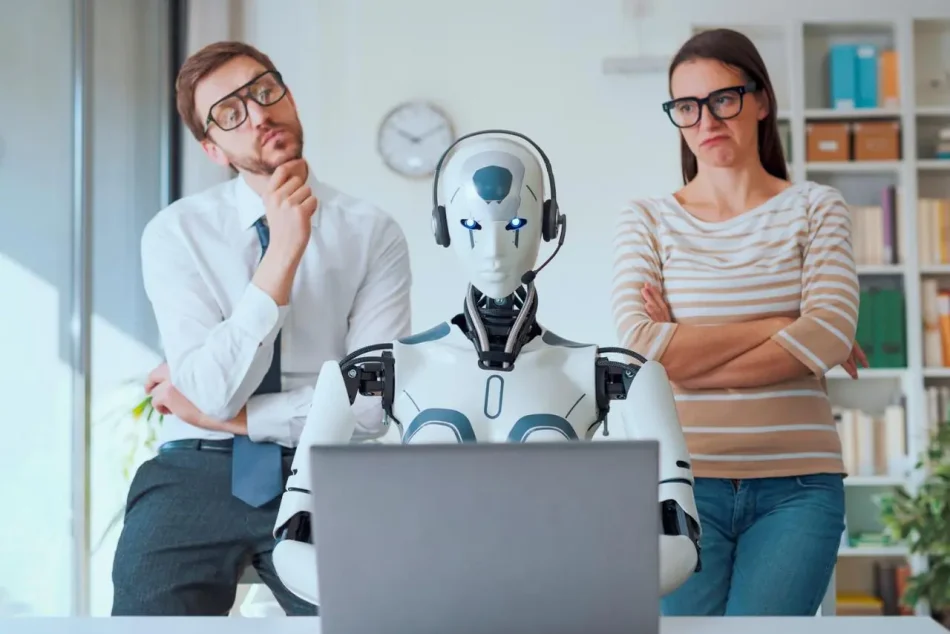
In the summer of 2023, Suumit Shah made a controversial decision that garnered global attention. Dukaan announced it would fire nearly its entire human staff, replacing them with AI-powered chatbots. This sweeping change aimed to drive down operational costs while simultaneously improving customer service quality.
The sheer scale of Dukaan’s transformation is notable, even in today’s AI-enthused business environment. While many companies are gradually integrating AI tools, few have taken such a bold—or controversial—approach. Unsurprisingly, Dukaan’s decision sparked heated ethical debates about corporate social responsibility and the obligations businesses owe to their employees.
A Test Case for the Digital Future
Dukaan’s experiment provides a revealing look at what is possible, especially in sectors like online retail. In this field, business processes tend to be standardized, and customer queries are often predictable—ideal conditions for automation, at least in theory.
After a year of implementation, the results of this trial have been described by Shah as overwhelmingly positive, at least when assessed through company metrics. Chatbots have exceeded expectations across several key performance indicators. One significant improvement is the response time to customer requests. What previously took about two minutes for a human operator is now almost instantaneous when handled by AI.
Moreover, the average time needed to fully resolve a customer support query has decreased dramatically—from over two hours to just a few minutes. This newfound efficiency, according to company data, has translated into higher customer satisfaction.
More Than a Numbers Game?
On paper, these operational results seem to validate Dukaan’s radical strategy. However, they also raise deeper questions. Does technical efficiency alone justify the social cost of laying off so many employees? Are purely quantitative measures sufficient to assess the quality of a service, or does human interaction provide value that numbers cannot capture?
This Indian experiment is fueling a pivotal debate over the future of work in the age of AI. On one side are proponents of automation, who argue that:
- Increased efficiency can lead to better service.
- Lowered human error enhances reliability.
- Automation frees up human workers for more creative and strategic tasks, rather than repetitive routines.
These advocates envision a future where AI complements rather than replaces human labor. Conversely, critics highlight the risks associated with mass technological unemployment, growing social inequalities, and the potential dehumanization of services. For them, Dukaan’s story represents a troubling trend: humans being swapped out for machines in the name of cost-cutting.
What Next for Humans and AI at Work?
Amid these contrasting perspectives, an urgent conversation is unfolding about how humans and intelligent machines might coexist in the workplace. Will Suumit Shah’s bold model become the standard, or will it be remembered as an outlier?
In the coming years, we will begin to uncover the answers to these crucial questions regarding the future of work. One thing is certain: the debate surrounding the role of AI in the workplace is far from over, and the world is watching closely to see what happens next.
Conclusion
The experiment conducted by Dukaan raises significant questions about the intersection of technology and employment. As businesses increasingly turn to AI for efficiency, the implications for human workers and the nature of work itself will continue to be a topic of critical discussion.
Note: The information presented in this article is based on a case study involving Dukaan and reflects the current discourse surrounding AI in the workplace as of April 2026.