IIT Hyderabad develops a new index to predict and track devastating droughts
Hyderabad, April 18, 2026 – Engineers from the Indian Institute of Technology (IIT) Hyderabad have made significant strides in understanding and managing drought conditions through the development of a new index known as the Integrated Water Deficit Index (IWDI). This innovative method combines satellite data on weather patterns and underground water reserves to provide a comprehensive overview of drought dynamics.
The Need for a Comprehensive Drought Index
Traditional methods of measuring droughts have often fallen short in capturing the full extent of water scarcity, particularly in large, arid regions. Recognizing this gap, researchers Sai Srinivas Gorugantula and BVN P Kambhammettu set out to create a more effective tool for assessing drought conditions. The IWDI aims to provide a clearer understanding of how droughts develop and how different regions recover from them.
Components of the Integrated Water Deficit Index
The IWDI is built on two critical components of the water cycle:
- Climatic Water: This refers to the amount of rainfall received in a specific area, adjusted for water lost to evaporation.
- Terrestrial Water Storage: This encompasses all physical water stored in the environment, including rivers, soil moisture, and deep groundwater reserves.
Data Collection and Methodology
To create the IWDI, the researchers utilized data from local weather stations and satellite systems, notably the Gravity Recovery and Climate Experiment (GRACE). This joint mission between NASA and the German Aerospace Center measures changes in Earth’s gravity, which can indicate variations in underground water levels.
The researchers employed a statistical method known as a Clayton copula to merge the two extensive datasets. This mathematical function calculates the joint probability of two events occurring simultaneously, allowing for a comprehensive analysis of water availability and drought conditions.
Application of the IWDI
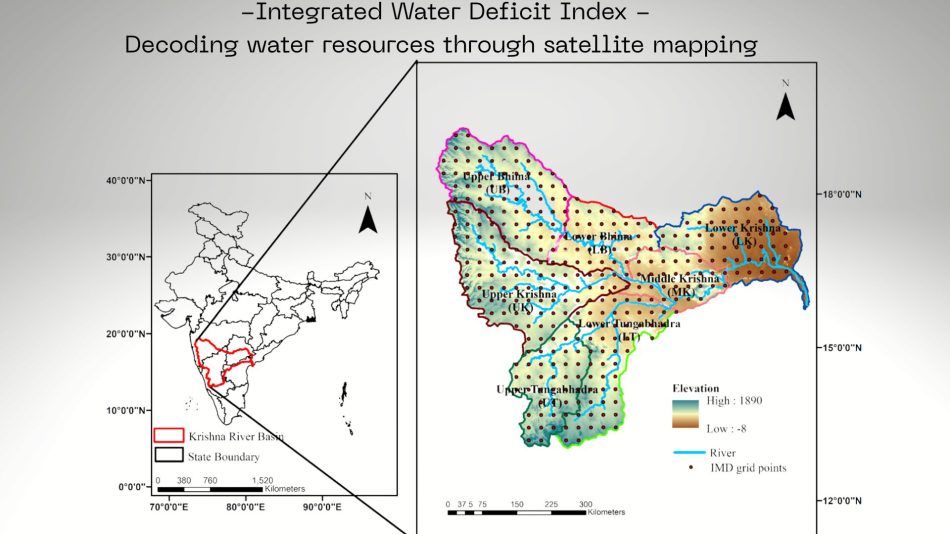
The IWDI was applied to the Krishna River Basin, a crucial water source for millions of people across four Indian states. The findings revealed significant patterns regarding drought impacts:
- Between 2002 and 2017, recent dry spells led to a 25% reduction in crop production.
- Vital water bodies in the region experienced a 15% decrease in volume.
- Higher elevation areas faced prolonged and severe droughts that took over a year to develop and recover from.
- Conversely, lower areas encountered frequent but shorter dry spells.
Additionally, the research highlighted that while a lack of rainfall initiates drought conditions, high temperatures and evaporation rates exacerbate the severity of these events.
Advantages of the IWDI
The IWDI offers a more accurate and holistic representation of extreme drought events compared to older models. By integrating both atmospheric conditions and underground water storage, this new index provides valuable insights for various stakeholders, including:
- Government agencies responsible for water management.
- Reservoir managers who oversee water supplies.
- Farmers who need to plan agricultural strategies based on water availability.
With the increasing frequency of severe droughts due to climate change, understanding the nuances of water resource depletion and recovery is essential for ensuring human survival and food security.
Challenges and Future Directions
Despite its advantages, the IWDI does face some limitations. The researchers noted challenges in accurately mapping the speed at which short, seasonal droughts develop and recover. False recovery events, such as brief rain showers that temporarily interrupt dry spells, complicate the analysis.
To address these challenges, the researchers emphasize the need for future studies to incorporate data with finer temporal resolution. This will enhance the understanding of seasonal variations and allow for more precise tracking of rapid changes in water availability.
Conclusion
The development of the Integrated Water Deficit Index by IIT Hyderabad marks a significant advancement in drought prediction and management. As climate change continues to impact weather patterns and water resources, tools like the IWDI are crucial for safeguarding communities against the devastating effects of drought and famine. By providing governments, reservoir managers, and farmers with the foresight needed to manage water supplies effectively, the IWDI plays a vital role in protecting vulnerable populations and ensuring sustainable agricultural practices.
Note: This article is based on research conducted by IIT Hyderabad and aims to highlight the importance of innovative approaches in addressing water scarcity and drought management.