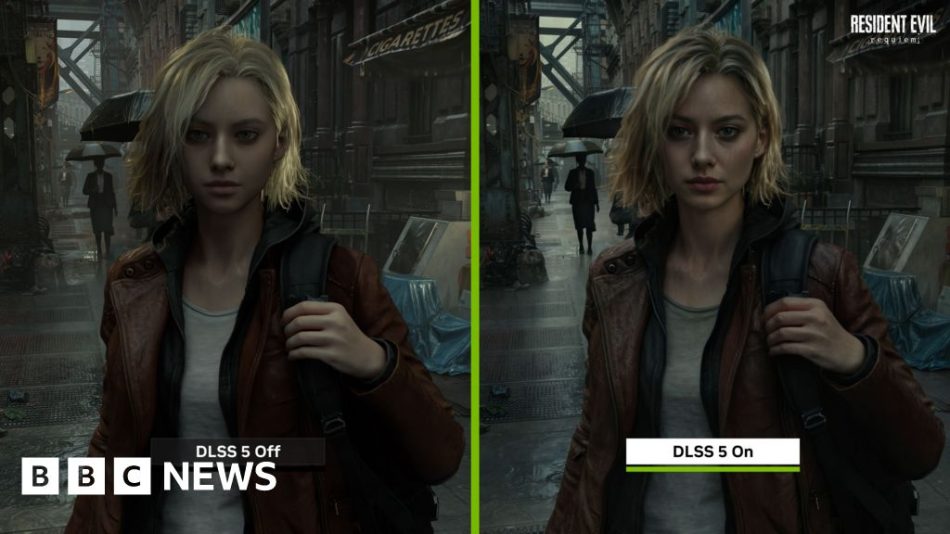
Nvidia faces backlash over 'breakthrough' AI graphics feature
Nvidia, a leading chip-maker known for its innovations in graphics technology, has recently unveiled a new feature that promises to revolutionize video game graphics. However, the announcement has sparked significant backlash from various segments of the gaming community. The feature, named DLSS 5, is touted as a tool that will enable cinematic-quality graphics in video games, but critics argue that its use of artificial intelligence (AI) may compromise artistic expression.
What is DLSS 5?
DLSS 5, which stands for Deep Learning Super Sampling, is Nvidia’s latest advancement in computer graphics technology. Scheduled for rollout in the autumn, this tool claims to provide “photoreal computer graphics” that were previously only achievable in Hollywood visual effects. Nvidia has showcased the capabilities of DLSS 5 through images from popular games such as Resident Evil Requiem and Hogwarts Legacy, highlighting how the technology can dramatically enhance the appearance of characters and environments.
Industry Reactions
Despite Nvidia’s optimistic portrayal of DLSS 5, reactions from industry professionals have been mixed. Some critics have expressed concerns that the AI-driven enhancements may lead to graphics that feel overly polished, lacking the depth and character of traditional game art. Video game critic Alex Donaldson commented on Bluesky, stating, “Clearly this is a massive glow-up for environments, but the character stuff is uncanny & weird tho, and it feels like artistic expression risks being squeezed out.” Similarly, Jeff Talbot, a concept artist at Gunfire Games, noted, “This is NOT the direction games should be going in. Each DLSS 5 shot looked worse and had less character than the original.”
Nvidia’s Vision
Nvidia has positioned DLSS 5 as a significant breakthrough in computer graphics, claiming it is the most important advancement since the introduction of real-time ray tracing in 2018. Ray tracing is a rendering technique that enhances the realism of light, shadows, and reflections in games. According to Nvidia’s CEO Jensen Huang, DLSS 5 aims to “reinvent computer graphics once again,” promising a “dramatic leap in visual realism while preserving the control artists need for creative expression.”
Support from Game Developers
Despite the backlash, Nvidia has garnered support from major game publishers and developers, including Bethesda, CAPCOM, and Warner Bros. Games. These companies believe that DLSS 5 can enhance the gaming experience by providing more immersive environments and realistic character representations. Charlie Guillemot, joint CEO of Vantage Studios, which is developing Assassin’s Creed Shadows, stated, “The way it renders lighting, materials, and characters changes what we can promise to players. On Assassin’s Creed Shadows, it’s letting us build the kind of worlds we’ve always wanted to.”
The Growing Debate Over AI in Gaming
The introduction of AI-generated content in video games has led to a broader debate within the gaming community. While some developers advocate for the use of AI as a means to push the industry forward, others express concern over its implications for creativity and artistic integrity. Instances of backlash against AI-generated content have emerged, with some studios even scrapping projects due to negative reception. For example, Running With Scissors, the publisher behind the Postal shooter franchise, canceled a forthcoming game after critics claimed it relied heavily on AI-generated graphics.
Conclusion
The controversy surrounding Nvidia’s DLSS 5 highlights the ongoing tension between technological advancement and artistic expression in the gaming industry. As developers continue to explore the possibilities offered by AI, the community remains divided on the implications of these innovations. The future of gaming graphics may very well depend on finding a balance that respects both technological progress and the unique artistic vision that defines the medium.
Note: The opinions expressed in this article do not necessarily reflect the views of Nvidia or any affiliated organizations. The discussion surrounding AI in gaming is complex and multifaceted, warranting ongoing dialogue among developers, critics, and players alike.