Race on to establish globally recognised 'AI-free' logo
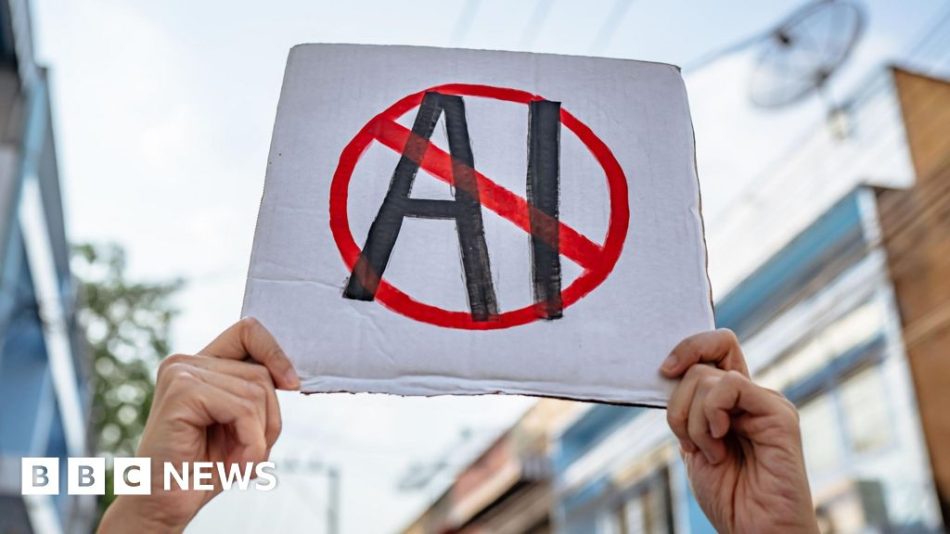
As the use of artificial intelligence (AI) continues to grow, organisations worldwide are racing to develop a universally recognised label for “human-made” products and services. This movement is part of a growing backlash against the increasing reliance on AI technologies across various industries.
The Emergence of AI-Free Labels
Labels such as “Proudly Human,” “Human-made,” “No A.I,” and “AI-free” are making their way into films, marketing materials, books, and websites. This trend is a direct response to concerns that jobs and entire professions may be at risk due to AI-powered automation.
According to reports, at least eight different initiatives are currently working to create a label that could achieve the same level of global recognition as the “Fair Trade” logo, which is synonymous with ethically produced goods. However, the presence of multiple competing labels and the ambiguity surrounding the definition of “AI-free” could lead to consumer confusion.
Expert Opinions on the Need for Standardisation
Dr. Amna Khan, a consumer expert from Manchester Metropolitan University, emphasises the importance of establishing a universal definition for “human-made” products. She states, “AI is creating significant disruption, and competing definitions of what is ‘human made’ are confusing consumers. A universal definition is essential to build trust, clarification, and confidence.”
How the Certifications Work
The certification systems vary significantly. Some labels, such as no-ai-icon.com, ai-free.io, and notbyai.fyi, can be downloaded for free or for a small fee, often without rigorous auditing. In contrast, platforms like aifreecert require payment and implement a strict vetting process to determine whether a product has used AI. This process often involves professional analysts and AI-detecting software.
However, experts in the field argue that reaching a consensus on what constitutes “human-made” will be challenging, especially as AI becomes increasingly integrated into everyday tools and services. Sasha Luccioni, an AI research scientist, notes, “AI is now so ubiquitous and so integrated into different platforms and services that it’s truly complicated to establish what ‘AI free’ means. I think that AI is a spectrum, and we need more comprehensive certification systems rather than a binary AI/AI-free approach.”
Generative AI and Its Implications
Some experts suggest that the line should be drawn at the use of generative AI—AI technologies that create text, code, music, or video based on human prompts. For instance, the 2024 Hugh Grant thriller “Heretic” included a disclaimer in its closing credits stating: “No generative AI was used in the making of this film.” This initiative has inspired the film distributor The Mise en scène Company to adopt a “No AI was used” stamp for its latest projects.
Paul Yates, CEO of The Mise en scène Company, explains, “We support the AI industry and think it’s an exciting time, but we believe that as a result of AI content, there is an economic premium placed on human-made content, and we want to lean into that.”
The Arts Industry and AI Disruption
The arts sector has become a focal point in the pushback against AI, with entire books and films being produced using AI technologies at a speed and cost that traditional methods cannot match. For example, Bollywood film studio Intelliflicks has gained attention for producing films entirely with generative AI tools.
However, the lack of transparency regarding AI’s role in certain products has raised concerns among consumers. A notable example is the viral band Velvet Sundown, which was revealed to be entirely AI-generated. In the publishing sector, Faber and Faber has begun to label some of its books with a “Human Written” stamp, although the criteria for this classification remain unclear.
Establishing Trust in Human Authorship
Books by People, a UK-based company, is advocating for a trusted standard to disclose human authorship. Co-founder Esme Dennys states, “Publishers are grappling with a new landscape where books can be produced in minutes rather than months or years, and readers can no longer be sure if a book reflects a human experience or machine imitation.” The company has already partnered with five publishers and issued its first stamp on the book “Telenova,” released in November.
In Australia, a competing initiative called Proudly Human employs a rigorous verification process to ensure that authors are not using generative AI. Their auditors conduct checks at every stage of publication, including any changes made from manuscript to ebook edition. Alan Finkel, the company’s CEO, believes that a certification of “human origin” is essential, stating, “Self-certification is not good enough, so we have a full verification process to ensure that it’s truly human-originated material.”
Conclusion
The race to establish a globally recognised “AI-free” logo reflects a growing concern about the implications of AI on creativity and employment. As various organisations strive to create a standard that consumers can trust, the challenge remains to define what constitutes “human-made” in an increasingly AI-driven world.
Note: This article is based on information available as of October 2023 and aims to provide an overview of the current landscape regarding AI-free certification initiatives.