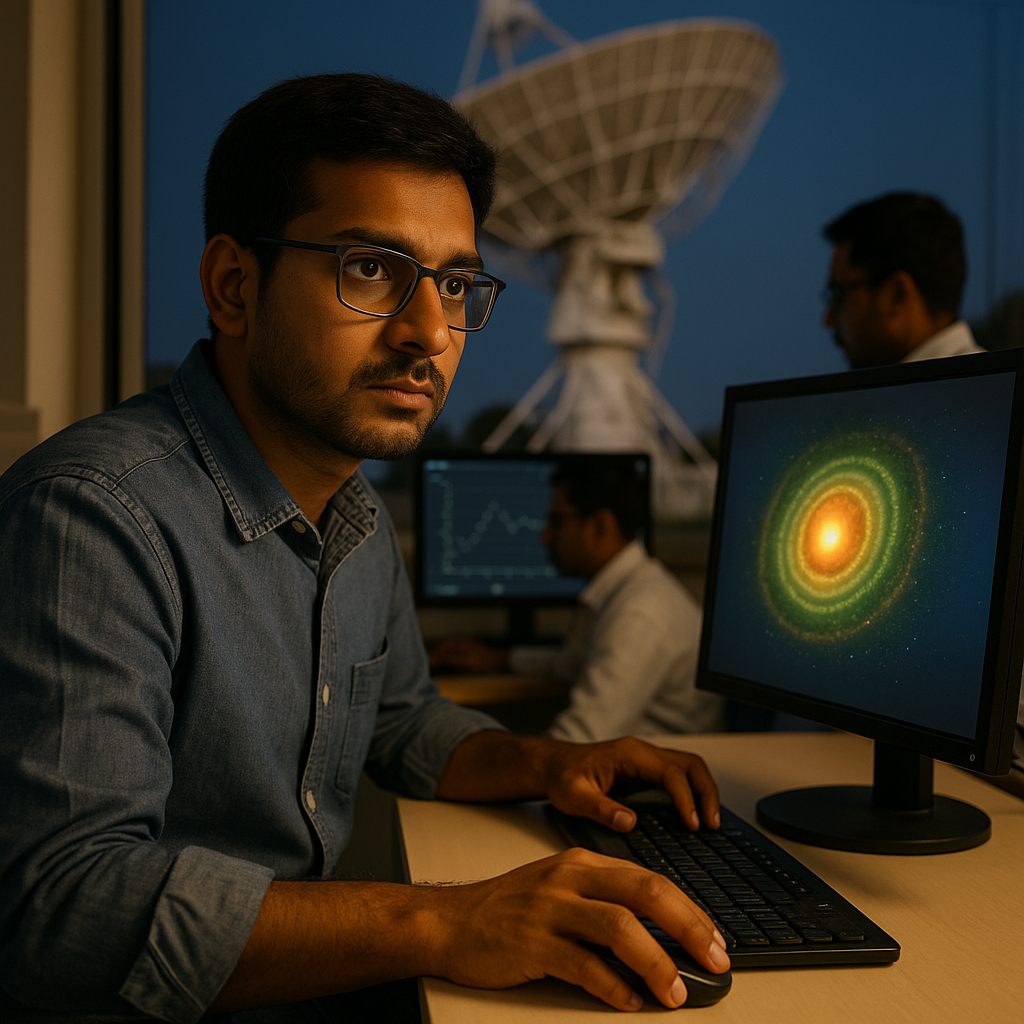
Indian astronomers including IIT-Kanpur develop pulsar method to measure distances
In a groundbreaking development, Indian astronomers, including a team from the Indian Institute of Technology (IIT) Kanpur, have devised a novel method to measure astronomical distances using pulsars. This innovative approach leverages the unique properties of pulsars, which are super-dense remnants of massive stars that emit radio waves in a highly regular manner.
Understanding Pulsars
Pulsars are neutron stars that have undergone a supernova explosion, resulting in a highly compact object with a mass greater than that of the Sun, but with a radius of only about 10 kilometers. The intense gravitational forces compress the matter to such an extent that it becomes incredibly dense, leading to the formation of a pulsar.
These celestial objects emit beams of electromagnetic radiation, including radio waves, that sweep across space as the star rotates. This rotation can be incredibly fast, with some pulsars spinning hundreds of times per second. The regularity of their signals makes pulsars act like cosmic clocks.
The New Method: Measuring Distances Using Pulsars
The research team from IIT Kanpur has developed a technique that utilizes the consistent radio signals emitted by pulsars to measure distances in space more accurately. The method involves tracking the changes in the pulsar signals as they pass through ionized gas clouds in our galaxy.
As these radio waves travel through space, they encounter various interstellar media, including clouds of ionized gas. These clouds can distort the signals, causing slight variations in the timing and frequency of the pulsar emissions. By analyzing these distortions, astronomers can gain insights into the properties of the intervening medium and, consequently, improve the accuracy of distance measurements.
Importance of Accurate Distance Measurements
Accurate distance measurements in astronomy are crucial for several reasons:
- Mapping the Universe: Understanding the scale and structure of the universe relies heavily on precise distance measurements.
- Cosmological Studies: Accurate distances help in determining the expansion rate of the universe and studying cosmic phenomena.
- Galactic Dynamics: Knowing distances to various celestial objects aids in understanding their motion and interactions within the galaxy.
Advancements in Cosmic Measurements
The new pulsar-based method represents a significant advancement in the field of astronomy. Traditional methods of measuring distances, such as parallax and standard candles, have limitations, especially when it comes to measuring vast cosmic distances. The pulsar technique offers a more reliable alternative, particularly for distances that are challenging to measure using conventional methods.
By enhancing our ability to measure distances, this research contributes to a more detailed understanding of the cosmos. It allows astronomers to create more accurate models of the universe, leading to better insights into its formation and evolution.
Challenges and Future Directions
While the pulsar method shows great promise, it is not without challenges. The variability of the ionized gas clouds and the need for precise timing measurements are critical factors that researchers must address. Additionally, the method requires a network of pulsars to provide a comprehensive understanding of the cosmic landscape.
Looking ahead, the research team aims to refine their technique and expand its application. By incorporating data from a larger number of pulsars and improving the technology used to detect and analyze their signals, astronomers hope to enhance the precision of their distance measurements even further.
Conclusion
The development of a pulsar-based method for measuring distances in space marks a significant milestone in astronomy. This innovative approach not only enhances our understanding of the universe but also paves the way for future discoveries. As researchers continue to refine this technique, we can expect to gain deeper insights into the cosmos and its intricate workings.
Note: This article is based on recent developments in the field of astronomy and reflects the ongoing efforts of Indian scientists to advance our understanding of the universe.