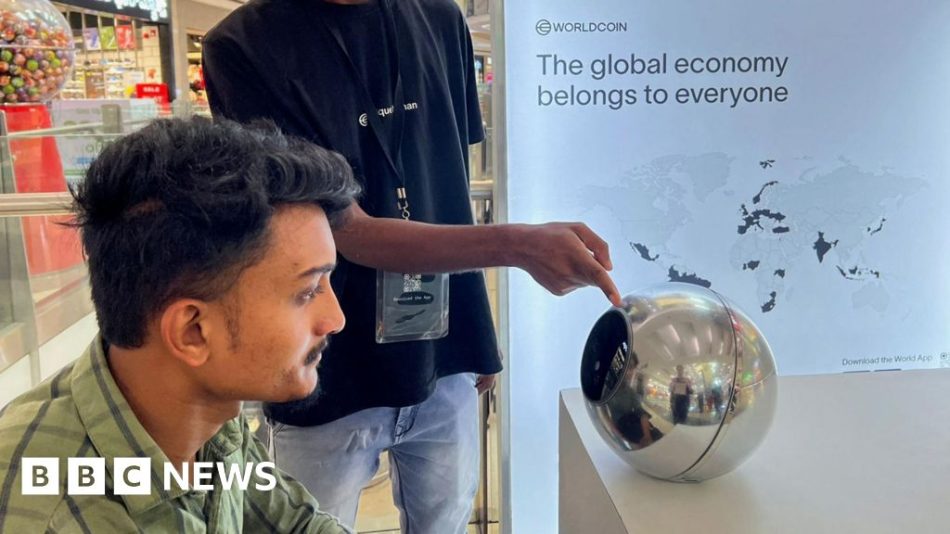
Tinder and Zoom offer 'proof of humanity' eye-scans to combat AI
Tinder and Zoom have announced a new initiative to combat the rising concerns over artificial intelligence (AI) impersonation by introducing advanced eye-scanning technology. This feature aims to allow users to prove their humanity and earn a “proof of humanity” badge that will be attached to their profiles.
Understanding the New Technology
Users of Tinder and Zoom will be able to scan their irises, the colored part of the eye, to confirm they are human. This process can be done through an online application or via a specialized orb-shaped scanning device developed by a company known as World, formerly known as Worldcoin. This startup is co-founded and chaired by Sam Altman, who is also the head of OpenAI, the organization behind ChatGPT.
How It Works
Once a user undergoes the iris scan and is confirmed as human, they will receive a unique identification code stored on their smartphone, referred to as their World ID. This new World ID app, along with partnerships with Tinder and Zoom, was unveiled during a live event in San Francisco. The event featured a video montage of historical journalists and public figures discussing the importance of identifying human users in an increasingly AI-driven world.
The Need for Verification
As AI technology continues to advance, platforms like Tinder and Zoom have faced increasing challenges with fake or malicious accounts. These issues have been exacerbated by the ability of AI to mimic human speech, voice, and appearance. For instance, Tinder has seen a rise in fake profiles, commonly referred to as “bots,” which are often used to scam users out of money or personal information. One user, Victoria Brooks, reported that she encountered a staggering 30% of profiles on Tinder that were “AI-enhanced, emotionally manipulative, algorithmically-optimized romance scammers.”
The Impact of Romance Scams
According to the Federal Trade Commission, romance scams led to losses exceeding $1 billion in the United States last year. In response to these challenges, Tinder has previously required users to submit a video selfie to verify their identity. The integration of World ID is seen as a natural progression to enhance user verification.
Zoom’s Concerns with Deepfakes
Zoom, primarily used for video conferencing, is particularly concerned about sophisticated deepfakes that can impersonate known individuals. A notable incident occurred in 2024 when a worker in Hong Kong was duped by deepfake videos of his company’s chief financial officer and other colleagues, resulting in a loss of $25 million. Research from Deloitte predicts that financial fraud involving deepfake technology could reach $40 billion in the United States by 2027.
World’s Unique Approach
The company behind the eye-scanning technology, World, has undergone several name changes. Initially launched as Worldcoin in 2022, it transitioned to World Network in 2024, and finally shortened to World. The iris is chosen for identification due to its uniqueness, which surpasses even that of fingerprints. The verification process is designed to be anonymous, requiring no personal information such as names or addresses.
Current Status of World ID
As of now, World claims that 18 million individuals have been verified through its World ID system, with users having utilized their verification over 450 million times. This growing user base highlights the increasing demand for secure and reliable identification methods in the digital age.
Future Implications
The introduction of eye-scanning technology by Tinder and Zoom signifies a proactive approach to safeguarding users against the threats posed by AI. Sam Altman, during the San Francisco event, expressed optimism about the future, stating, “I’m not afraid for the future as long as we can tell between the two,” referring to the distinction between human-generated and AI-generated content.
Conclusion
The integration of eye-scanning technology into popular platforms like Tinder and Zoom represents a significant step towards enhancing user security and trust in an era where AI’s capabilities are rapidly advancing. As these technologies evolve, they may play a crucial role in preserving authentic interactions in both dating and professional environments.
Note: The information presented in this article is based on recent developments and may be subject to change as new technologies emerge and evolve.