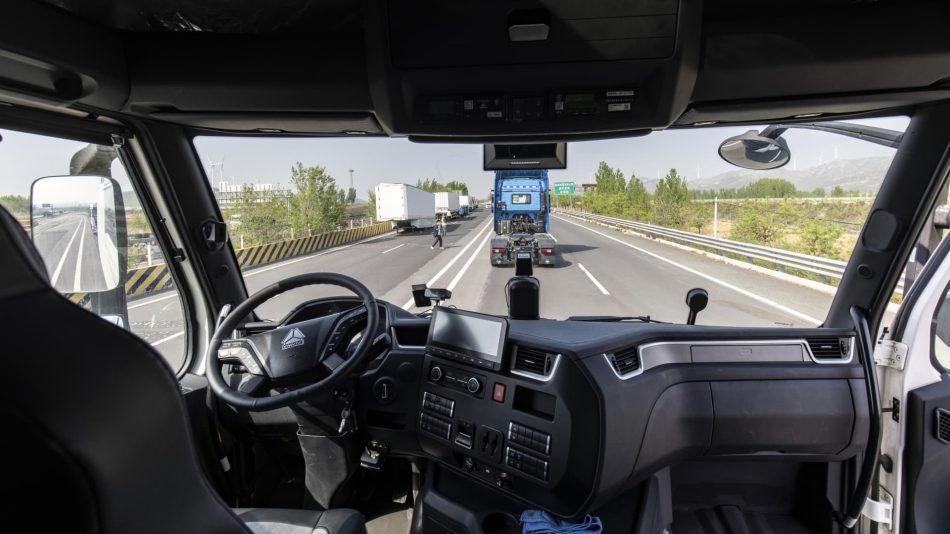
China’s self-driving truck leaders say AI breakthroughs won’t accelerate rollout
In recent discussions, leaders from China’s autonomous trucking industry have expressed skepticism regarding the impact of recent advancements in artificial intelligence (AI) on the rollout of self-driving trucks. Despite the rapid development of AI technologies, particularly in large language models, these advancements do not directly translate into faster deployment of autonomous vehicles on the roads.
The Disconnect Between AI Developments and Autonomous Driving
James Peng, CEO of Pony.ai, articulated this disconnect by stating, “The world’s best linguistics [expert] doesn’t mean he’s a good driver.” He emphasized that AI encompasses a broad range of technologies, and improvements in one area, such as language processing, do not necessarily correlate with advancements in another, such as autonomous driving.
Autonomous driving relies on a different set of skills and technologies, including a combination of sensors, chips, and algorithms that work together to replicate human driving capabilities. The training data required for autonomous vehicles is distinct from that which powers large language models like OpenAI’s ChatGPT. This data is often referred to as “world models,” which are crucial for the development of self-driving technology.
Inceptio’s Timeline for Commercialization
Inceptio, a prominent self-driving truck startup in China, maintains its timeline for commercialization, targeting mid-2028 for the rollout of fully autonomous heavy-duty trucks. CEO Julian Ma stated that the company aims to accumulate 5 billion kilometers (approximately 3.1 billion miles) of driving data by the third or fourth quarter of 2028. This extensive data collection is essential for enabling trucks to operate autonomously on public roads.
Ma explained that with 5 billion kilometers of collected data, AI can extrapolate this into 50 billion kilometers of experience within a world model. This extensive experience is deemed sufficient for autonomous trucks to navigate without human intervention in specific regions of the country.
The Importance of Data Collection
Data collection is a critical component of developing autonomous vehicles. Similar to robotaxi companies, self-driving truck operators conduct manned tests to gather training data safely. Inceptio has recorded the most commercial autonomous truck miles in the industry, surpassing its U.S. counterparts. According to ARK Invest’s Big Ideas 2026 report, Inceptio had driven 250 million miles, significantly more than Pony.ai, which had recorded 4.2 million miles.
As of late April, Inceptio’s trucks had driven 700 million kilometers (approximately 434.96 million miles), with a goal of reaching 1 billion kilometers (about 621.4 million miles) by the end of the year. The company utilizes AI to identify specific scenarios that require additional test data, enhancing the efficiency of their data collection efforts.
Technological Advancements and Regulatory Challenges
Pony.ai has also announced upgrades to its AI model, PonyWorld 2.0, aimed at improving data collection and training efficiency. The company, which operates robotaxis in China and other countries, recently unveiled a fully driverless light-duty truck developed in collaboration with battery manufacturer CATL.
Despite the rapid expansion of U.S. and Chinese robotaxi companies, regulatory challenges remain a significant hurdle. Reports indicate that Chinese authorities have suspended new autonomous driving licenses following incidents involving Baidu’s Apollo Go robotaxis, which experienced malfunctions and collisions in Wuhan. Similarly, a power outage in San Francisco caused autonomous vehicle operator Waymo’s fleet to stall across the city.
Innovation Driven by Companies
While China has established five-year development plans emphasizing technological goals, Ma asserts that it is often the companies themselves that drive innovation in the field. “We make it happen,” he stated, highlighting the need for companies to demonstrate technology in action before regulators can provide the necessary policy support.
However, experts agree that there is still a long way to go before fully autonomous trucks and cars become a common sight on the roads. Ma noted, “Automobiles are actually the most challenging area for AI, and exceeds the difficulty of embodied AI to some extent, because it involves safety.” This complexity underscores the need for thorough testing and regulatory approval before widespread deployment can occur.
The Future of Autonomous Trucks in China
As the industry continues to evolve, the timeline for the rollout of autonomous trucks remains uncertain. While advancements in AI are promising, they do not eliminate the need for extensive data collection, rigorous testing, and regulatory compliance. The path to fully autonomous vehicles will require collaboration between technology companies, manufacturers, and regulatory bodies to ensure safety and efficiency.
In conclusion, while the rapid pace of AI development is exciting, it is essential to recognize that the journey towards fully autonomous trucks involves a multitude of factors beyond just technological innovation. The focus must remain on gathering real-world data, ensuring safety, and navigating regulatory landscapes to achieve successful deployment.
Note: The information presented in this article is based on industry insights and developments as of April 2026.