How a Dikshitar Celebration at IIT Madras Turned Into a Platform for Pseudoscience
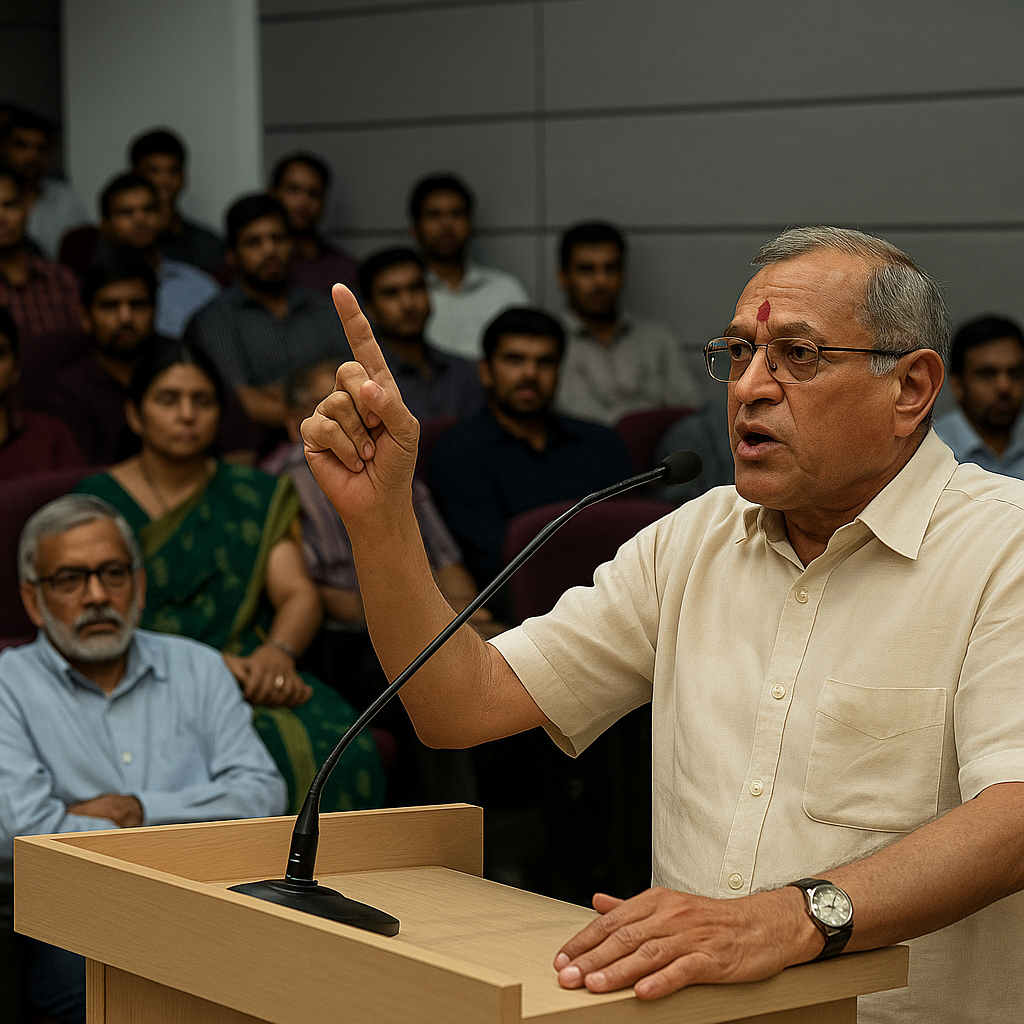
For decades, Carnatic music has been a source of inspiration for many, with composers like Muthuswamy Dikshitar leaving a profound impact on listeners. His compositions, such as “Sri Kantimathim,” resonate deeply with admirers, reflecting a cultural legacy that is cherished across generations. Therefore, the announcement by IIT Madras to celebrate the 250th birth anniversary of Dikshitar on March 23 was met with enthusiasm. However, what transpired during this celebration was unexpected and troubling, as the event became a platform for pseudoscience rather than a tribute to music.
The Speaker: S. Gurumurthy
S. Gurumurthy, an ideologue associated with the Rashtriya Swayamsevak Sangh (RSS) and editor of the Tamil magazine Thughlak, was invited to speak at the event. His speech, available on YouTube, quickly shifted from celebrating music to promoting dubious claims under the guise of intellectual discourse. Despite admitting his lack of expertise in both science and music, Gurumurthy proceeded to make sweeping assertions that drew from both fields.
Misunderstanding Science and Music
Gurumurthy began his address by urging the audience to “empty” their thoughts, referencing a questionable anecdote from the life of Sri Aurobindo. This notion of “emptying” one’s mind is scientifically unfounded, as thought is a continuous cognitive process. He further claimed that the Newtonian worldview obscures reality, a statement that reflects a lack of understanding of both science and philosophy.
Questionable Historical References
During his speech, Gurumurthy referenced two books that he believed illustrated the influence of Hindu philosophy on Greek thought: India in Greece or, Truth in Mythology by E. Pococke and The Shape of Ancient Thought: Comparative Studies in Greek and Indian Philosophies by Thomas McEvilley. However, he misrepresented both authors. Pococke was an Englishman, and McEvilley was an American, neither of whom were Greek. Furthermore, Pococke’s theories are largely discredited in modern scholarship, while McEvilley’s work is recognized for its scholarly rigor, emphasizing the interconnectedness of ancient philosophies without endorsing Gurumurthy’s one-sided claims.
Scientific Inaccuracies
Gurumurthy made several incorrect assertions regarding scientific concepts. He mistakenly attributed the discovery of thermodynamic theory to Newton, a claim that would likely confuse even a high school student. Additionally, he inaccurately placed Erwin Schrödinger’s birth in 1867, twenty years before he was actually born.
Misrepresenting the Universe
One of the most egregious claims made by Gurumurthy involved the nature of the universe. He referenced the NASA sonification of the Big Bang, suggesting that the sound produced was akin to the ‘Om’ sound from the Vedas and Upanishads. This interpretation is misleading; sound cannot travel through the vacuum of space. The early universe was a hot, dense plasma that supported pressure waves, which can be translated into audible frequencies, but this does not equate to a specific Sanskrit syllable.
Furthermore, Gurumurthy stated that “the universe is empty,” a misrepresentation of scientific understanding. Modern physics does not claim that the universe is devoid of substance; rather, it describes a universe filled with invisible fields, such as the Higgs field, which are not classified as matter but are crucial to the existence of particles.
The False Connection Between Science and Spirituality
Gurumurthy’s assertion that modern science supports the idea that matter originates from “non-matter” or Brahman is fundamentally flawed. While it may sound appealing, it lacks scientific validity for several reasons:
- Falsifiability: There is no empirical method to disprove the claim that the universe is merely a dream of Brahman.
- The Consciousness Problem: Current scientific understanding suggests that consciousness arises from complex matter, not the other way around.
- Mechanism: Science demands a repeatable, mathematical explanation for phenomena, which is not provided by philosophical texts.
Gurumurthy attempted to bolster his arguments by invoking the names of renowned scientists like Roger Penrose, Erwin Schrödinger, and Werner Heisenberg. However, these scientists viewed the Vedas and Upanishads as metaphysical frameworks rather than empirical scientific texts. Their insights do not validate Gurumurthy’s claims but rather highlight the philosophical nature of their work.
The Impact of Pseudoscience
The conflation of science and spirituality, as demonstrated by Gurumurthy’s speech, poses a significant threat to public understanding of science. Pseudoscience can erode trust in genuine scientific expertise, leading to confusion and misinformation. It is crucial for academic institutions to uphold the integrity of scientific discourse, especially in settings that are meant to celebrate cultural and intellectual achievements.
Conclusion
The celebration of Muthuswamy Dikshitar at IIT Madras was intended to honor a significant cultural figure, but it was overshadowed by the promotion of pseudoscience. The event serves as a reminder of the importance of critical thinking and the need to differentiate between genuine scientific inquiry and unfounded claims. As we navigate the complexities of modern knowledge, it is essential to foster an environment that values empirical evidence and intellectual rigor.
Note: The views expressed in this article are based on the analysis of the event and do not necessarily reflect the opinions of all attendees or participants.