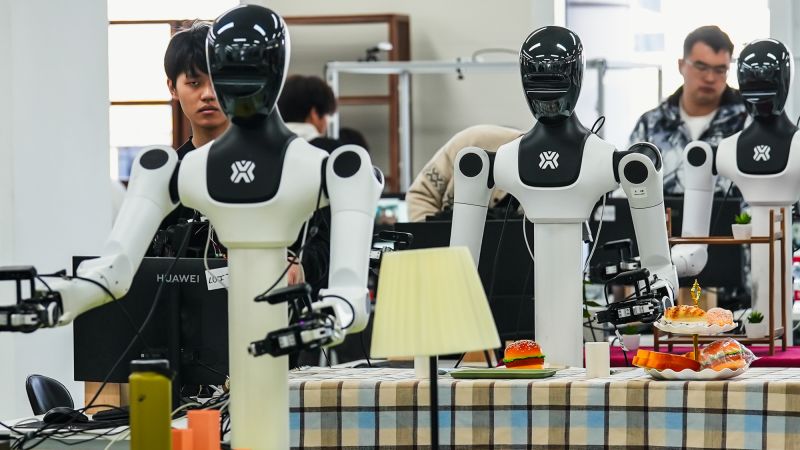
How filming your chores could train the android butlers of the future
As technology advances, the dream of having humanoid robots assist in our daily lives is becoming increasingly feasible. The rise of artificial intelligence (AI) has opened up new opportunities for the development of general-purpose robots capable of performing a variety of tasks in homes, offices, and shops. However, to achieve this goal, a significant amount of data is required to train these robots effectively. One innovative solution is the concept of filming everyday chores to generate valuable training data.
The Need for Data in Robotics
The development of humanoid robots has become a competitive field, with numerous companies striving to create models that can walk, dance, and perform various tasks with agility. Yet, the ultimate challenge lies in creating robots that can seamlessly integrate into human environments. To accomplish this, developers need extensive data that captures the nuances of human movements and interactions.
What is Egocentric Data?
In the context of robotics, the term “egocentric data” refers to first-person footage that provides insights into how humans perform tasks. This type of data is crucial for training robots to understand and replicate human actions safely and effectively. Startups have emerged to collect and annotate videos from individuals recording themselves while completing mundane household tasks, such as cooking, cleaning, and gardening.
The Role of Remote Videographers
Companies like Micro1 have begun recruiting individuals to serve as remote videographers. These workers are provided with headgear to attach a camera, filming instructions, and a list of chores to complete. Each videographer is expected to submit a minimum of 10 hours of video footage per week, capturing various household activities. This initiative not only generates valuable data for training robots but also creates a new type of job in the process.
Filming Instructions and Tasks
Videographers are encouraged to film a wide range of activities, as the more diverse the data, the better the robots can adapt to different environments. Arian Sadeghi, the vice president of robotics data at Micro1, emphasizes the importance of variety in the footage collected. He states, “If you think you want a robot to do this for you, go ahead and record it.” This approach allows for a broader understanding of how tasks can vary across different households and cultures.
The Demand for Data
Despite the current efforts, the demand for training data remains immense. Micro1 currently has around 4,000 remote videographers across 71 countries, generating over 160,000 hours of video each month. However, Sadeghi notes that this is only a fraction of what is needed, estimating that billions of hours of footage will be required to train robots effectively.
Comparing AI Training Approaches
The data requirements for training robots differ significantly from those of AI models like ChatGPT. While ChatGPT was trained on vast amounts of text data sourced from the internet, robot developers require a more specific set of training data tailored to physical tasks. This presents a unique opportunity for startups focused on data collection and annotation, with market research firms predicting that the data collection industry will grow at an average rate of 30% annually, reaching at least $10 billion by 2030.
Challenges in Data Collection
Ravi Rajalingam, founder of the data annotation company Objectways, highlights the challenges in collecting usable footage. After shifting his focus to robotics, he found that only about half of the submitted videos were suitable for training purposes. Despite this, there is a willingness among companies to pay a premium for data collected from US households, as they believe that American consumers will adopt humanoid robots more quickly than those in other regions.
The Importance of Cultural Context
Rajalingam points out that cultural differences play a significant role in the types of tasks and tools used in different regions. For instance, a kitchen in India may differ greatly from one in the US, and even common tools like broomsticks can vary in design and usage. This diversity emphasizes the need for a wide-ranging data collection strategy that considers various cultural contexts.
The Future of Household Robots
As the demand for humanoid robots continues to grow, the methods of training these machines will evolve. Traditionally, robots were trained using remote controls, which required expensive hardware and was not scalable. The new approach of using filmed data allows for a more cost-effective and efficient training process.
Potential Applications
The potential applications for trained humanoid robots are vast. They could assist in various settings, including:
- Household chores
- Retail environments
- Healthcare facilities
- Manufacturing and warehousing
Each of these environments presents unique challenges that require tailored training data to ensure robots can perform tasks safely and effectively.
Conclusion
Filming everyday chores represents a groundbreaking method for generating the data necessary to train the android butlers of the future. As more individuals participate in this initiative, the potential for creating robots that can seamlessly integrate into our daily lives becomes increasingly attainable. The collaboration between humans and technology is paving the way for a future where robots can assist us in ways we have only dreamed of.
Note: The information presented in this article is based on current trends and projections in the field of robotics and artificial intelligence.