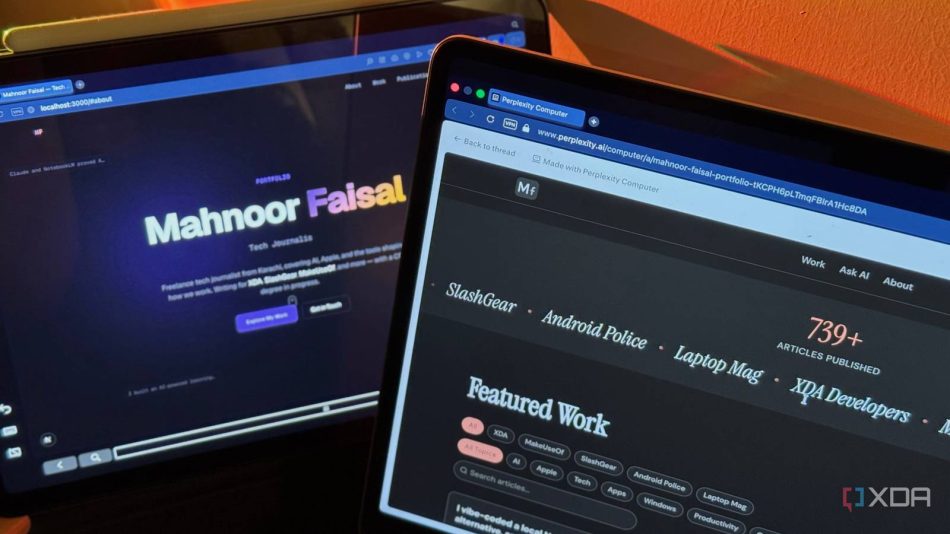
I used Claude Code, Antigravity, and Perplexity Computer to build a portfolio — there was a clear winner
By Mahnoor Faisal, Published April 5, 2026
Introduction
In recent years, web development has undergone a significant transformation. Gone are the days when building a website required a deep understanding of HTML and CSS. With the advent of user-friendly platforms like Wix and Squarespace, creating a visually appealing website has become as simple as dragging and dropping elements. Today, we are witnessing the rise of AI-driven tools that allow users to describe their desired website, which the AI then builds for them. This article explores my experience using three such tools—Claude Code, Antigravity, and Perplexity Computer—to create a personalized portfolio website.
Setting the Stage
As a tech journalist with a growing body of work, I have long wanted to create a portfolio website. However, my busy schedule often left me with little time to learn the intricacies of web development. This prompted me to test the capabilities of three AI tools by providing them with the same prompt and instructions to build my portfolio.
The Objective
I aimed to create an interactive portfolio that featured:
- Fluid animations
- A section showcasing my published work
- An integrated AI chatbot for readers to ask questions about my work
Methodology
To ensure a fair comparison, I used the same process across all three tools. First, I instructed each tool to gather as much information about me as possible. I specified that I am a journalist and asked them to find my published work online. Once they completed their research, I provided them with the same detailed prompt describing the desired portfolio website.
Evaluation Criteria
I judged the outputs based solely on the first version produced by each tool, without any edits or follow-up prompts. This approach allowed me to assess their initial capabilities without any influence from additional instructions or modifications.
Tool Performance
Perplexity Computer
Perplexity Computer stood out in this experiment. Although it took the longest to conduct its research, the depth and breadth of information it provided were impressive. It not only gathered data from my published articles but also scoured my social media profiles, including Instagram and Twitter. To my surprise, it even uncovered features about my work that I was unaware of, such as mentions on the Authory website.
The final output from Perplexity was a well-structured portfolio that met all my requirements. The interactive elements and fluid animations were seamlessly integrated, and the AI chatbot functioned effectively, allowing users to engage with my work in a meaningful way.
Claude Code
Claude Code, developed by Anthropic, is designed primarily for coding and development tasks. While it performed adequately, it did not quite match the level of detail provided by Perplexity. The initial version of the portfolio was functional but lacked some of the interactive features I had envisioned. The AI chatbot was present but required additional prompts to function optimally.
Antigravity
Antigravity also performed reasonably well, but like Claude Code, it fell short of the expectations set by Perplexity. The portfolio created was visually appealing but lacked the depth of content and interactivity that I desired. The AI chatbot was included but needed further refinement to enhance user engagement.
Conclusion
After testing all three tools, it became clear that Perplexity Computer was the standout performer. Its ability to gather comprehensive information and create a detailed, interactive portfolio surpassed the capabilities of Claude Code and Antigravity. While both of the latter tools have their strengths, they did not deliver the same level of depth and functionality as Perplexity.
Future of AI in Web Development
The advancements in AI-driven web development tools are exciting and hold great promise for the future. As these technologies continue to evolve, we can expect even more sophisticated features and capabilities. For those who may not have the time or skills to build a website from scratch, these AI tools offer a viable solution, allowing users to focus on ideation and creativity rather than technical details.
Note: This article reflects my personal experience and evaluation of the tools mentioned. Individual results may vary based on specific use cases and requirements.