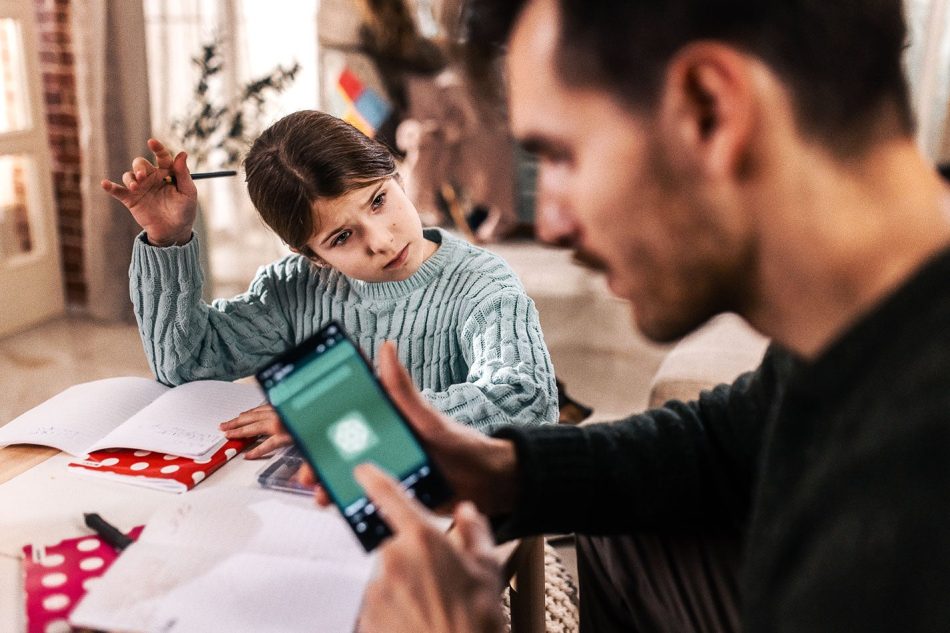
I Used to Love Turning to My Dad for Advice. Guess Who He Wants Me to Ask Now.
My father-daughter bond is on the verge of breaking. It’s ChatGPT’s fault—and I’m not alone.
The Shift in Our Relationship
Like many twentysomethings, I often turn to my dad for advice. Whether it’s about an easy weeknight recipe, fixing a leak under the sink, or understanding “federal withholding,” he used to have the answers. However, lately, his response has been simple: “Ask ChatGPT.”
My dad, 57, became captivated by ChatGPT last year and hasn’t looked back. He uses it for everything, from home repairs and online shopping to weather reports and even planning hiking trips. This is a stark contrast to my childhood, where he would meticulously plan our trips with a map in one hand and a travel guide in the other.
When I asked him if he missed the old way of doing things, he shrugged and said, “The books were always getting outdated and they never had all the information. It’s like being nostalgic for a rotary telephone.”
Breaking Tradition
During my visits home, I’ve noticed a change in how he approaches cooking. He still introduces the meal as he always has, but now he acknowledges his sous-chef, ChatGPT, who developed the recipe. My dad holds up his phone at the dinner table, allowing a robotic voice to read the answers to his questions. It’s annoying and breaks my heart a little.
Why does he need artificial intelligence for tasks he’s always been capable of? It feels as though he has adopted a robot child, and this new “child” threatens to create a divide between us.
A Generational Divide
My dad is surprised by my aversion to ChatGPT; it’s usually the younger generation that is tech-savvy. According to a 2025 Pew Research Center survey, only 25 percent of U.S. adults aged 50 to 64 have used ChatGPT, compared to 58 percent of adults under 30. Statistically, I should be the one using ChatGPT at the dinner table.
But my father is not alone in this trend. Many parents have become enamored with ChatGPT, leading to a phenomenon dubbed “ChatGPDads” by TikTok users. These parents often express a sense of wonder, exclaiming, “Can you believe it can do that?” or proudly stating, “Chat did this for me.” This fascination can be endearing, yet it also raises concerns among their children.
Practical Uses of AI
While there are practical uses for AI, older generations are also being encouraged to use this technology in their professional lives. For instance, Ken Potter, a 61-year-old real estate developer, shared how he uses large language models to create visual representations of dilapidated rooms for contractors. He also employs AI to better understand his teenage daughter, seeking advice on her behavior.
“She doesn’t know this, but sometimes she’ll do something and I just don’t get it. So I’ll ask it for advice and it’ll give me a bit more of her perspective,” he explained.
Creative Concerns
As a writer, I worry about the implications of AI on creative jobs. Meanwhile, my dad has started using ChatGPT to write jokes. When a friend asked whether he should serve bacon at his son’s bar mitzvah, my dad rushed to ChatGPT for a humorous line. He settled on: “Oy vey! Who knew the Torah portion came with a side of barbecue sauce?”
Across social media, people have shared stories of their parents sending them AI-generated images, silly videos, and even songs. One daughter mentioned waking up to a new AI-generated song based on their text messages every morning, which left her perplexed given her dad’s artistic background.
Different Perspectives on Technology
While the capabilities of large language models are impressive, they don’t inspire the same awe in me as they do in my dad. My generation has grown up with technology that has evolved rapidly, leading to a more cautious approach to new tools like ChatGPT. We were taught to be wary of plagiarism and misinformation, making us more critical of AI’s role in our lives.
Elaine Kasket, a cyberpsychologist, notes that Gen Xers, like my dad, experienced the rise of computers and cell phones, making them more excited about technology than older generations. In contrast, only 10 percent of adults aged 65 and older have tried ChatGPT, according to the same Pew Research Center study.
Concerns from the Younger Generation
Many young people are concerned about their parents’ reliance on AI. Athena, an 18-year-old, expressed her worries about her father suggesting she use ChatGPT for her college essays and stand-up comedy sets. She fears that his dependence on AI diminishes his critical thinking skills.
Similarly, Ves Trujillo Navarro, 17, noted that her parents, who once monitored her screen time, now rely heavily on their phones. They even use ChatGPT for directions, despite it lacking GPS capabilities. “Why wouldn’t we use Google Maps? I think they forget that there are other ways to function,” she remarked.
Conclusion
As technology continues to evolve, the dynamics of parent-child relationships may shift significantly. While AI can offer practical solutions, it also raises questions about the value of human interaction and critical thinking. My dad’s reliance on ChatGPT has changed how I view our relationship, making me long for the days when he was my go-to source for advice.
Note: The relationship between technology and personal connections is complex and evolving. As we navigate these changes, it is essential to find a balance that honors both innovation and the meaningful bonds we share with our loved ones.