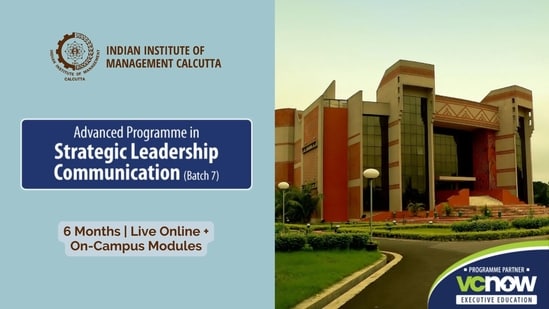
IIM Calcutta’s Advanced Programme in Strategic Leadership Communication: Reframing the language of leadership
In today’s complex corporate landscape, the role of communication in leadership has evolved significantly. For senior leaders, the most challenging aspect of their role is no longer merely deciding what actions to take; it is about effectively mobilizing their organizations to align, commit, and act amidst uncertainty. Strategies often fail not because they are inherently flawed, but because they are misunderstood, contested, or lack genuine ownership. In boardrooms and leadership teams, the outcomes are increasingly shaped by how decisions are framed, how trade-offs are discussed, how dissent is managed, and how meaning is constructed among stakeholders.
Overview of the Advanced Programme in Strategic Leadership Communication (APSLC)
The Advanced Programme in Strategic Leadership Communication (APSLC) at IIM Calcutta is a unique six-month initiative designed specifically for senior professionals with over five years of experience. This program, delivered in partnership with VCnow, aims to help corporate leaders develop strategic communication capabilities and enhance their executive presence.
Communication has become the operating system of leadership, not merely in terms of performance or polish, but as a foundational element that shapes decision-making. Leaders utilize communication as a strategic system to influence outcomes in complex environments characterized by conflict, data, digital channels, and the growing impact of artificial intelligence.
Transforming Communication into a Strategic Tool
One of the primary goals of the APSLC is to redefine communication from being a mere act of expression to becoming a critical infrastructure for leadership. Experienced leaders frequently communicate, but their instinctive approach may lack the structure necessary for effective leadership. Participants in the program report a significant shift from relying on intuition to employing deliberate design in their communication strategies.
Sam B., a participant and Co-Founder of Creator Engine, emphasizes this transformation: “What changed for me was learning to break communication down into frameworks. Instead of relying on instinct, I now have a structure I can apply, whether it’s conflict in a team, public speaking, or feedback conversations.” This architectural approach is a hallmark of the program’s multidisciplinary curriculum.
Multidisciplinary Curriculum
The APSLC curriculum draws on a wide range of disciplines, including:
- Behavioral Economics
- Law
- Psychology
- Humanities
- Marketing
- Corporate Communication
- Analytics
- Digital Media
Participants learn to view communication as a system that encompasses context, stakeholders, incentives, timing, medium, narrative, evidence, and follow-through. This approach fosters repeatability, enabling leaders to construct influence deliberately rather than leaving it to chance.
Designing Leadership Influence through Communication
Senior leaders often find that their primary challenge is not being heard, but rather shaping decisions when interests diverge, uncertainty is high, or authority is diffused. In these scenarios, effective persuasion is less about rhetoric and more about the architecture of communication. This includes how choices are presented, how trade-offs are articulated, and how coalitions are built.
Ganesh Pai, a participant and consultant at Finnosights Consulting LLP, reflects on his experience: “The real shift for me was learning to align every message with the stakeholder’s perspective, purpose, and business outcome. Communication stops being about delivery and starts being about design.” This program equips participants with a new toolkit and lens through which to view their communication strategies.
Building Credibility through Narrative and Data
In complex organizations, where data is abundant but attention is scarce, leaders must balance rigor with persuasion. The APSLC emphasizes the importance of narrative and storytelling in communication. Facts alone are insufficient; they require structure, context, and relevance to resonate with decision-makers.
Participants work on developing contemporary leadership narratives, connecting strategy to reality, presenting data as a compelling case for action, and maintaining credibility even when delivering difficult messages. The program includes studying great communicators, dissecting their arguments, and practicing how to convey complex ideas in a clear and impactful manner.
Kranti Khanolkar Sety, a Senior President & Group Head at Svatantra Microfin Pvt. Ltd., captures the essence of this shift: “When you communicate, there are many things you’re unaware of, especially how your audience is actually hearing you. The frameworks helped me move from speaking to designing how messages land.”
Managing Conflict and Dissent as a Leader
In the realm of leadership, influence serves as the architecture of movement, while conflict acts as a stress test. Modern leaders navigate a landscape filled with diverse functions, cultures, and competing priorities. Disagreement should not be viewed as a failure but rather as an inherent aspect of leadership.
The APSLC equips leaders with strategies to navigate these challenges effectively. By understanding the dynamics of conflict and dissent, leaders can foster an environment where constructive dialogue leads to better decision-making and alignment among stakeholders.
Conclusion
The Advanced Programme in Strategic Leadership Communication at IIM Calcutta offers a transformative experience for senior leaders looking to enhance their communication skills. By reframing communication as a strategic tool, participants learn to influence outcomes, build credibility, and navigate complex organizational dynamics. The program’s multidisciplinary approach ensures that leaders are well-equipped to tackle the challenges of modern leadership.
Note: The information presented in this article is based on the latest updates from IIM Calcutta and is intended for informational purposes only.