IIT Bhilai Develops Dual-Trigger 4D Polymer
Raipur: A research team from the Indian Institute of Technology (IIT) Bhilai has made a significant advancement in the field of smart materials by developing next-generation 4D-printed polymer materials. These innovative polymers can change shape in response to two different triggers: temperature and pH. This breakthrough opens up exciting possibilities for advanced medical devices and implants.
Understanding 4D Printing
4D printing is an extension of 3D printing technology, where the printed objects can change their shape or properties over time in response to external stimuli. The fourth dimension refers to the time aspect, allowing materials to adapt and transform after they have been printed. This technology has the potential to revolutionize various fields, including medicine, robotics, and engineering.
The Research Team
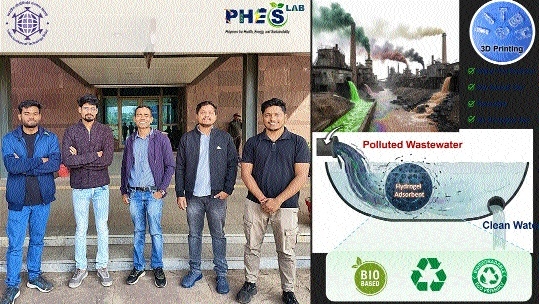
The research was conducted by a dedicated team at IIT Bhilai, consisting of:
- Bhanendra Sahu
- Nishikanta Singh
- Sudipta Paul
- Dr. Sanjib Banerjee
Dr. Banerjee, a key figure in this research, emphasized the uniqueness of their 4D-printed smart polymer, stating, “Our material is special because it can respond to two different triggers—temperature and pH—and remember and return to its original shape when triggered.”
Properties of the 4D Polymer
The newly developed polymer exhibits several remarkable properties:
- Flexibility: The material can bend and fold, allowing it to adapt to various conditions.
- Strength: Despite its flexibility, the polymer is strong and durable.
- Programmability: It can be programmed to respond to specific stimuli, making it versatile for different applications.
- Memory Effect: The polymer can “remember” its original shape and revert to it when the triggering conditions change.
Potential Applications
The implications of this research are vast, particularly in the medical field. Some potential applications include:
- Minimally Invasive Surgeries: The smart polymer can be used in devices that change shape to navigate through the body more easily.
- Targeted Drug Delivery: The material can self-open and release medication at precise locations within the body, improving treatment efficacy.
- Adaptive Prosthetics: Prosthetic devices made from this polymer could adjust their shape in response to body heat, providing a more natural movement.
- Injectable Bio-Robots: The technology could lead to the development of bio-robots that can be injected into the body and perform specific tasks.
The Science Behind It
Dr. Banerjee elaborated on the scientific principles underlying their research. The technology relies on a phenomenon known as “shape memory.” When the polymer is heated to approximately 44 degrees Celsius, its inner polymer chains become flexible. This flexibility allows the material to “remember” the original shape it was programmed into. As it cools down, it locks back into that programmed form.
Future Prospects
The research team is optimistic about the future of their innovation. Dr. Banerjee mentioned that if further studies on biocompatibility and large-scale manufacturing progress smoothly, they could see early prototype devices within the next few years. The potential for clinical or commercial use is also on the horizon, which could significantly impact the healthcare industry.
Conclusion
The development of this dual-trigger 4D polymer at IIT Bhilai represents a significant leap forward in smart material technology. With its ability to respond to multiple stimuli and its potential applications in medicine, this innovation could pave the way for a new era of biomedical devices that are not only effective but also adaptable to the needs of patients.
Note: The information presented in this article is based on the latest research findings and is subject to change as further studies are conducted.