
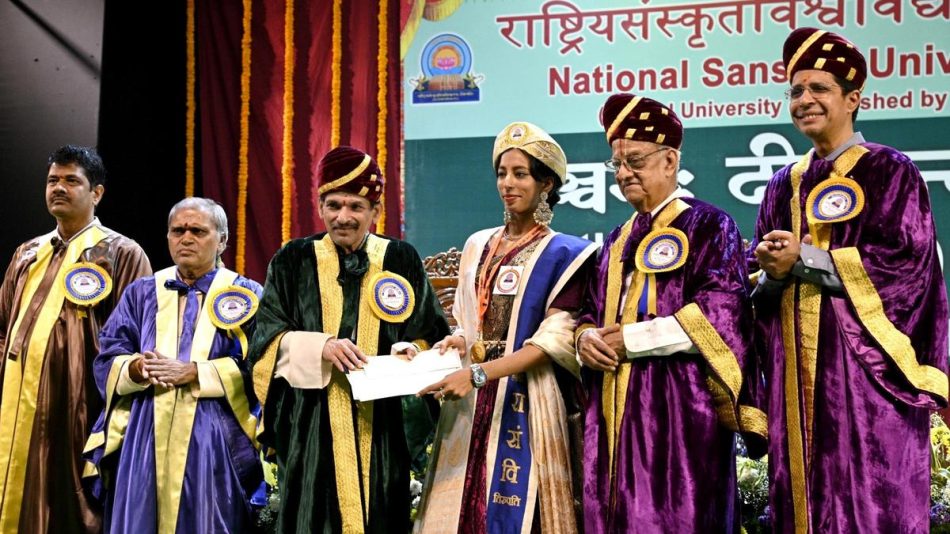
IIT Madras director advocates Sanskrit’s role in advancing AI technology
On April 10, 2026, during the 5th convocation of the National Sanskrit University (NSU) in Tirupati, Professor Veezhinathan Kamakoti, the Director of the Indian Institute of Technology Madras (IIT-M), emphasized the significant role of Sanskrit in the modern technological landscape, particularly in the field of Artificial Intelligence (AI). His remarks highlighted the intersection of ancient linguistic wisdom and contemporary technological advancements.
The Relevance of Sanskrit in Modern Times
Professor Kamakoti reiterated that Sanskrit, often regarded as a classical language, possesses attributes that can be leveraged in the development of AI technologies. He pointed out that the complexities of human language, which AI aims to understand through Natural Language Processing (NLP), align closely with the analytical frameworks established by ancient Sanskrit literature.
Understanding Natural Language Processing
Natural Language Processing is a branch of AI that focuses on the interaction between computers and humans through natural language. The goal of NLP is to enable machines to understand, interpret, and respond to human language in a valuable way. Professor Kamakoti noted that this requires a deep comprehension of:
- Meaning
- Context
- Intention
According to him, these elements have been meticulously analyzed in Sanskrit philosophical texts, particularly in the schools of Nyaya and Mimamsa, which have explored the nature of language and meaning for centuries.
Nyaya and Mimamsa: Ancient Philosophies with Modern Applications
The Nyaya school of philosophy is primarily concerned with logic and epistemology, while Mimamsa focuses on the interpretation of Vedic texts and rituals. Both schools offer profound insights into the structure and function of language, which can provide a foundation for developing more sophisticated AI systems.
Insights from Nyaya
Nyaya philosophy emphasizes the importance of logical reasoning and the analysis of arguments. This can be particularly beneficial for AI systems that require robust reasoning capabilities to process and understand human language. The principles derived from Nyaya can help in creating algorithms that mimic human-like reasoning, thereby improving the performance of AI technologies in understanding nuanced human communication.
Insights from Mimamsa
Mimamsa, on the other hand, delves into the meaning of words and sentences, focusing on the context in which they are used. This aspect is crucial for NLP, as understanding context is essential for accurate interpretation. The methodologies developed by Mimamsa scholars can inform the design of AI systems that need to grasp context-dependent meanings, leading to more effective communication between humans and machines.
The Future of AI and Sanskrit
As AI continues to evolve, the integration of ancient linguistic principles could pave the way for advancements in how machines interpret and generate human language. Professor Kamakoti’s advocacy for Sanskrit in AI development underscores the potential of interdisciplinary approaches in technology. By drawing from the rich heritage of Sanskrit literature, researchers and developers can enhance the capabilities of AI systems.
Potential Applications
The implications of incorporating Sanskrit principles into AI are vast. Some potential applications include:
- Enhanced Language Translation: AI systems could achieve higher accuracy in translating languages by applying the contextual and semantic insights from Sanskrit.
- Improved Chatbots: Chatbots could become more adept at understanding user intent and providing relevant responses, leading to better user experiences.
- Advanced Sentiment Analysis: By utilizing the analytical frameworks of Sanskrit, AI could more effectively interpret emotions and sentiments in text.
Conclusion
Professor Kamakoti’s remarks at the NSU convocation highlight a significant and often overlooked connection between ancient linguistic traditions and modern technological advancements. As the field of AI continues to grow, the insights derived from Sanskrit can contribute to creating more sophisticated and human-like interactions in technology. The future of AI may very well benefit from the wisdom of the past, demonstrating that ancient knowledge can play a vital role in shaping contemporary innovations.
Note: The integration of ancient languages like Sanskrit into modern technology is an evolving field, and ongoing research may reveal further applications and benefits.


