IIT Madras: Founders, funders, facilitators spar over startup success
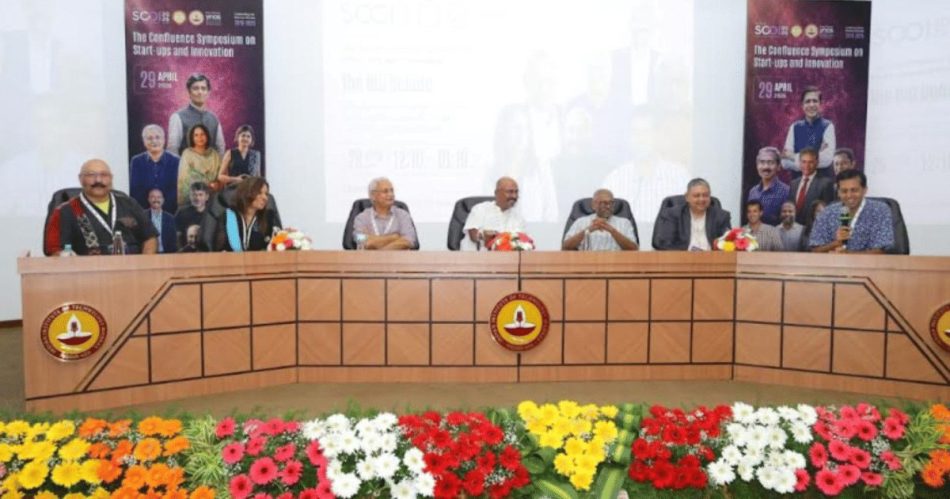
CHENNAI: What truly drives startup success: founder’s vision, funder’s capital, or facilitator’s ecosystem? This question was at the center of a high-energy ‘Omega Debate’ held during the Confluence symposium at IIT Madras. The debate, moderated by Prof Ashwin Mahalingam, adopted a format inspired by ‘Omega Ball’, a three-sided debate where teams simultaneously compete against two others to examine the shifting dynamics of the startup ecosystem.
The Founders’ Perspective
Representing the founders, Badri Seshadri, co-founder of Cricinfo, and LS Ganesh, former professor of IIT Madras, argued that the founder remains the only indispensable element in a startup’s journey. “Ventures have always been brought out by founders who are driven by passion,” Seshadri stated, emphasizing that repeated failures often do not enter success narratives.
Recalling Cricinfo’s early years, Seshadri noted that access to capital led to higher spending with the expectation of further rounds, until a market collapse left the company struggling and close to a fire sale. “That experience,” he said, “underscored the need for prudence in building revenues rather than depending on capital cycles. You can build with customers. Customer funding is far more important than venture funding, and that bootstrapping, as seen in companies like Zoho, fosters a more resilient business culture.”
Seshadri emphasized that while funders see a portfolio, founders commit blood and sweat to a single vision that cannot be diversified. “It’s not your company; it’s your money,” he stated, addressing the funders directly.
The Funders’ Argument
Countering the founders’ claims, Balamurugan, co-founder of Anicut Capital, and Prof Suresh Bhagavatula from IIM Bangalore argued that ideas and intent do not translate into execution without capital. They drew on historical examples, referring to the funding of Christopher Columbus’ voyage as an early instance of capital enabling exploration. They maintained that even large ideas require initial backing to begin.
The funders’ argument centered on the role of capital as a constant force across ventures. While founders may move from one idea to another, they described funders as a continuing presence across multiple businesses. Bhagavatula pointed to shifts within the investment landscape itself, noting, “Modern investing is increasingly myopic and deterministic with a focus on unicorns and flavor of the season sectors such as edtech and AI. Earlier approaches supported the exploratory journey of entrepreneurship.”
The Role of Facilitators
Pravin Shekar of Outlier Marketer and Sonali Gupta, founder of Science of Startups, positioned facilitators as the layer that enabled both founders and funders to operate effectively. Shekar argued that both ideas and capital remain ineffective without the systems that connect them. Using the analogy of a ship that remains stationary until it catches wind, he said, “Facilitators provide momentum through networks, mentorship, and access.”
He emphasized that founders often rely on peer networks and informal advisory groups to navigate decisions, particularly in situations where they cannot turn to employees or investors. Gupta extended this argument by focusing on infrastructure, pointing out how lack of basic access could prevent opportunities from being realized. “Facilitators,” she explained, “perform the role of enabling infrastructure. A majority of Indians believe they can start a business, but a significant proportion are held back by fear of failure, which is a barrier that facilitators help address.”
Gupta also highlighted sectoral imbalances, noting that while consumer-facing sectors attract large numbers of startups, areas such as air quality receive far less attention and often depend on ecosystem support rather than venture capital.
Conclusion of the Debate
In his closing remarks, Prof Mahalingam noted, “Elements within a system may remain inactive until the right conditions bring them together, just like catalysts in chemistry.” An audience poll showed founders emerging as the most popular choice among the participants, indicating a strong belief in the founder’s role in driving startup success.
Note: The dynamics of startup success are complex and multifaceted, involving the interplay of founders, funders, and facilitators. Each plays a crucial role in shaping the entrepreneurial landscape.