IIT Madras Launches Param Shakti, 3.1 Petaflop Indigenous Supercomputer
On January 8, 2026, the Indian Institute of Technology (IIT) Madras unveiled its latest achievement in high-performance computing: the Param Shakti supercomputer. This indigenous system boasts a remarkable processing capability of 3.1 petaflops, which translates to over 3.1 quadrillion calculations per second. This launch marks a significant milestone for India in the realm of advanced computing technology.
Significance of Param Shakti
The introduction of Param Shakti is expected to provide a substantial boost to research and development across various fields. The supercomputer will enable researchers to tackle large and complex problems with greater speed and accuracy, thereby reducing the time required for experimental work. This advancement is crucial for India to enhance its competitiveness in several critical sectors, including:
- Aerospace
- Materials Science
- Climate Modelling
- Drug Discovery
- Advanced Manufacturing
Development and Infrastructure
Param Shakti was developed entirely in India at the Centre for Development of Advanced Computing (C-DAC), which is part of IIT Madras. The system utilizes C-DAC’s RUDRA server series and operates on open-source software, showcasing India’s capabilities in developing cutting-edge technology.
This supercomputer is integrated into the Param Rudra supercomputing cluster, which features advanced infrastructure for continuous power supply, sophisticated cooling systems, and efficient data center operations. The project has been funded under the National Supercomputing Mission, a collaborative initiative led by the Ministry of Electronics and Information Technology (MeitY) and the Department of Science and Technology (DST).
Inauguration Ceremony
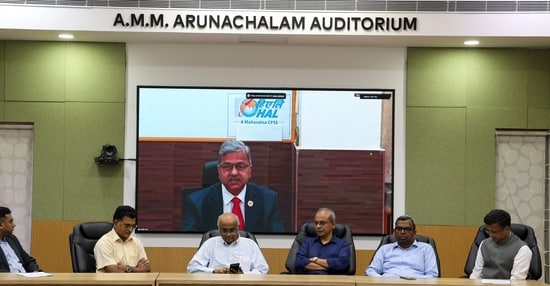
The inauguration ceremony was attended by several dignitaries, including S. Krishnan, Secretary of MeitY, V. Kamakoti, Director of IIT Madras, and E. Magesh, Director General of C-DAC. During the ceremony, S. Krishnan emphasized the importance of the National Supercomputing Mission in supporting a diverse range of applications and projects. He noted that the mission aims to enhance India’s research and innovation ecosystem by providing access to multiple GPU architectures, rather than promoting a single technology.
Future Prospects
With the launch of Param Shakti, India now has a total of 37 supercomputers installed across various institutions nationwide, with more systems planned for the future. One of the most ambitious projects is the development of the largest supercomputer, which is set to be established in Bengaluru. These efforts are aimed at strengthening the research landscape in India and fostering innovation across multiple disciplines.
Encouragement for Indigenous Development
E. Magesh, Director General of C-DAC, highlighted the journey of developing the Rudra platform and encouraged researchers to increasingly adopt indigenous high-performance computing systems. The focus on homegrown technology is a vital aspect of India’s strategy to enhance its capabilities in the global technology arena.
Conclusion
The launch of Param Shakti represents a significant step forward for India’s technological capabilities. By investing in indigenous supercomputing technology, India is positioning itself to tackle some of the most pressing challenges of our time while fostering a culture of innovation and research. The Param Shakti supercomputer is not just a technological marvel; it is a testament to India’s growing prowess in the field of advanced computing.
Note: The information provided in this article is based on the latest updates available as of January 2026.