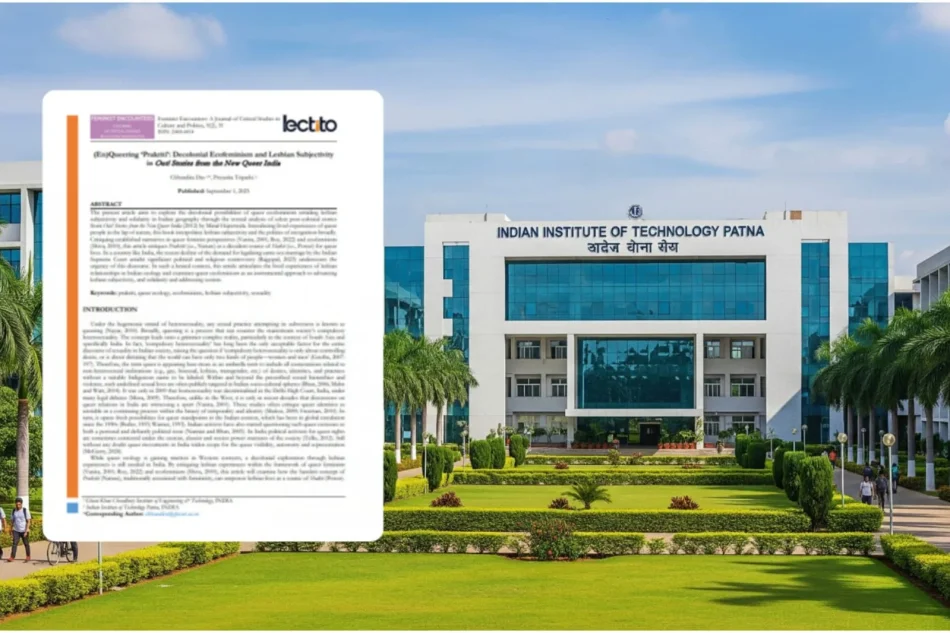
IIT Patna Paper on Lesbian Subjectivity and ‘Shakti’ Sparks Debate Over Humanities in IITs
A recent academic paper from the Humanities Department of IIT Patna has ignited a nationwide debate after reinterpreting the Hindu concept of Shakti through the lens of lesbian subjectivity and queer ecofeminist theory. The paper, titled “(En)Queering ‘Prakriti’: Decolonial Ecofeminism and Lesbian Subjectivity in Out! Stories from the New Queer India,” argues that Prakriti (Nature) can be understood as a “dissident source of Shakti” for queer, specifically lesbian, subjectivity.
Overview of the Controversy
The paper’s interpretation has drawn widespread criticism online, with many arguing that it crosses the line from academic reinterpretation into ideological overreach. Critics assert that the work fundamentally recodes classical philosophical categories into contemporary ideological frameworks, which they believe distorts the original meanings of these concepts.
Key Arguments of the Paper
The authors of the paper claim that lesbian experience can be framed as a “heightened Shakti,” moving “beyond the heteronormative Prakriti and Purusha dualism.” They further assert that “nature is queer” and boldly declare that “fully and properly, ecology is queer theory and queer theory is ecology.” This framing has led many to question whether such theoretical experiments are appropriate in publicly funded technical institutions.
Criticism of the Paper
One of the most controversial excerpts from the paper interprets a fictional narrative in which two women die together. The authors state: “For these young women, death is liberation, not just annihilation.” This line has triggered immediate backlash, with critics arguing that it romanticizes death as an ideological victory and replaces dharmic struggle with fatalistic symbolism.
Social media reactions have been swift. User Harshil commented, “Read the entire paper. One word summary: Outrageous.” He criticized the authors for reducing Prakriti and Purusha, which are ontological principles in classical Sankhya philosophy, to mere gender binaries. He further stated, “Authors romanticising death as ideological victory is dangerous moral theatre.”
Philosophical Concerns
In classical Sankhya philosophy, Prakriti and Purusha represent primordial materiality and pure consciousness, respectively. They are not biological sexes or sociological categories; rather, they describe the structure of reality itself. By labeling this dualism as “heteronormative,” critics argue that the paper collapses metaphysical concepts into modern sexual politics, which many scholars consider intellectually untenable.
Similarly, Shakti within Shakta and broader Hindu traditions refers to divine cosmic energy, the dynamic power of the Absolute. Critics argue that to reinterpret it primarily through the lens of lesbian subjectivity risks shrinking a vast theological category into a metaphor for identity politics.
Public Reaction
The backlash against the paper has been significant, with many questioning the appropriateness of such theoretical frameworks in publicly funded institutions. A widely shared post by the account “Gems of Indian Academia” described the work as a “distortion of Hindu Scriptures by IIT Patna’s Humanities Department.” The post raised concerns about the use of taxpayer money for such academic endeavors.
The Role of Humanities in IITs
This controversy has drawn attention to the expanding role of humanities departments within IITs. Over the years, India’s premier technical institutes have broadened their academic offerings to include philosophy, cultural studies, sociology, and critical theory. Supporters argue that exposure to critical thinking and interdisciplinary scholarship benefits engineers and technologists.
However, detractors assert that some strands of contemporary theory appear disconnected from India’s intellectual traditions and the core technical mission of these institutes. They argue that the application of Western theoretical frameworks, such as queer theory and ecofeminism, onto Indic metaphysical systems distorts foundational meanings.
Previous Controversies in IITs
This incident is not isolated; it follows a pattern of controversies surrounding humanities departments in IITs. For instance, in January 2026, IIT Delhi’s Department of Humanities and Social Sciences hosted a conference titled “Critical Philosophy of Caste and Race (CPCR3).” This event drew national attention for its ideological framing, particularly a session that sought to draw parallels between Dalit experiences in India and the Israel-Palestine conflict.
Critics argued that such comparisons risked oversimplifying complex and historically distinct realities. Keynote speakers framed caste within international advocacy and comparative race frameworks, reinforcing a globalized lens that some felt was narrow and insufficiently representative of India’s own historical context.
Conclusion
The debate surrounding the IIT Patna paper on lesbian subjectivity and Shakti highlights the tensions between traditional philosophical frameworks and contemporary ideological movements. As humanities departments continue to expand within technical institutes, the discourse surrounding the appropriateness and implications of such academic work will likely remain a contentious issue.
Note: The opinions expressed in this article do not necessarily reflect the views of IIT Patna or its affiliated scholars.