IITian turns 'bookman': UPSC setback to literary rise, now supporting new Hindi Writers
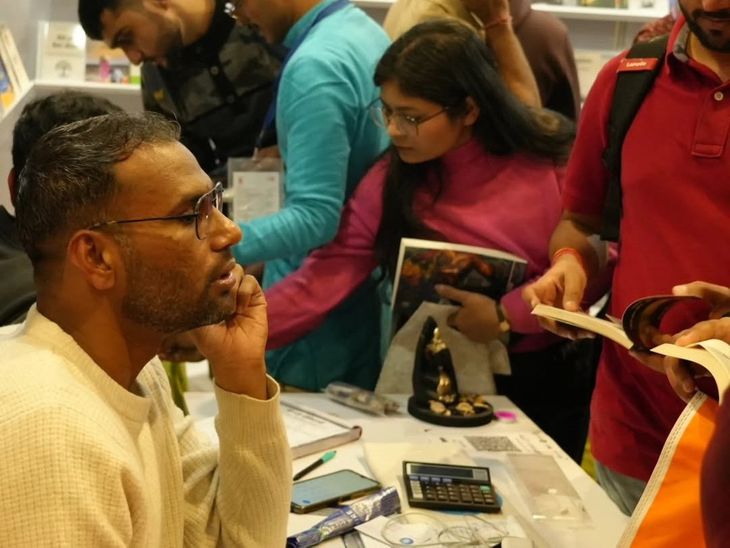
On this World Book Day, we celebrate the remarkable journey of Deepak Shankar Jorwal, an IIT Kanpur graduate who transformed his life from civil engineering to becoming a pivotal figure in Hindi literature. His story is one of resilience, passion, and a commitment to empowering new voices in the literary world.
From Engineering to Literature
Deepak was initially destined to measure the depths of dams and design bridges. However, he found himself measuring the depth of words instead. His journey began at IIT Kanpur, where he pursued a B.Tech degree. Despite his academic success, Deepak struggled with the language barrier that many students faced.
“At IIT, students predominantly converse in Hindi, especially during their time on campus. However, when it came to public speaking, many switched to English, which created an inferiority complex among those from rural backgrounds or state boards,” Deepak recalls. This realization prompted him to start Hindi Panktiyaan, a platform aimed at promoting Hindi literature and encouraging students to express themselves in their native language.
Challenges of Starting a Publishing House
Deepak graduated in 2018 and initially prepared for the UPSC exams, a path that many IITians consider prestigious. However, he soon realized that his true passion lay elsewhere. “It was challenging to venture into a field where no one from my background had walked before,” he explains. Convincing his family of his decision was a significant hurdle, especially given the high expectations placed on IIT graduates.
After two years of UPSC preparation, during which he faced personal tragedies, including the loss of his parents, Deepak decided to abandon his pursuit of civil services and focus on his literary ambitions.
Establishing Hindi Panktiyaan
Deepak founded Hindi Panktiyaan with a vision to bridge the gap between readers and Hindi literature. “We aim to make Hindi a part of everyday life,” he states. The platform has become a nurturing ground for first-time authors, with around 90% of its contributors being new writers.
“People used to rely on English quotes for captions, but now even English speakers are using Hindi quotes. We publish lines sent to us by non-writers, which boosts their confidence and encourages them to express their thoughts,” he shares.
Myths and Realities of Hindi Literature
Deepak challenges the prevalent myth that Hindi writers face financial difficulties. “This misconception arises from a lack of commitment and effort among those who spread it. Historically, writing was seen as a means of spreading awareness rather than a source of income,” he explains.
He cites the example of renowned writer Vinod Kumar Shukla, who received a meager annual royalty of ₹7,000. With improved publishing and marketing strategies, the same work later generated ₹30 lakh in a year. “The issue lies not in the writing itself, but in the outdated publishing system,” Deepak asserts.
Evaluating Literary Works
When assessing manuscripts, Deepak and his team adopt a reader-centric approach. “We ask ourselves if we enjoy the story, connect with the characters, and feel the emotions conveyed. If the answer is affirmative, we proceed,” he explains.
Currently, two types of writing dominate the market: slow writing, which delves into depth with a smaller audience, and fast writing, which focuses on relatability. “Relatable content is currently more popular, but as readers explore more books, they begin to appreciate depth,” Deepak notes.
Emerging Themes and Formats
Deepak observes that themes of tragedy and love continue to resonate with readers. “Even those who haven’t experienced love can connect with it through literature,” he states. Additionally, new themes are emerging, such as the struggles of students preparing for competitive exams, as seen in works like Sarkari Chai.
Innovative formats are also being explored. For instance, the book Lifafa is based on real love letters exchanged via emails. Furthermore, Deepak prefers the term panktiyaan over kavita to liberate poetry from rigid conventions.
Addressing Piracy and Supporting Writers
Deepak acknowledges the challenge of piracy in the publishing industry. “Pirated books are cheaper, but they deprive authors and publishers of their rightful earnings. Many unknowingly purchase pirated copies,” he warns. He advises readers to buy books directly from publishers or trusted sources to support the literary community.
For aspiring writers, Deepak offers sage advice: “Don’t write just to get published. Ensure that your title and content align, and most importantly, write from your own experiences. Authenticity is key.”
Conclusion
Deepak Shankar Jorwal’s journey from an IIT graduate to a literary entrepreneur exemplifies the power of following one’s passion. Through Hindi Panktiyaan, he is not only nurturing new writers but also redefining the landscape of Hindi literature, making it accessible and relatable to a broader audience. His story serves as an inspiration for many who wish to carve their own paths in the world of literature.
Note: This article highlights the inspiring journey of Deepak Shankar Jorwal and his contributions to Hindi literature through his platform, Hindi Panktiyaan.