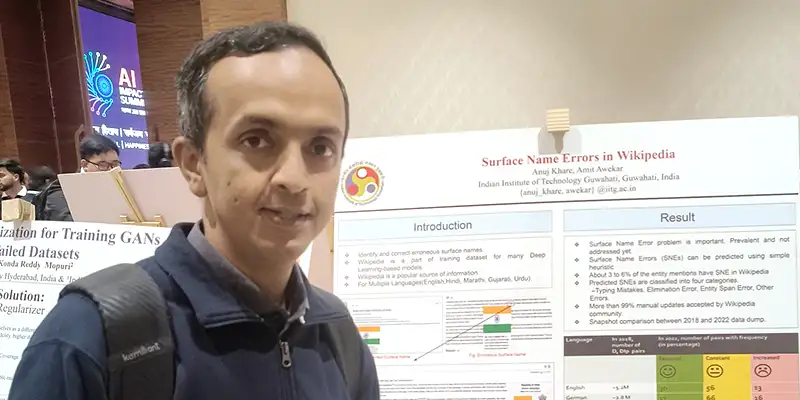
India AI Impact Summit 2026: IIT Guwahati showcases process to detect and correct Wikipedia surface name errors
The Indian Institute of Technology (IIT) Guwahati has made significant strides in improving the reliability of information on Wikipedia by developing a multilingual and scalable method to detect and correct Surface Name Errors (SNEs). This innovative approach was presented at the India AI Impact Summit 2026, highlighting the importance of accurate data for both human users and artificial intelligence systems.
Understanding Surface Name Errors (SNEs)
Wikipedia is a free, multilingual online encyclopedia that relies on a global community of volunteers for its maintenance and updates. A surface name refers to the text used in Wikipedia articles to mention or link to another entity. A Surface Name Error occurs when this text is incorrect. For example, a misspelled name like “Parise” linking to the page for Paris is an SNE.
The Scope of the Problem
Research conducted by the IIT Guwahati team indicates that approximately 3% to 6% of all entity mentions in Wikipedia contain Surface Name Errors. While these errors may seem minor, they can have significant implications:
- For Human Users: Incorrect surface names can diminish the perceived credibility and reliability of the information provided.
- For AI Systems: Many machine learning and deep learning models utilize Wikipedia as a core dataset. Errors in surface names can adversely affect AI tasks and model performance.
The Innovative Method Developed by IIT Guwahati
To tackle the challenge of Surface Name Errors, Prof. Amit Awekar, an associate professor in the Department of Computer Science and Engineering, along with M.Tech student Anuj Khare (batch of 2022), developed a method that employs mathematical frequency patterns, making it adaptable across multiple languages.
Three-Step Process for Classifying SNEs
The method consists of a three-step process:
-
Scanning Wikipedia: The initial step involves scanning Wikipedia and converting every link into a quadruplet containing:
- The page where the link appears
- The page it points to
- The surface name used in the link
- The surrounding textual context
-
Reviewing Surface Names: In this step, the method evaluates the surface name and considers it correct only if:
- It appears at least 10 times
- It accounts for at least 5% of all links pointing to a specific page
Surface names that do not meet these criteria are flagged as potential errors.
-
Categorizing Detected Errors: The final step involves categorizing the identified errors into:
- Typing Mistakes: For instance, “Gawahati” instead of “Guwahati”.
- Entity Span Errors: Where extra or incorrect words are mistakenly included in the link.
Testing the Method Across Languages
The researchers tested their method on eight languages: English, Sanskrit, German, Italian, Urdu, Hindi, Marathi, and Gujarati. The outcomes were found to be accurate, demonstrating the method’s versatility and effectiveness across different linguistic contexts.
Real-World Applications and Validation
Prof. Amit Awekar emphasized the real-world applications of the developed method, stating, “This work shows us that we should not be trusting the data from the web blindly, both for human use and training AI models. Good data is the beginning of any good AI model and downstream application.”
To validate the effectiveness of their system, the research team compared snapshots of the English Wikipedia from 2018 and 2022. They discovered that approximately 30% of the errors predicted by their method had been corrected on Wikipedia over the four-year period, confirming the accuracy of their approach.
Community Engagement and Acceptance
Wikipedia is maintained by volunteers worldwide, and the developed method can assist editors in identifying hidden typos and linking errors that might otherwise remain undetected for years. Notably, the Wikipedia community has accepted over 99% of the manual corrections suggested by the researchers, indicating a strong collaboration between the academic community and Wikipedia editors.
Conclusion
By combining scalable data processing with practical validation through the Wikipedia community, the IIT Guwahati team has demonstrated an effective approach to enhancing digital knowledge systems. Their work not only improves the quality of information available on Wikipedia but also reinforces the importance of accuracy in data used for training AI models.
Note: The advancements presented at the India AI Impact Summit 2026 underscore the critical role of accurate data in both human and AI contexts, paving the way for future innovations in information reliability.