Japan’s demographic shift is India’s job jackpot, says minister Noriaki Abe at IIM Nagpur
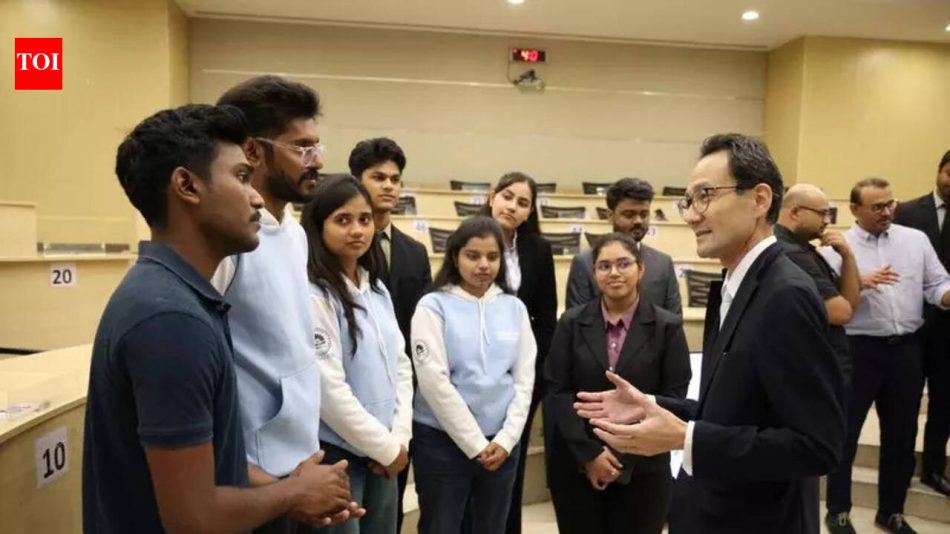
Nagpur, March 11, 2026 – With Japan’s average age standing at 44 years and India’s at just 22, a golden door of opportunity is opening for young Indians looking to build global careers. This message was the highlight of a special session delivered by Noriaki Abe, minister of political affairs at the embassy of Japan in New Delhi, during his visit to the Indian Institute of Management (IIM) Nagpur.
Indo-Japan Research Centre
Speaking at the institute’s Indo-Japan Research Centre (IJRC), Abe explained that the two nations formalized an ‘Action Plan for Human Resource Exchange’. Simply put, Japan needs young talent, and India has it in abundance. The IJRC is one of the few dedicated academic centers in India focused on translating the India-Japan strategic partnership into actionable research and cross-cultural corporate leadership.
Bilateral Economic Ties
Highlighting the sheer financial scale of this partnership, Abe shared a massive update on bilateral economic ties. He revealed that Japan successfully achieved its recent 5-trillion-Yen investment target in India and has now boldly upscaled the goal to 10 trillion Yen in private investment.
Opportunities for Indian Professionals
“This 10-trillion-yen target is not just a number on a screen; it represents thousands of new businesses, start-ups, and high-paying career opportunities for Indian professionals in the coming years,” Abe stated.
Emerging Fields and Job Creation
So, where are these jobs opening up? Moving beyond traditional manufacturing, the minister detailed specific areas of expansion. Through newly-launched frameworks like the “AI Cooperation Initiative (JAI)” and “Digital Partnership 2.0,” Japan is aggressively seeking Indian talent and collaboration in booming emerging fields such as:
- Artificial Intelligence
- Semiconductors
- Space Exploration
- Clean Energy
Corporate Hiring and Collaborations
Showcasing the intense momentum of this relationship, Abe revealed that the recent AI summit resulted in over 170 Memorandums of Understanding (MoUs) signed by private entities, directly paving the way for corporate hiring and collaboration.
Changes in Japanese Corporate Culture
“Japan’s corporate culture is undergoing structural changes, making it much more welcoming for Indian youth,” Abe shared. This shift is essential as it aligns with Japan’s need for fresh talent to sustain its economic growth amidst a declining workforce.
Conclusion
The visiting delegation, which also included CR Jayachandran, senior political advisor at the Japanese Embassy, was welcomed by the IJRC leadership, including chairperson Prof. Rahul Kumar Sett and core faculty member Prof. Ankita Dash. This meeting signifies a pivotal moment in India-Japan relations, where both nations can leverage their strengths for mutual benefit.
Note: The information presented in this article is based on statements made during the event and reflects the current trends in India-Japan relations as of March 2026.