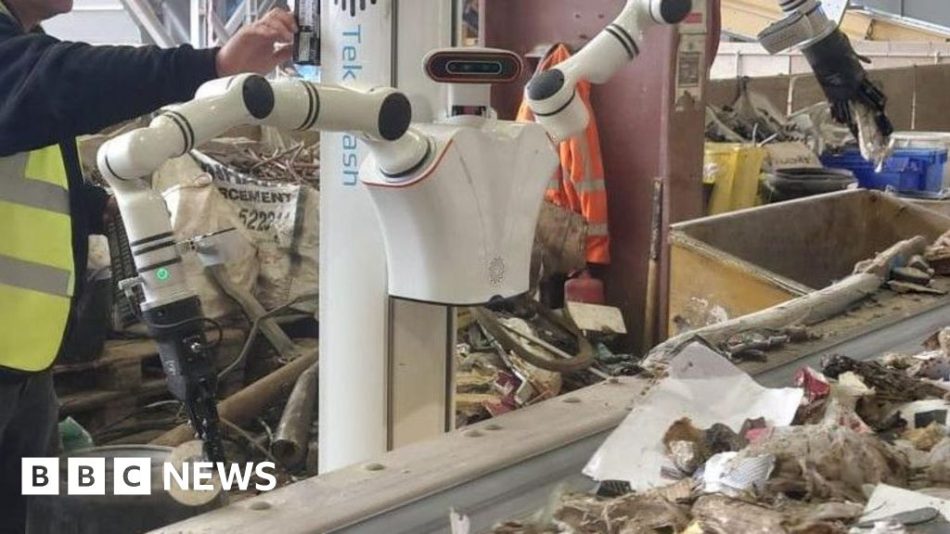
Robots move in as waste firms struggle to find staff
The waste management industry is facing a significant challenge as firms struggle to find and retain staff. This has led to an increased interest in automation, particularly the use of robots to assist in waste sorting and recycling processes.
The Challenges of Waste Management
Working in waste management can be a daunting task. Facilities like the Sharp Group’s recycling plant in Rainham, east London, are often dusty and noisy, making the environment less than appealing for workers. The plant processes up to 280,000 tonnes of mixed recycling each year with a team of 24 agency workers on its conveyor belts.
Unfortunately, this industry is hazardous. Despite Sharp Group’s commitment to safety, work-related injuries and health issues in waste management are 45% higher than in other sectors. Additionally, the fatality rate is significantly above the national average. These factors contribute to a high turnover rate, which runs at approximately 40% annually.
The Role of Automation
To address these staffing challenges, companies are increasingly looking toward automation. One notable innovation is a humanoid robot named Alpha (Automated Litter Processing Humanoid Assistant), which is currently being trained to assist in waste sorting. Developed by RealMan Robotics in China and adapted for real-world applications by TeknTrash Robotics in the UK, Alpha aims to improve efficiency in recycling operations.
While automated robots are not new to the waste management sector, the humanoid design is relatively unique. Al Costa, founder and CEO of TeknTrash, believes that mimicking human movement allows robots like Alpha to integrate seamlessly into existing facilities without necessitating significant redesigns.
Training the Robot
During a recent visit to the Sharp Group facility, Alpha was seen undergoing training to identify and sort waste. A plant worker was wearing a virtual reality headset to demonstrate successful picking and sorting techniques. The training process involves two main components: recognizing items on the conveyor belt and physically lifting them.
Costa emphasized that the perception of robots as ready-to-use solutions is misleading. “They need extensive data to be effective,” he explained. A system called HoloLab is employed to collect data from multiple cameras, guiding Alpha’s movements and reporting any failures when items remain unpicked on the belt. This system generates millions of data points daily, which are crucial for the robot’s learning process.
Benefits of Automation
Despite the time required for training, the potential benefits of using robots in waste management are significant. Chelsea Sharp, finance director at Sharp Group, highlighted that robots can work continuously without the need for breaks, holidays, or sick days. This reliability can greatly enhance operational efficiency.
In addition to TeknTrash’s Alpha, other companies are also exploring automation solutions. For instance, AMP, a Colorado-based firm, uses air jets to guide waste into chutes, while incorporating AI to improve sorting capabilities. Tim Stuart, CEO of AMP, noted that their robots can operate eight to ten times faster than human workers, significantly increasing efficiency and accuracy.
AI and Machine Learning in Waste Management
Another player in the field is GlacierAI, co-founded by Rebecca Hu-Thrams. Their system utilizes mounted robotic arms and AI to enhance sorting processes. Hu-Thrams pointed out the challenges posed by the variability of waste, citing instances where hazardous items, such as firearms, have been found in waste streams. As their AI models learn from billions of items, the efficiency of their sorting technology continues to improve.
Across the industry, experts agree that the shift towards automation is not only inevitable but necessary. Professor Marian Chertow from Yale University stated, “Robotics coupled with AI-driven vision systems offers the greatest potential for improving material recovery, worker experience, and economic competitiveness in the recycling sector.”
Future of Human Workers
While the introduction of robots raises questions about the future of human workers in waste management, Chelsea Sharp believes there will still be opportunities for upskilling. “The plan is to upskill those staff to maintain and oversee the robots,” she said. This approach aims to transition workers away from hazardous tasks, allowing them to focus on roles that are less physically demanding and more technologically oriented.
Conclusion
The integration of robots in the waste management sector represents a significant shift in how recycling and waste sorting are approached. As firms continue to face staffing challenges, automation appears to be a viable solution that not only enhances efficiency but also improves the working environment for human employees. The future of waste management may very well depend on the successful collaboration between humans and machines.
Note: The information presented in this article is based on current trends and developments in the waste management industry as of October 2023.