Supercomputer Param Shakti Launched at IIT Madras
In a significant advancement for India’s high-performance computing (HPC) capabilities, the Indian Institute of Technology (IIT) Madras has officially launched the indigenously developed supercomputing facility known as Param Shakti. The inauguration of this state-of-the-art facility took place on January 3, 2026, and was officiated by S. Krishnan, the Secretary of the Ministry of Electronics and Information Technology (MeitY).
Background of the Initiative
The establishment of Param Shakti is part of the National Supercomputing Mission (NSM), a collaborative effort between MeitY and the Department of Science and Technology (DST). This mission aims to enhance the country’s computational capabilities and promote technological self-reliance in critical computing infrastructure.
Technical Specifications
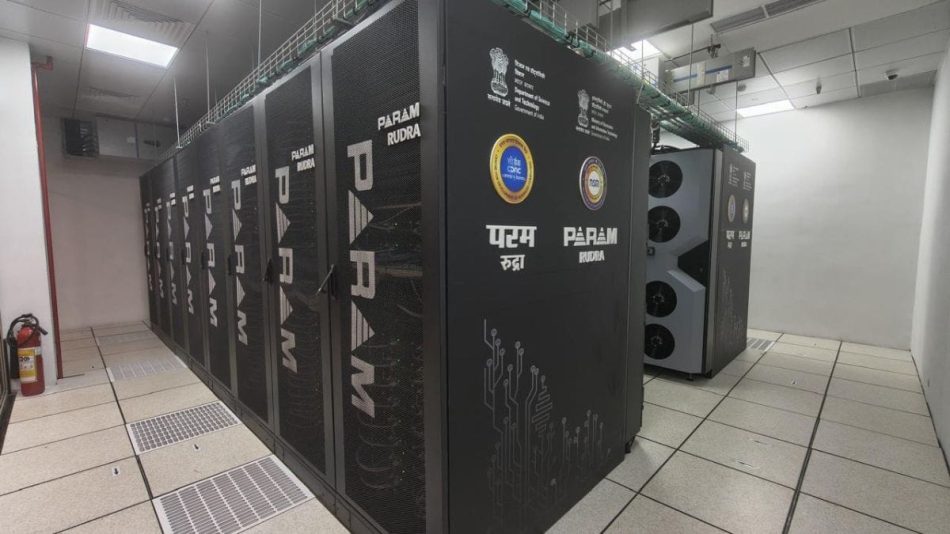
Param Shakti is powered by the Param Rudra supercomputing cluster, which has been entirely designed, developed, and manufactured in India by the Centre for Development of Advanced Computing (C-DAC). This initiative not only showcases India’s engineering prowess but also reinforces the country’s commitment to developing indigenous technologies.
Performance Capabilities
The supercomputer boasts a peak performance of 3.1 petaflops, which translates to the ability to perform over 3.1 quadrillion calculations per second. This immense computational power positions Param Shakti among the most powerful supercomputing installations in India.
Importance of Param Shakti
The computational capacity offered by Param Shakti is crucial for a variety of applications, particularly in handling large-scale simulations and data-intensive workloads. Such tasks would typically require extensive experimental efforts, often taking years to complete. With the capabilities of Param Shakti, researchers and scientists can expedite their work significantly.
Applications and Use Cases
The applications of Param Shakti are vast and varied, including but not limited to:
- Scientific Research: Facilitating complex simulations in fields such as physics, chemistry, and biology.
- Climate Modeling: Enhancing the accuracy of climate predictions and weather forecasting.
- Artificial Intelligence: Supporting machine learning and deep learning applications that require substantial computational resources.
- Engineering Simulations: Assisting in the design and testing of new materials and products.
- Healthcare: Enabling advanced research in genomics and personalized medicine.
Technological Features
Param Shakti employs a diverse range of technologies to maximize its efficiency and performance. Notably, the facility runs on open-source platforms, including AlmaLinux, and utilizes C-DAC’s indigenously developed system software stack. This approach not only promotes transparency and collaboration but also aligns with India’s goal of achieving self-sufficiency in technology.
GPU Architecture Flexibility
One of the standout features of Param Shakti is its flexible architecture. The department has deliberately avoided promoting a single technology or graphics processing unit (GPU) type. Instead, it provides access to multiple GPU architectures. This strategy allows innovators, scientists, and researchers to gain broad exposure and develop the capability to master diverse platforms. S. Krishnan emphasized this point, stating, “Our aim is to enable a wide range of technological experiences for our users.”
Future Prospects
The launch of Param Shakti is expected to have a profound impact on India’s research landscape. As more scientists and researchers gain access to such powerful computing resources, the potential for groundbreaking discoveries and innovations increases significantly. The facility is not only a testament to India’s growing capabilities in the field of supercomputing but also a stepping stone towards becoming a global leader in high-performance computing.
Collaborative Opportunities
With the introduction of Param Shakti, IIT Madras is poised to foster collaborations with various academic institutions, research organizations, and industries. This collaborative approach can lead to the development of cutting-edge technologies and solutions that address some of the world’s most pressing challenges.
Conclusion
The launch of the supercomputer Param Shakti at IIT Madras marks a significant milestone in India’s journey towards enhancing its high-performance computing capabilities. This facility is set to empower researchers and scientists across various fields, enabling them to tackle complex problems with unprecedented speed and efficiency. As India continues to invest in technological advancements, the future of research and innovation looks promising.
Note: The information provided in this article is based on the latest updates available as of January 2026.