
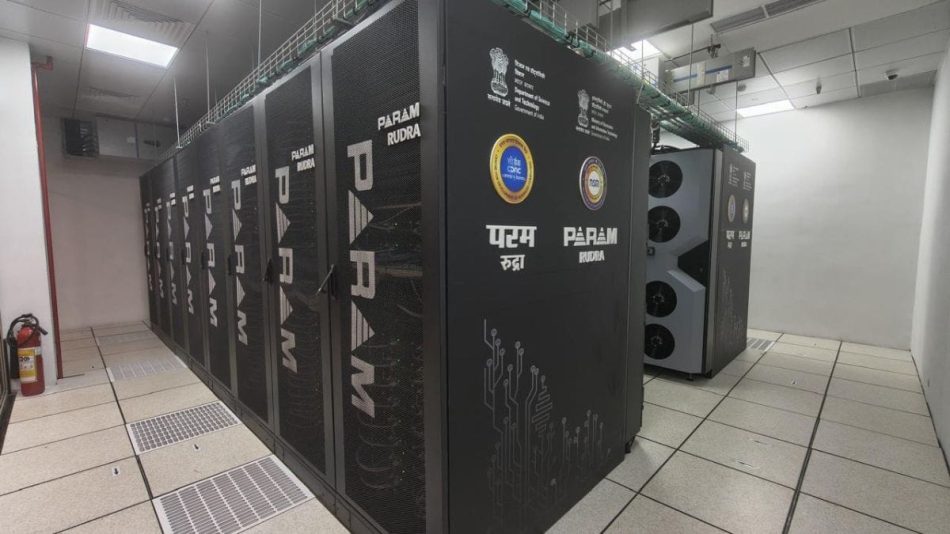
Supercomputer Param Shakti: A Milestone in Indigenous Technology
On January 3, 2026, the Indian Institute of Technology (IIT) Madras inaugurated Param Shakti, a supercomputer that marks a significant achievement in India’s indigenous technological capabilities. This supercomputer is the 37th installation under the National Supercomputing Mission (NSM) and is designed to bolster research and innovation across various fields.
Overview of Param Shakti
Param Shakti boasts an impressive computational capacity of 3.1 petaflops, enabling it to perform 3.1 quadrillion calculations per second. This makes it one of the most powerful supercomputers in India’s academic sector, second only to the supercomputer at the Indian Institute of Science (IISc) in Bengaluru, which has a capacity of 3.3 petaflops.
Developed by the Centre for Development of Advanced Computing (C-DAC), Param Shakti is not just another supercomputer; it represents a leap towards self-reliance in technology. G Phanikumar, Chairman of the Computer Centre at IIT Madras, emphasized that the server, which is the core component of the supercomputer, was designed and built entirely in India, without reliance on imported parts.
The National Supercomputing Mission
The National Supercomputing Mission was launched in 2015 with the objective of enhancing India’s supercomputing capabilities. The mission aims to develop indigenous hardware and software while installing supercomputers across educational institutions, including IITs, NITs, and IISERs. The successful installation of 37 supercomputers, including Param Shakti, signifies the completion of the first phase of this mission.
Significance of Param Shakti
Param Shakti is part of the RUDRA series of supercomputers, which are entirely built in India using indigenous RUDRA servers and software stacks. This initiative not only strengthens India’s research capabilities but also mitigates risks associated with global supply chains in technology.
According to S Krishnan, Secretary of the Ministry of Electronics and Information Technology (MeitY), the installation of these supercomputers is crucial for enhancing India’s research and innovation ecosystem. He stated, “With 37 supercomputers already installed across institutions nationwide and more in the pipeline, these efforts are strengthening India’s research and innovation ecosystem.”
Applications of Supercomputing
Supercomputers like Param Shakti play a vital role in various fields, including:
- Computational Biology: Assisting in complex biological simulations and analyses.
- Climate Modelling: Providing insights into climate change and environmental impacts.
- Astrophysics: Facilitating research in space and celestial phenomena.
- Big Data Analytics: Processing vast amounts of data for various applications.
Phanikumar explained that a task that would take a laptop a year to complete can be finished in just two hours using a supercomputer. This immense computational power, combined with a storage capacity 4,500 times greater than that of a standard laptop, showcases the scale and capability of these machines.
Future Developments
While Param Shakti is a remarkable achievement, it is just one part of a larger vision for supercomputing in India. The NSM is currently working on several additional projects, including:
- A 20 petaflop supercomputer at C-DAC in Bengaluru, which will be the largest and most powerful supercomputer in the country.
- A 6 petaflop supercomputer at IIT Delhi.
- An 838 teraflop supercomputer at IIT Jammu.
All these systems are expected to be built on indigenous RUDRA servers, further enhancing India’s capabilities in supercomputing.
Global Context and National Credibility
Despite the advancements represented by Param Shakti, it is essential to note that the strongest supercomputer in India remains the PARAM Siddhi AI, which has a capacity of 5.2 petaflops and is located at C-DAC in Pune. However, PARAM Siddhi AI is based on an NVIDIA DGX SuperPOD architecture, indicating that it is not entirely indigenous.
Prime Minister Narendra Modi highlighted the importance of developing indigenous supercomputing capabilities, stating that it is a matter of national credibility. He emphasized that in the digital age, computing capacity equates to national capability.
Conclusion
Param Shakti represents a significant step towards self-reliance in technology for India. As the nation continues to invest in its supercomputing infrastructure, the potential for groundbreaking research and innovation grows exponentially. The establishment of indigenous supercomputers not only enhances academic research but also positions India as a key player in the global technological landscape.
Note: The information presented in this article is based on data available as of October 2023 and may be subject to change as new developments occur.


