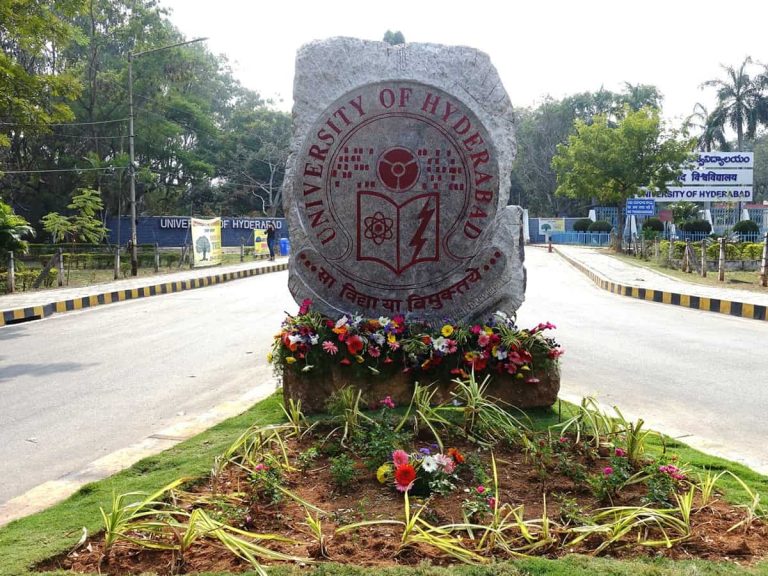
UoH Faculty and Scholars Present Community Media Research at the SPARC Conclave in Kolkata
On March 8-9, 2026, the University of Hyderabad (UoH) made a notable contribution to the academic community by participating in the two-day SPARC (Scheme for Promotion of Academic and Research Collaboration) Conclave held at the Indian Institute of Technology (IIT) Kharagpur Research Park in Kolkata. This event brought together nearly 400 faculty members, researchers, and students from various universities and research institutions across India, along with international collaborators and academic leaders involved in SPARC-funded projects.
Event Overview
The SPARC Conclave was organized by IIT Kharagpur, in collaboration with the National Coordination Centre for the SPARC initiative under the Ministry of Education, Government of India. The event was inaugurated by Mr. Armstrong Pame, Joint Secretary of the Department of Higher Education, Ministry of Education, Government of India. He was joined by notable figures such as:
- Prof. Suman Chakraborty, Director of IIT Kharagpur
- Prof. Rabibrata Mukherjee, National Coordinator of SPARC
- Prof. Sudeshna Sarkar, Joint National Coordinator of SPARC
UoH Contributions
Representing the University of Hyderabad at the conclave were Prof. Kanchan K. Malik, along with PhD research scholars Treesa Reena John and Vamsi Krishna Pothuru, all from the Department of Communication. Prof. Malik, who holds the UNESCO Chair on Community Media, presented her research during a technical session focused on the SPARC project titled “Community Media, Participation & the Decolonisation of Knowledge Systems.”
Key Presentation Insights
In her presentation, Prof. Malik discussed fieldwork conducted at Nityananda Janavani (NJ) in West Bengal. She emphasized the critical role of Indian community radio in:
- Preserving and promoting local knowledge systems
- Amplifying the voices of marginalized communities
Prof. Malik highlighted the epistemic concerns central to the project, illustrating how community radio serves as a voice infrastructure that empowers indigenous communities. This infrastructure enables these communities to articulate their knowledge systems, sustain their languages, and assert culturally rooted ways of knowing and being.
Collaborative Efforts
The project is a collaborative initiative involving several esteemed academics:
- Prof. Pradip Thomas and Prof. Elske Van de Fliert from the University of Queensland
- Prof. Vinod Pavarala from Mahindra University
- Prof. Kanchan K. Malik and Prof. Vasuki Belavadi from the University of Hyderabad
Research Scholars’ Contributions
In addition to Prof. Malik’s presentation, research scholars Treesa Reena John and Vamsi Krishna Pothuru showcased a poster titled “Local Knowledges and Community Radio in India: Learnings from the Field.” Their poster drew insights from two Indian community radio stations:
- Sangham Radio in Telangana
- Nityananda Janavani (NJ)
Furthermore, the poster included reflections from their visit to three Australian community radio stations:
- 4EB
- Triple A
- 4ZZZ
This visit took place in April 2025 at the University of Queensland, Australia, and provided valuable comparative insights into community radio practices across different cultural contexts.
SPARC Initiative Highlights
Prof. Rabibrata Mukherjee, the National Coordinator for SPARC, remarked on the initiative’s success in funding and representing higher educational institutions across all states of India. He described the program as “One Nation One SPARC,” emphasizing its inclusive approach to academic collaboration.
Notable Achievements
The conclave featured presentations that highlighted several “SPARCling moments,” which are notable achievements emerging from SPARC-supported collaborations. These moments serve to inspire and motivate participants, showcasing the impact of collaborative research and academic endeavors across the nation.
Conclusion
The participation of the University of Hyderabad at the SPARC Conclave underscores the institution’s commitment to advancing community media research and its role in fostering inclusive knowledge systems. The insights shared by Prof. Malik and her research scholars contribute significantly to the ongoing dialogue about the importance of community radio in India and its potential to empower marginalized voices.
Note: The information presented in this article is based on the events and contributions made during the SPARC Conclave held in March 2026. For further details, please refer to official communications from the University of Hyderabad.