Google Maps Launches AI-Powered EV Routing Support and New Visuals
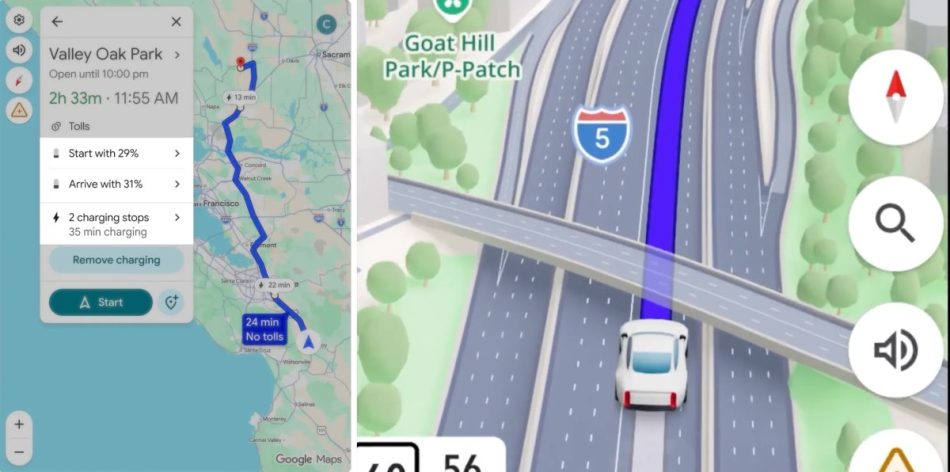
On March 31, 2026, Google announced a significant update to its navigation system specifically designed for electric vehicles (EVs). This update introduces AI-powered trip planning and battery predictions for over 350 car models through Android Auto. The new features include recommendations for charging stops and adjustments to estimated arrival times based on battery levels, weather conditions, and road elevation. Users can even set their preferred state of charge upon arrival, a feature that Tesla has recently implemented, though it is not yet available in the Google Maps app.
The Impact of Google’s AI Update
While Tesla has offered similar functionalities natively for several years, Google’s new AI capabilities have sparked curiosity among EV owners about whether Tesla could leverage this technology to address its navigation issues. Many Tesla drivers have experienced peculiar routing decisions, such as taking three left turns to make a right or being directed down unnecessary residential streets.
“Getting so sick of these FSD navigation problems. I could have swerved back but it wouldn’t be safe to do. Not even 500 miles and I’ve fixed so many nav mistakes. FSD is SO good at driving but makes so many routing mistakes it ruins the magic.”
Why Google’s Update Doesn’t Help Tesla
Google’s update is a powerful tool for the electric vehicle market, utilizing artificial intelligence and advanced energy models to analyze vehicle characteristics such as weight and battery capacity. The system combines this data with real-time mapping information regarding traffic, road elevation, and weather conditions, providing accurate battery predictions and recommending optimal charging stops. This update simplifies trip planning for drivers of supported car models, eliminating the need for multiple third-party apps.
However, this update does not address the routing anomalies experienced by Tesla owners. Google’s enhancements focus on energy calculations rather than pathfinding solutions. Tesla already boasts industry-leading energy predictions and does not utilize Android Auto in its vehicles, rendering the new Google Maps features irrelevant to Tesla’s routing decisions.
Tesla’s Navigation Architecture
To understand why Tesla cannot simply adopt Google’s new routing capabilities, it is essential to examine the architecture of Tesla’s navigation system. Many assume that Tesla relies on Google Maps for all its navigation needs, given that the visual map displayed on the touchscreen is indeed powered by Google. However, the routing engine operates independently.
Tesla employs a customized version of an open-source routing engine called Valhalla for route calculations and turn-by-turn directions. This engine primarily utilizes OpenStreetMap data instead of Google’s proprietary algorithms. Consequently, when Tesla’s navigation system makes an unusual routing decision, it is often due to quirks within the OpenStreetMap data or errors in the mathematical weights Tesla uses to determine the fastest route.
Google Maps Visual Enhancements
In addition to the new routing features, Google has revamped its Maps app to include an AI-powered voice assistant and is gradually rolling out visual enhancements. These updates aim to improve user experience and make navigation more intuitive.
Steps for Tesla to Improve Routing
If Tesla wishes to address its routing anomalies, it must refine its Valhalla routing engine and enhance how the system interprets OpenStreetMap data. Although Tesla could theoretically license Google’s turn-by-turn routing API to replace Valhalla, the company has opted to maintain control over its ecosystem and ensure seamless integration with its Supercharger network.
However, with Google now providing charging stop calculations, Tesla may need to reconsider this strategy and evaluate whether Google’s routing API can meet its specific needs, particularly if it allows for limitations to Tesla’s Supercharger stations.
Tesla and Google Partnership
Tesla’s navigation system already relies heavily on Google services. The company uses Google APIs for points of interest, reviews, hours of operation, map tiles, satellite imagery, 3D buildings, and traffic information. While Tesla has developed its navigation system in-house, it still depends significantly on Google data. Routing is one of the few areas where Tesla maintains control.
Conclusion
Google’s latest AI update represents a significant advancement for electric vehicle drivers, particularly those using supported models from legacy automakers. It brings essential battery forecasting capabilities to the forefront, enhancing the overall driving experience. However, Tesla’s unique navigation architecture and commitment to its proprietary systems mean that these improvements may not directly benefit Tesla owners in the immediate future.
Note: The information presented in this article is based on the latest updates and developments as of October 2023. For ongoing updates, please refer to official sources.