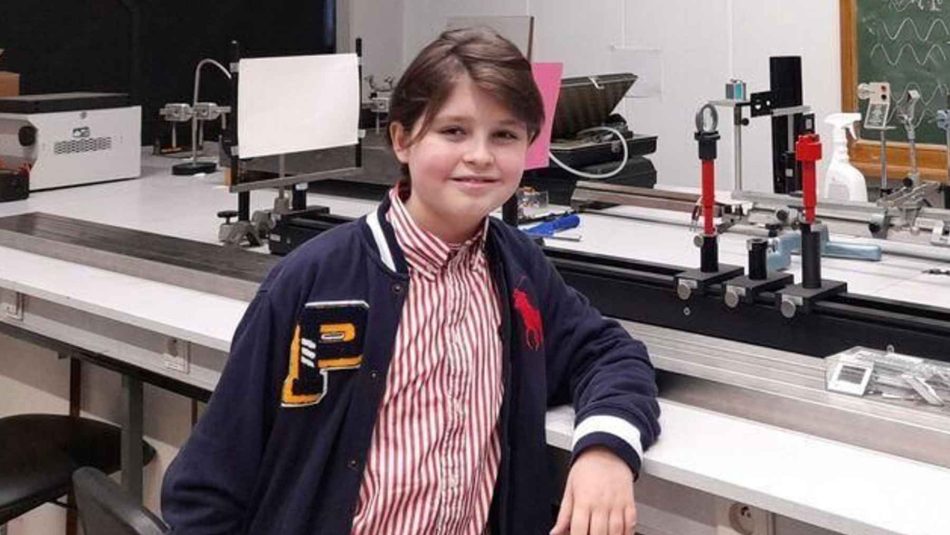
A young man aged just 15 is about to officially become a doctor of quantum physics in Antwerp, and what is most surprising is that he already lives in Munich, where he is preparing a second doctorate focused on medicine and artificial intelligence
In a remarkable feat that has captured the attention of the scientific community, a 15-year-old named Laurent Simons is set to officially become a doctor of quantum physics at the University of Antwerp. What makes this achievement even more astonishing is that Simons is already residing in Munich, where he is simultaneously preparing for a second doctorate focused on medicine and artificial intelligence.
The Journey of Laurent Simons
At just 15 years old, most teenagers are preoccupied with school tests, hobbies, and weekend plans. However, Laurent Simons has taken a distinctly different path. He recently defended his doctoral thesis in quantum physics, a field that is often considered one of the most complex areas of study in modern science.
Academic Accomplishments
Simons’ thesis, titled “Bose polarons in superfluids and supersolids,” explores the behavior of tiny impurities in exotic ultracold matter. This research is critical as it helps physicists understand unusual quantum behaviors that are difficult to observe in other settings. His academic timeline is nothing short of extraordinary:
- Completed high school at an unusually early age.
- Studied electrical engineering in Eindhoven for a brief period.
- Earned a bachelor’s degree in physics from the University of Antwerp in 2021, graduating with 85%, the highest distinction.
- Completed a master’s degree in quantum physics in 2022.
This rapid progression through academia is not merely a coincidence; it reflects Simons’ profound understanding and passion for physics.
Research Focus
Simons’ master’s thesis demonstrated his ability to utilize Bose-Einstein condensates as quantum simulators to investigate complex phenomena such as Hawking radiation and the Casimir effect. His research is not only groundbreaking but also highlights his unique approach to bridging different fields of study.
From Quantum Physics to Medicine
During an internship at Ludwig Maximilian University and the Max Planck Institute of Quantum Optics, Simons discovered his interest in medicine-oriented research. He expressed a desire to contribute to the field by exploring the potential of growing artificial organs, a concept that may sound like science fiction but is increasingly becoming a focus of scientific inquiry.
Current Endeavors
Currently, Simons is listed as a PhD candidate at Helmholtz Munich, where he is part of the Theis Lab. This research group focuses on machine learning, single-cell genomics, and computational health. His work aims to push the boundaries of human capabilities, and he envisions creating “superhumans” through the integration of advanced physics, artificial intelligence, and biomedical research.
The Intersection of Physics, AI, and Health
While Simons’ age continues to attract headlines, the essence of his journey is rooted in the pursuit of knowledge and innovation. He is not merely a curiosity; he is building a comprehensive toolkit that spans multiple disciplines:
- Physics: His foundational work in quantum physics provides a deep understanding of matter at its most fundamental level.
- Artificial Intelligence: Simons is exploring how AI can enhance medical research and applications, particularly in the context of health.
- Medicine: His ambition to develop artificial organs reflects a commitment to improving human health and capabilities.
Implications for the Future
Simons’ research could have far-reaching implications, not only for the fields of physics and medicine but also for society as a whole. By merging advanced physics with machine learning and biomedicine, he is poised to contribute to breakthroughs that could redefine our understanding of health and human enhancement.
Public Reception and Future Aspirations
After defending his thesis, Simons shared his vision with the media, stating his desire to create “superhumans.” While this statement may sound ambitious, it encapsulates the spirit of innovation that drives many young scientists today. The merging of different scientific disciplines can lead to unprecedented advancements that were once thought to be impossible.
Conclusion
Laurent Simons is not just a young prodigy; he represents a new generation of scientists who are breaking barriers and redefining the boundaries of knowledge. His journey from quantum physics to medicine and artificial intelligence exemplifies the interconnectedness of various scientific fields and the potential for transformative discoveries.
Note: The achievements of young individuals like Laurent Simons inspire future generations to pursue their passions and explore the limitless possibilities of science and technology.