On Thin Ice: Indus Basin Snow Droughts Deepen, Kashmir Loses Winter Snow Buffer
Srinagar, January 13, 2026 – The Indus River basin has experienced at least 14 significant snow droughts over the past two decades, with Kashmir, situated in the upper reaches of the basin, being the region most affected. This alarming trend has been highlighted in a recent study conducted by researchers at the Indian Institute of Technology (IIT) Jammu.
Key Findings of the Study
The study, titled Intensified occurrences of snow droughts are related to snow cover dynamics in the Hindu Kush Himalayas, identifies the Indus basin as one of the most snow-stressed river systems in the Himalayas. The research links the warming of the basin and the reduction of snow cover directly to warmer winters, decreased snowfall, and a shorter snow season currently observed in Kashmir.
Research Methodology
Utilizing Snow Water Equivalent (SWE) data from the High Mountain Asia Snow Reanalysis and MODIS satellite snow cover records, the researchers analyzed snow drought patterns across 11 major Himalayan river basins. The Indus basin was found to be particularly vulnerable, recording 14 snow drought events, a figure surpassed by only a few Western Himalayan basins.
Kashmir: A Snow-Drought Hotspot
Kashmir falls within the Indus-B2 sub-basin, which the study identifies as a snow-drought hotspot. The authors emphasize that Kashmir is situated in a zone experiencing repeated and severe snow scarcity. One of the critical findings is the consistent loss of snow-covered days across the Indus basin, which explains the changing character of winters in Kashmir.
Declining Snow Cover
On average, the basin has lost approximately 0.65 snow-covered days per year, resulting in nearly 12 fewer snow days over the past two decades. For Kashmir, this translates to less winter snow surviving long enough to function as a natural reservoir. The study warns that the decline in snow cover is undermining the Indus basin’s capacity to store winter precipitation as snow.
Impact on Water Availability
Reduced snow persistence is significantly affecting water availability in spring and summer. The researchers found compelling evidence of elevation-dependent warming in the upper Indus basin, particularly in the mountain ranges surrounding Kashmir. Areas above 4000 meters are warming at an alarming rate of approximately 0.34 degrees Celsius per decade, compared to 0.20 degrees Celsius per decade at lower elevations.
Consequences of Warming
This accelerated warming at high altitudes is leading to decreased snow accumulation and faster melting, which disrupts the timing of water flows into the Jhelum River, a major tributary of the Indus that sustains Kashmir. Experts in the region have noted that the findings from satellite data closely reflect the realities on the ground.
Expert Insights
Riyaz Ahmad Mir, a geologist at the National Institute of Hydrology in Jammu, explained, “Kashmir is experiencing more frequent snow droughts because it is located within the Indus basin, where warming is most pronounced.” He further elaborated that since the 1980s, average winter temperatures in Kashmir have increased by about 0.8 degrees Celsius, with a more rapid rise noted after the year 2000.
Changing Precipitation Patterns
As a result of these temperature increases, a larger proportion of winter precipitation is now falling as rain rather than snow. Recent winters have seen snowfall deficits ranging from 40 to 80 percent, while satellite studies indicate a 20 to 25 percent decline in snow cover across Kashmir.
Effects on Agriculture and Water Resources
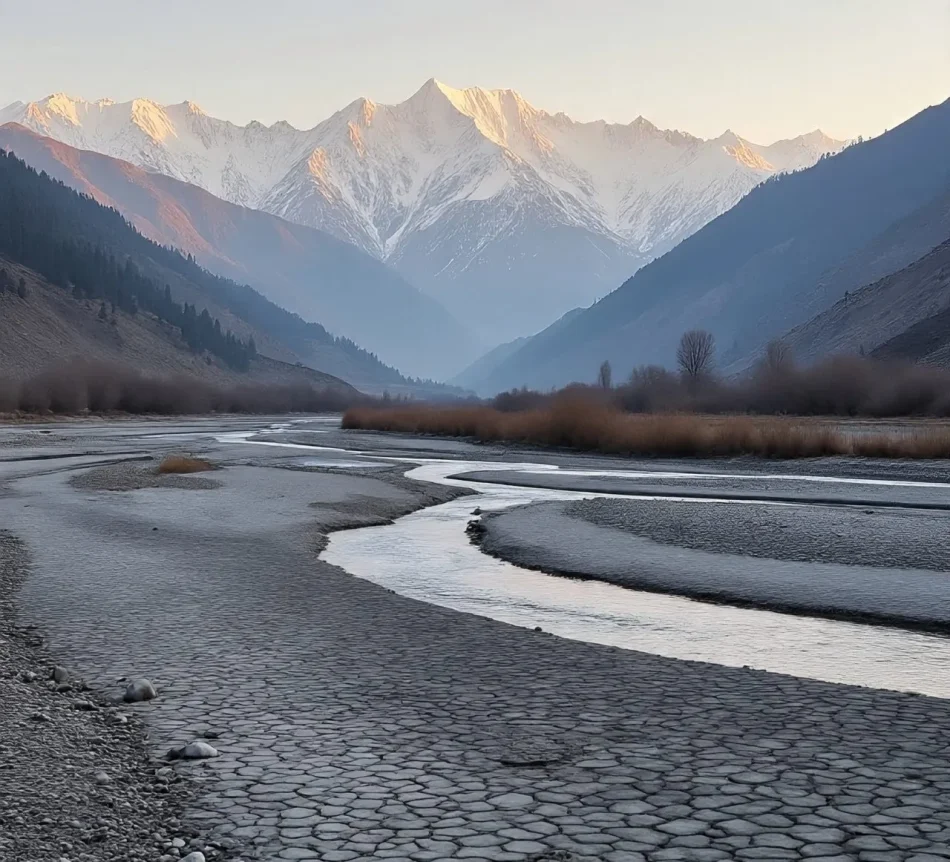
The diminishing snowpack is already impacting the Indus-Jhelum river system, which relies on slow, sustained snowmelt from the surrounding mountains in Kashmir. “The Jhelum, springs, and groundwater recharge in Kashmir are directly linked to snowmelt in the Indus basin headwaters,” Mir stated. “Snow droughts are resulting in lower spring and summer water flows, leading to the drying up of traditional water sources.”
Broader Implications
The repercussions extend beyond hydrology. Agricultural sectors, including apple orchards and paddy fields, depend on gradual snowmelt, while winter tourism is suffering, and drinking water security is becoming increasingly fragile. Meteorological records indicate that recent winters in Kashmir align with the basin-wide patterns highlighted in the IIT Jammu study.
Recent Weather Trends
Muhtar Ahmad, Director of the Meteorological Department in Kashmir, noted that except for the winters of 2020 and 2021, the peak winter months—particularly December and January—have largely been dry since 2018. High maximum and minimum temperatures, along with prolonged dry spells, have led to significant glacier area shrinkage in the Indus basin headwaters.
Long-Term Climate Change
Ahmad emphasized that climate change is altering precipitation forms, with snowfall increasingly being replaced by rainfall, even during core winter months. This winter has followed a similar pattern, characterized by extended dry spells and above-normal temperatures, raising concerns that Kashmir’s snow droughts represent a long-term shift in the Indus basin rather than mere short-term weather variability.
Conclusion
While the authors of the study acknowledge data limitations, particularly the absence of post-2016 reanalysis, experts agree that the trend is unmistakable. “Snow drought in the Indus basin has become a significant driver of water insecurity in Kashmir,” Mir concluded. “What was once a reliable winter snow regime is now increasingly uncertain.” The research conducted by Hemant Sinh, Divyesh Vare, and Viv Gupta makes it clear that Kashmir’s snow crisis cannot be viewed in isolation; it is deeply rooted in basin-wide climatic changes that are reshaping winters, water availability, and livelihoods across the Valley.
Note: This article is based on a study from IIT Jammu and reflects the current understanding of the impacts of snow droughts in the Indus basin and their implications for Kashmir.