
Shaping Policy Leaders for a Changing India: IIM Bangalore’s PGPPM Stands Out – THE NEWSMAN OF INDIA.COM
As governance challenges grow more complex and interlinked, the need for skilled policy professionals who can bridge administration, economics, and management has never been greater. Addressing this demand, the Post Graduate Programme in Public Policy and Management (PGPPM) at the Indian Institute of Management Bangalore (IIMB) continues to emerge as a premier platform for nurturing future-ready policy leaders.
Overview of the PGPPM
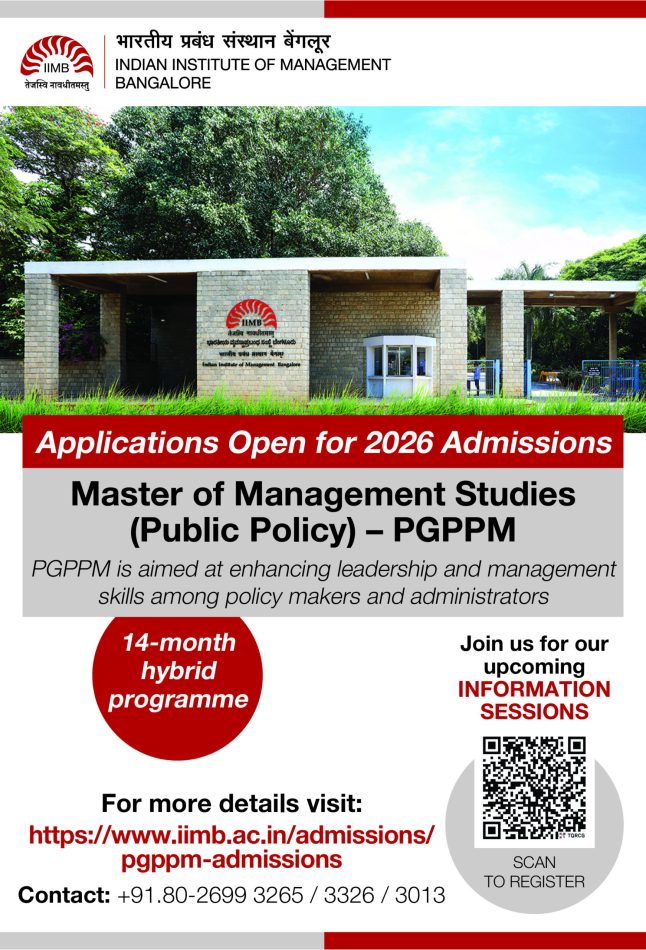
Launched in 2002, the PGPPM has built a strong legacy of producing professionals who have made meaningful contributions across diverse areas of public policy. The re-designed PGPPM is now structured as a 14-month hybrid postgraduate programme, catering to both Government-sponsored candidates through the Department of Personnel and Training (DoPT) as well as open (non-government) participants.
Academic Credentials
Successful candidates are awarded a Master of Management Studies (Public Policy) degree, reflecting its academic depth and practical relevance. The programme is distinguished by its unique approach—blending the rigour of public policy with the analytical strength of general management.
Curriculum and Learning Approach
The PGPPM curriculum is carefully curated to enhance policy formulation skills, strengthen leadership capabilities, and improve administrative efficiency. Participants gain exposure to core management principles while engaging deeply with real-world policy challenges, making the learning both contextual and impactful.
Key Features of the Curriculum
- Interdisciplinary Learning: The programme integrates various disciplines, allowing participants to understand the multifaceted nature of public policy.
- Real-World Challenges: Case studies and practical projects are integral to the curriculum, ensuring that participants apply theoretical knowledge to actual policy issues.
- Leadership Development: Focus on enhancing leadership skills prepares participants for roles that require strategic decision-making and effective governance.
Flexible Learning Environment
The hybrid format of the PGPPM ensures flexibility while maintaining academic intensity, enabling working professionals to participate without completely stepping away from their responsibilities. This makes the programme particularly attractive to senior officers from All India Services, State Government officials, and professionals from social, infrastructure, and private sectors.
Diversity and Cohort Interaction
Equally important is the diversity of the cohort, which fosters cross-learning between participants from varied backgrounds. This interdisciplinary exchange enriches perspectives and prepares participants to navigate the complexities of modern governance with greater confidence and competence.
Impact of PGPPM Graduates
Over the years, PGPPM graduates have gone on to influence policymaking, institutional reforms, and governance frameworks at multiple levels. As India continues its journey of transformation, programmes like PGPPM play a crucial role in building a cadre of professionals equipped with both policy insight and managerial acumen.
Career Opportunities
For those aspiring to make a tangible impact in the policy space, the PGPPM at IIM Bangalore offers not just a degree, but a pathway to meaningful leadership in public life. Graduates find themselves well-positioned for roles in:
- Government agencies
- Non-governmental organizations (NGOs)
- International organizations
- Private sector firms with a focus on public policy
- Think tanks and research institutions
Conclusion
The PGPPM at IIM Bangalore stands out as a transformative programme designed to equip future leaders with the skills necessary to tackle the evolving challenges of governance in India. By combining rigorous academic training with practical insights, it prepares participants to not only understand policy intricacies but also to effectuate change in their respective fields.
Note: The information presented in this article is based on data available up to October 2023 and is subject to change.

