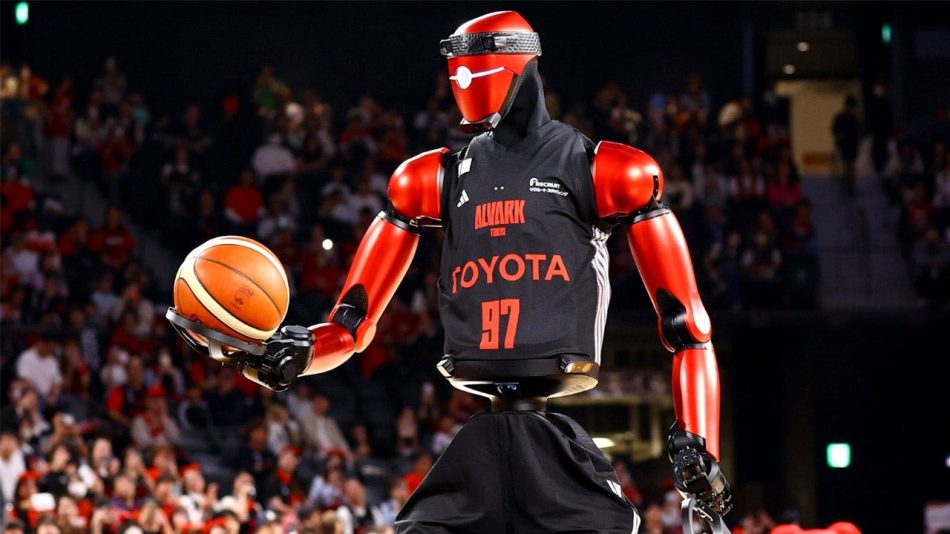
Toyota's CUE7 robot shoots hoops using AI
In a remarkable display of technological advancement, Toyota has introduced its latest humanoid robot, the CUE7, which has taken to the basketball court. This 7-foot-2 robot recently showcased its skills by shooting free throws during halftime at a professional basketball game in Toyota Arena, Tokyo, captivating an audience of approximately 8,400 fans.
The CUE7’s Impressive Performance
The CUE7’s performance was nothing short of extraordinary. The robot smoothly transitioned from a seated position, dribbled a basketball, and effortlessly sank a free throw without any human intervention. The crowd erupted in applause, and the engineers behind the project likely breathed a sigh of relief as their creation successfully demonstrated its capabilities.
Why is a Car Company Building Basketball Robots?
At first glance, it may seem unusual for a car manufacturer like Toyota to invest in robotics, particularly in the realm of sports. However, the development of the CUE7 serves a purpose that extends beyond mere entertainment. The project reflects Toyota’s commitment to innovation and its exploration of artificial intelligence (AI) in various applications.
The Evolution of the CUE Series
The CUE series of robots began as a voluntary side project initiated by a group of Toyota employees in 2017. Over the years, the project evolved into a formal research program, resulting in significant advancements in humanoid robotics. The CUE3, a predecessor to the CUE7, even earned a Guinness World Record in 2019 for the most consecutive basketball free throws made by a humanoid robot.
Starting from Scratch
What sets the CUE7 apart from its predecessors is its development process. The team at Toyota made a bold decision to discard all previous designs and start from scratch. Tomohiro Nomi, the research leader for humanoid robots at Toyota’s Frontier Research Center, explained, “We made full use of AI, and we discarded everything we had built up and started again from scratch.” This approach allowed the team to leverage the latest advancements in AI technology to create a more capable and efficient robot.
AI and Complex Physical Movements
The CUE7’s ability to shoot hoops is a testament to the advancements in AI and robotics. The robot’s design incorporates sophisticated algorithms that enable it to learn and execute complex physical movements with precision. This capability not only showcases the potential of AI in sports but also highlights its broader applications in various fields.
Applications Beyond Sports
While the CUE7’s basketball skills are impressive, the implications of its technology reach far beyond the sports arena. The advancements made in robotics and AI can be applied to numerous industries, including:
- Healthcare: Robots can assist in surgeries, rehabilitation, and patient care.
- Manufacturing: AI-powered robots can enhance production efficiency and safety in factories.
- Logistics: Autonomous robots can streamline warehouse operations and delivery services.
- Education: Robots can serve as interactive learning tools in classrooms.
The Future of Robotics and AI
The introduction of the CUE7 robot marks a significant milestone in the integration of AI and robotics. As technology continues to advance, we can expect to see more sophisticated robots capable of performing a variety of tasks that were once thought to be the exclusive domain of humans.
Challenges Ahead
Despite the exciting prospects, the journey toward fully autonomous robots is not without challenges. Issues such as safety, ethical considerations, and the need for regulatory frameworks must be addressed as robots become more prevalent in society. Additionally, the integration of AI into everyday life raises questions about job displacement and the future of work.
Conclusion
Toyota’s CUE7 robot is a remarkable example of how artificial intelligence can be harnessed to create innovative solutions in unexpected areas. By pushing the boundaries of robotics, Toyota not only entertains but also paves the way for future advancements in technology that can benefit various sectors. The journey of the CUE series serves as a reminder of the potential that lies in the intersection of AI and human creativity.
Note: This article reflects the advancements in robotics and AI as of October 2023 and highlights the ongoing developments in these fields.