Vision 2047 Conference: IIT Roorkee, Swadeshi Shodh Sansthan unveil roadmap for prosperous Bharat
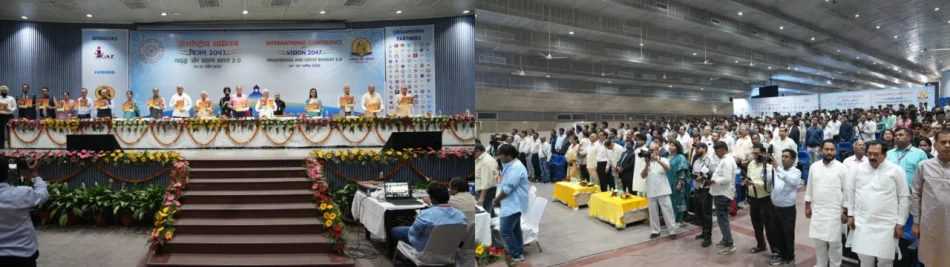
India’s roadmap to becoming a developed nation by 2047 took center stage at the International Conference on “Vision 2047 – Prosperous and Great Bharat 2.0,” hosted by IIT Roorkee in collaboration with Swadeshi Shodh Sansthan from April 24 to 26, 2026. This three-day summit brought together leading scientists, policymakers, academics, and industry leaders to focus on building a practical and inclusive strategy for the country’s centenary year.
The Inaugural Ceremony: A Confluence of Visionary Minds
The opening ceremony commenced with the formal reception of eminent leaders, headlined by the Honourable Governor of Himachal Pradesh, Kavinder Gupta Ji, who served as the Chief Guest. Other notable figures included:
- Prof. K. K. Pant, Director of IIT Roorkee
- Prof. U. P. Singh, Deputy Director of IIT Roorkee
- Prof. NP Padhy, Director of MNIT Jaipur
- Prof. Somnath Sachdeva, Executive Chairperson of Swadeshi Shodh Sansthan
- Prof. Ajit Chaturvedi, Vice Chancellor of Banaras Hindu University
- Prof. Surekha Dangwal, Vice Chancellor of Doon University
Prof. K. K. Pant opened the dialogues by emphasizing the vital synergy required between academia, government, and industry. He underscored that research-driven product design and an entrepreneurial spirit are the engines of this transformation. Prof. Somnath Sachdeva further detailed the organisation’s commitment, noting that SSS has signed Memorandums of Understanding (MoUs) with over 100 institutions to drive national development verticals.
The Launch of Three Landmark Policy Frameworks
A central feature of the conference was the official unveiling of three transformative policy frameworks designed to move India beyond a mere “wish list” toward concrete, actionable progress:
- The National Employment Policy Act, 2026
- World Policy 2026 (Exporter-Academia Collaboration)
- One Nation One Research Policy Act, 2026
These initiatives aim to transition India from a nation of job-seekers to a global hub of innovation. By integrating ethical entrepreneurship with high-value research, these policies provide the concrete 3-5 year roadmaps necessary to achieve a $1 trillion bio-economy and a fully “Viksit Bharat” by 2047.
Economic Reimagination: From GDP to QDP
One of the most provocative themes discussed was the challenge to Western paradigms of development. Satish Ji advocated for a decisive shift from Gross Domestic Product (GDP) to “Quality Domestic Product” (QDP). He argued that while traditional models often prioritize money-driven pursuits, India’s “Samriddh Bharat” must be rooted in ethical wealth creation, environmental sustainability, and collective happiness.
This shift includes a focus on energy independence. Currently, India’s energy imports account for nearly $190 billion, contributing to 60 percent of the nation’s trade deficit. Achieving true “Atmanirbharta” (Self-Reliance) requires not just producing more green energy, but radical research into curbing energy wastage and enhancing efficiency.
The Bio-Economy and the “Amrit Generation”
Dr. Jitendra Singh, Union Minister of State for Science & Technology, delivered a virtual keynote highlighting that the 21st century will be dominated by India’s biology-centered economic model. The domestic bio-economy, which grew from $10 billion in 2014 to over $130 billion today, is projected to reach $1 trillion by 2047.
The BioE3 Policy (Economy, Employment, and Environment) is the catalyst, driving breakthroughs in high-performance biomanufacturing and carbon-neutral technologies. Dr. Singh tasked the “Amrit Generation” (the youth leading the way during the 25-year lead-up to the centenary) to transition from theoretical research to practical, market-ready solutions.
JP Nadda echoed these sentiments via video message, stating that India is at a “defining moment” where the fusion of tradition and technology will create an inclusive “Viksit Bharat” that reaches the last person in the last village.
A Holistic Vision for ‘Viksit Bharat’
Shri Nadda highlighted that the collective aspiration for 2047 is to build a “Viksit Bharat” (Developed India) that is prosperous, inclusive, innovative, and globally respected. He stressed, “The vision of a developed India is not limited to economic progress alone. It encompasses social equity, technological advancement, environmental sustainability, and the empowerment of every citizen.”
Innovation and the Knowledge Economy
Identifying innovation as the key driver of India’s transformation, the address called for India to emerge as a global hub of research, technology, and entrepreneurship. By nurturing talent and promoting a culture of inquiry, India can unlock the immense potential of its youth.
Sustainable and Equitable Growth
The development model for 2047 must be people-centric, ensuring that opportunity reaches the “last mile.” Furthermore, Nadda reaffirmed a commitment to sustainable development, stating that economic ambition must be integrated with environmental responsibility to pave the way for a “greener and more resilient future.”
The Power of ‘Jan Bhagidari’
Underscoring that the journey to 2047 is not the government’s responsibility alone, Nadda pointed to “Jan Bhagidari” (people’s participation) as the cornerstone of national progress. He noted that when the country moves forward with a shared purpose and determination, no goal is beyond reach.
Rural Empowerment: The Zoho “Tenkasi Model”
Sridhar Vembu, CEO of Zoho Corporation, provided insights into innovative rural empowerment strategies that can be replicated across India. His model emphasizes the importance of technology in enhancing productivity and quality of life in rural areas.
Conclusion
The Vision