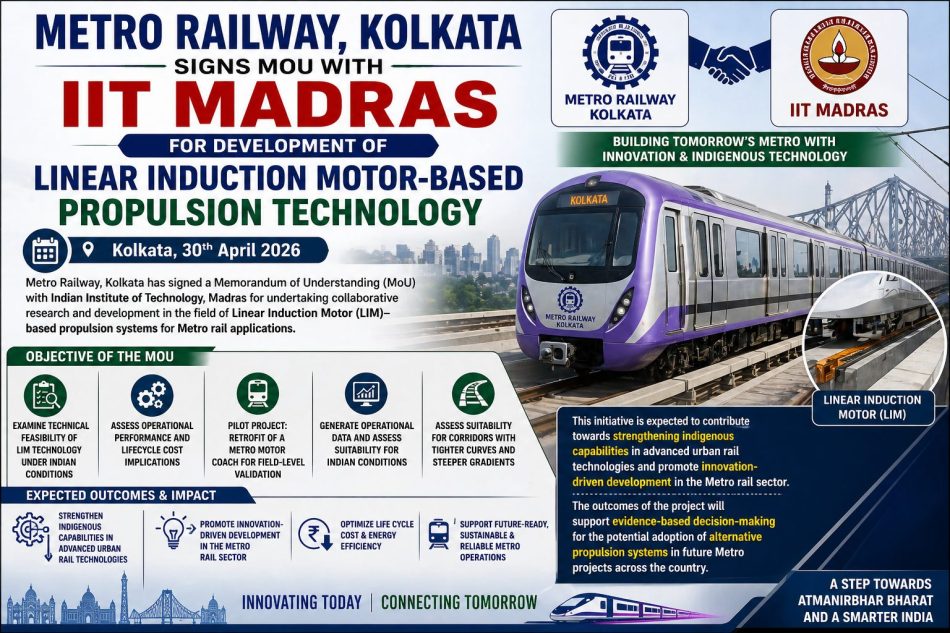
METRO RAILWAY KOLKATA SIGNS MOU WITH IIT MADRAS FOR DEVELOPMENT OF LINEAR INDUCTION MOTOR-BASED PROPULSION TECHNOLOGY
In a significant advancement for urban transportation, Metro Railway Kolkata has signed a Memorandum of Understanding (MoU) with the Indian Institute of Technology (IIT) Madras. This collaboration aims to develop linear induction motor (LIM)-based propulsion technology, which is expected to enhance the efficiency and sustainability of metro rail systems.
Understanding Linear Induction Motor Technology
Linear induction motors are a type of electric motor that produces linear motion instead of rotational motion. They work on the principle of electromagnetic induction, where a magnetic field is generated to propel the train along the track. This technology offers several advantages over traditional propulsion systems, including:
- Higher Efficiency: LIMs can achieve higher efficiency rates, leading to reduced energy consumption.
- Reduced Maintenance: With fewer moving parts, the maintenance requirements are significantly lower.
- Improved Acceleration: LIMs provide better acceleration and deceleration, leading to shorter travel times.
- Lower Noise Levels: The operation of LIMs results in quieter trains, contributing to a better urban environment.
Benefits of the Collaboration
The partnership between Metro Railway Kolkata and IIT Madras is poised to bring numerous benefits to the metro system and the city as a whole:
1. Innovation in Urban Transport
This collaboration is expected to foster innovation in urban transportation, making Kolkata’s metro system more competitive and efficient. The use of advanced technology will help in addressing the growing demands of urban mobility.
2. Research and Development
By working with IIT Madras, Metro Railway Kolkata will have access to cutting-edge research and development resources. This will facilitate the creation of a robust framework for testing and implementing LIM technology in real-world scenarios.
3. Skill Development
The partnership will also focus on skill development for engineers and technicians involved in the metro system. Training programs will be established to ensure that the workforce is well-equipped to handle the new technology.
4. Environmental Sustainability
With the global emphasis on sustainability, the development of LIM technology aligns with environmental goals. The reduced energy consumption and lower emissions associated with this technology will contribute to a greener urban transport system.
Implementation Timeline
The implementation of linear induction motor technology is expected to follow a structured timeline:
- Phase 1: Research and Development (Year 1-2) – Focus on theoretical studies and simulations to understand the feasibility of LIM technology in Kolkata’s metro environment.
- Phase 2: Prototype Development (Year 3) – Creation of a prototype system for testing and evaluation.
- Phase 3: Testing and Validation (Year 4) – Rigorous testing of the prototype in various conditions to ensure reliability and performance.
- Phase 4: Implementation (Year 5) – Full-scale implementation of the technology across the metro network.
Future Prospects
The successful implementation of linear induction motor technology in Kolkata’s metro system could set a precedent for other cities in India and abroad. As urban populations continue to grow, the need for efficient, reliable, and sustainable public transport systems becomes increasingly critical.
Furthermore, the collaboration between Metro Railway Kolkata and IIT Madras may inspire similar partnerships in other sectors, leading to technological advancements that benefit the broader community.
Conclusion
The signing of the MoU between Metro Railway Kolkata and IIT Madras marks a pivotal moment in the evolution of urban transportation in India. By embracing innovative technologies like linear induction motors, Kolkata aims to enhance its metro system’s efficiency, sustainability, and overall performance. This partnership not only promises to improve local transport but also serves as a model for future collaborations in the field of public transportation.
Note: The details provided in this article are based on the latest available information as of October 2023. Future developments may alter the specifics of the project.