
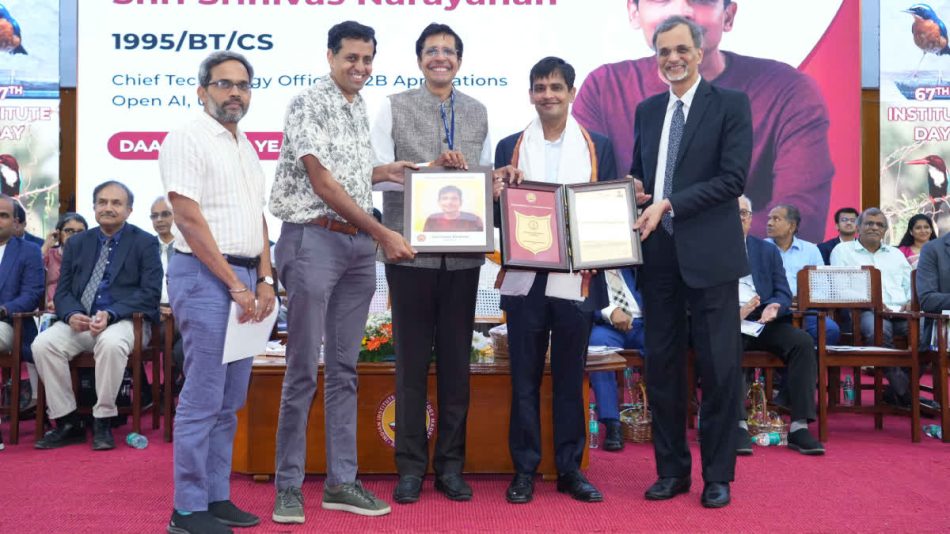
At IIT Madras's 67th Institute Day, Chief Economic Advisor Nageswaran Stresses Tech-Driven Growth
Chennai: V Anantha Nageswaran, Chief Economic Advisor to the Government of India, was the chief guest at the 67th Institute Day celebrations of the Indian Institute of Technology Madras (IIT Madras) held on April 30, 2026. The event was attended by students, faculty, alumni, and both teaching and non-teaching staff, celebrating the achievements of the institute and its members.
Celebrating Achievements
The Institute Day is a significant occasion for IIT Madras, marking its journey and accomplishments over the years. This year, the institute celebrated its remarkable achievement of being ranked No. 1 in the ‘Overall’ category of the National Institutional Ranking Framework (NIRF) for the seventh consecutive year. Additionally, it has maintained its position at the top of the ‘Engineering Institutions’ category for ten years, from 2016 to 2025.
About V Anantha Nageswaran
Before his current role, Nageswaran served as the Dean of the IFMR Graduate School of Business and was a distinguished Visiting Professor of Economics at Krea University. He was also a part-time member of the Economic Advisory Council to the Prime Minister of India from 2019 to 2021. Nageswaran holds a Post-Graduate Diploma in Management from the Indian Institute of Management, Ahmedabad, and a doctoral degree from the University of Massachusetts in Amherst.
Keynote Address: Technology, Talent, and Ambition
In his keynote address titled “Technology, Talent and the Trillion-Dollar Ambition of India,” Nageswaran projected that India’s GDP could reach approximately US$ 7.8 trillion by 2030. He emphasized the need for technological prowess and academic innovation to achieve this ambitious economic goal.
“Our current GDP is about US$ 3.91 trillion, and in the next six years, we could get to a GDP number of about US$ 7.8 trillion. Our goal is to reach US$ 30 trillion by the time we celebrate the centenary of Independence,” Nageswaran stated. He acknowledged that achieving such growth would require a sustained effort of about 12 percent growth in dollar terms over the next six years.
The Role of Technology
Nageswaran stressed the importance of understanding the challenges posed by the current geopolitical environment and the necessity of developing technological capabilities. “The world is not going to give it to us,” he remarked, underscoring the need for India to generate frontier research in science and engineering.
He called for Indian universities and laboratories to be at the cutting edge of the global knowledge ecosystem, highlighting the importance of adapting external technology to Indian conditions while considering scale and cost constraints. “Frugal innovation is India’s strength,” he added, emphasizing the need for continuous effort to foster innovation for future generations.
Challenges and Opportunities
During his address, Nageswaran noted that India’s population, currently at 1.45 billion, is expected to rise to nearly 1.6 billion in the next 20 to 30 years. This demographic reality presents both strengths and challenges for the nation. “Anything and everything that we do cannot be simply a sandbox experiment or a pilot phase; it has to be capable of being deployed at scale,” he stated.
He outlined the challenge of transitioning from pilot projects to patents and ultimately to economy-wide productivity gains across various sectors, including agriculture, manufacturing, services, and governance. “This is where premier institutes like IIT Madras will play a crucial role as they approach their centenary,” he concluded.
Presidential Address by Prof V Kamakoti
In his presidential address, Prof V Kamakoti, Director of IIT Madras, reflected on the significance of Institute Day. “It is not merely an occasion to commemorate our journey through decades; it is a moment to reflect on our purpose, celebrate our achievements, and renew our commitments to nation-building through education, research, and service,” he stated.
Kamakoti emphasized the growth of IIT Madras from a young engineering institution to a globally respected center of excellence, attributing this success to the dedication of faculty, curiosity of students, support of staff, and trust of alumni and partners.
Significant Milestones
He highlighted the past year as particularly significant, noting the launch of ‘IITM Global’ by Hon’ble External Affairs Minister Dr S Jaishankar. This initiative aims to position IIT Madras as the world’s first multinational university, reflecting the belief that knowledge should transcend borders and that India can lead the future of global higher education.
Conclusion
The 67th Institute Day at IIT Madras served as a platform to reflect on the institute’s achievements and the ambitious goals set for the future. With leaders like Nageswaran advocating for tech-driven growth and innovation, the path ahead seems promising for both IIT Madras and India as a whole.
Note: The information presented in this article is based on the events and speeches delivered during the 67th Institute Day at IIT Madras.


