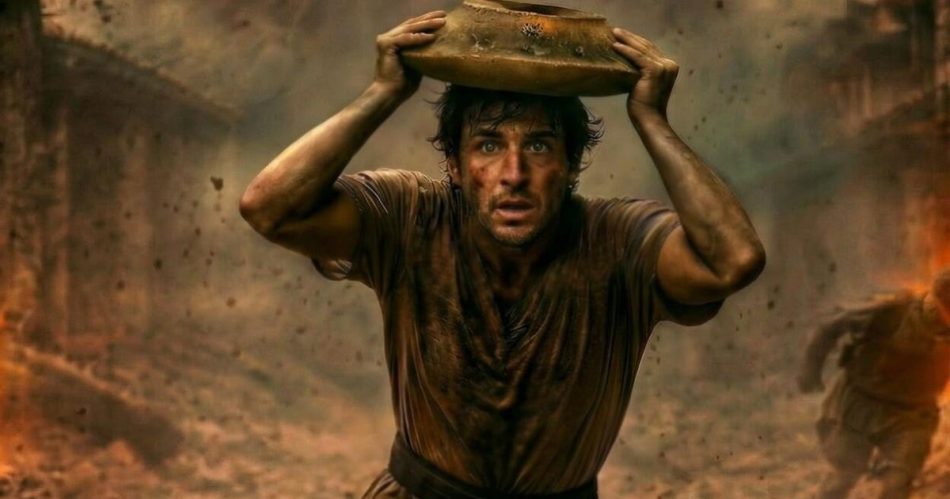
Archaeologists at Pompeii use AI to reveal the face of a victim trying to flee the Mount Vesuvius eruption
In a groundbreaking development, archaeologists at the ancient Roman site of Pompeii have utilized artificial intelligence (AI) for the first time to digitally reconstruct the face of a victim from the catastrophic eruption of Mount Vesuvius in AD 79. This innovative approach offers a fresh perspective on one of history’s most infamous natural disasters.
The Victim’s Story
The digital portrait represents an older man who was among two victims discovered as they attempted to flee the city towards the coast of what is now Italy during the volcanic eruption. Researchers believe that this man succumbed to the disaster during a heavy fall of volcanic debris.
Collaboration and Methodology
This remarkable reconstruction was developed by the Pompeii Archaeological Park in collaboration with the University of Padua. It is based on archaeological survey data collected from excavations near the Porta Stabia necropolis, located just outside the walls of the ancient city.
Historical Context of Pompeii
Pompeii, a UNESCO World Heritage site situated near Naples, was buried under layers of ash and pumice when Mount Vesuvius erupted nearly 2,000 years ago. This catastrophic event preserved the city and its inhabitants in remarkable detail, providing invaluable insights into ancient Roman life.
Discovery of the Victim
Archaeologists found the victim holding a terracotta mortar, which they interpret as an improvised attempt to shield his head from falling lapilli—small volcanic stones that rained down during the eruption. Ancient accounts, including those of Roman writer Pliny the Younger, describe residents using various objects to protect themselves as ash and debris blanketed the city.
Personal Artifacts
In addition to the mortar, the victim was found carrying an oil lamp, a small iron ring, and ten bronze coins. These personal items provide a glimpse into his final moments and daily life in Pompeii before the disaster struck.
Location of Discovery
Archaeologists noted that the victim, along with many others, was discovered near the city gates. This finding emphasizes the tragic reality that many individuals may have lost their lives outside the city, desperately trying to reach the coast for safety.
Reoccupation of Pompeii
Recent archaeological findings suggest that Pompeii was reoccupied following the eruption, as some survivors could not afford to start anew elsewhere. This highlights the resilience of the human spirit in the face of disaster.
Technological Innovation in Archaeology
The digital portrait was created using advanced AI and photo-editing techniques designed to translate skeletal and archaeological data into a realistic human likeness. This innovative use of technology marks a significant step forward in archaeological research.
Statements from Experts
Gabriel Zuchtriegel, the director of the Pompeii Archaeological Park, stated, “The vastness of archaeological data is now such that only with the help of artificial intelligence will we be able to adequately protect and enhance them. If used well, AI can contribute to a renewal of classical studies.”
Italian Culture Minister Alessandro Giuli added, “Pompeii is perhaps the most prestigious place in the world for archaeological research where every new discovery illuminates enthusiastically the plot of ancient life. Investigations conducted with these excavations demonstrate that innovative methodologies, used with care, can give us new historical perspectives.”
Recent Discoveries
Earlier this year, archaeologists at Pompeii announced the discovery of a 2,000-year-old love note and an illustrated gladiator fight scene on a wall, further showcasing the rich tapestry of life that existed in the city before the eruption.
Conclusion
The use of AI in archaeology not only enhances our understanding of historical events but also makes the research more accessible and emotionally engaging for the public. As technology continues to evolve, it will undoubtedly play an increasingly vital role in uncovering the mysteries of our past.
Note: The ongoing research and discoveries at Pompeii remind us of the importance of preserving our history and the stories of those who lived before us.